The Potential of Tradescantia Spathaceae Leaves Infusion as Sunscreen Gel Use Spectrophotometric UV-Vis Method
DOI:
https://doi.org/10.35814/jifi.v20i1.1087Keywords:
boat lily leaves, gel, infusion, sun protecting factorAbstract
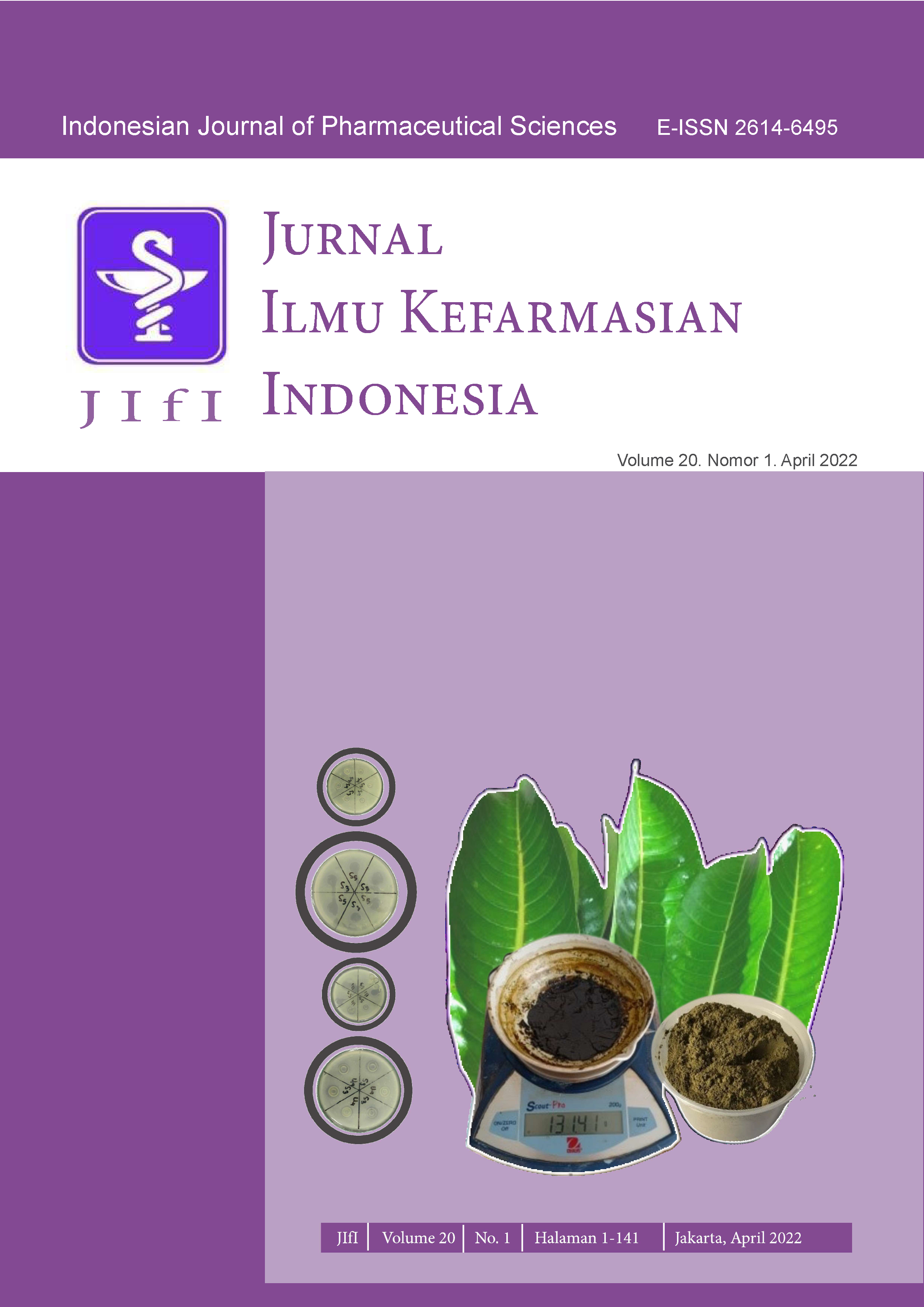
The boat lily (Tradescantia spathaceae) leaves have purple pigments produced from anthocyanins. This compound is thought to have sunscreen activity. The purpose of this study was to test the potential of sunscreen for both infusion and gel preparations of boat lily leaves in vitro using a spectrophotometric UV-Vis and determine its stability. The gel formula with a concentration of 12.5%; 25% and 50%. The parameters observed in this study were organoleptic, homogeneity, pH, dispersion test, viscosity, the value of Sun Protection Factor (SPF), and storage time test. The greater concentration of infusions, the lower the viscosity and inversely proportional to the dispersion value. The preparation has a good pH and follows the skin’s pH, which is in the range of 5.87-7.00. The boat lily infusion has SPF values: 3.64; 6.83, and 12.73. In comparison the boat lily gel has SPF in succession, namely: 7.48; 9.55, and 14.06. Based on the research, it can be concluded that the infusion of the boat lily can be made in a gel dosage form. Both infusion and infusion gel preparations of pineapple shellfish at a concentration of 12.5% to 50% have low protective power and boat lily infusion gel is unstable during storage.
References
Downloads
Published
Issue
Section
License
Licencing
All articles in Jurnal Ilmu Kefarmasian Indonesia are an open-access article, distributed under the terms of the Creative Commons Attribution-NonCommercial-ShareAlike 4.0 International License which permits unrestricted non-commercial used, distribution and reproduction in any medium.
This licence applies to Author(s) and Public Reader means that the users mays :
- SHARE:
copy and redistribute the article in any medium or format - ADAPT:
remix, transform, and build upon the article (eg.: to produce a new research work and, possibly, a new publication) - ALIKE:
If you remix, transform, or build upon the article, you must distribute your contributions under the same license as the original. - NO ADDITIONAL RESTRICTIONS:
You may not apply legal terms or technological measures that legally restrict others from doing anything the license permits.
It does however mean that when you use it you must:
- ATTRIBUTION: You must give appropriate credit to both the Author(s) and the journal, provide a link to the license, and indicate if changes were made. You may do so in any reasonable manner, but not in any way that suggests the licensor endorses you or your use.
You may not:
- NONCOMMERCIAL: You may not use the article for commercial purposes.

This work is licensed under a Creative Commons Attribution-NonCommercial-ShareAlike 4.0 International License.