Optimization of Emulgel Formula of Papain Crude Powder
Keywords:
papain emulgel, factorial design, optimum formulaAbstract
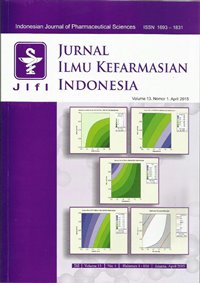
Crude powder of papain is very irritative and unstable, thus it should be formulated in emulgel using factorial design 2. The purpose of the study was to assess the effect of gelling agent (2.5% HPMC, 1 % Carbomer 940 ), oil phase ( liquid paraffin 5% to 7.5 % ), emulsifier ( 1.5% -2% Tween 80 - Span 80) and determine the optimum formula. Viscosity, ease of spread, proteolytic activity and antimicrobial activity of papain emulgel were used as the parameters in formula optimization. Each parameter had a contour plot. With the use of superimposed countor plot, the shaded area could be determined as the optimum formula. The results of the factor effect analysis and its interactions were that gelling agent gave significant effect (p<0.05) and dominant in increasing the viscosity of emulgel and the activity of papain proteolytic enzyme. However, it decreased the diameter of the dispersing area and the inhibition zone diameter. The increase in the concentration liquid paraffin concentration had a dominant and significant effect towards the improvement of the emulgel’s dispersive power and the proteolytic activity of papain. The increase in the combination of Tween 80-Span 80 emulgator had a dominant and significant effect towards the improvement of viscosity and the decrease in the dispersive power, the proteolytic activity, and the inhibition zone diameter. From the superimposed contour plots analysis and response optimizer, the optimum formula was achieved by 2.5% of HMPC gelling agent, 5.6% of liquid paraffin, and 2.4% of emulsifier combination.
References
Downloads
Published
Issue
Section
License
Licencing
All articles in Jurnal Ilmu Kefarmasian Indonesia are an open-access article, distributed under the terms of the Creative Commons Attribution-NonCommercial-ShareAlike 4.0 International License which permits unrestricted non-commercial used, distribution and reproduction in any medium.
This licence applies to Author(s) and Public Reader means that the users mays :
- SHARE:
copy and redistribute the article in any medium or format - ADAPT:
remix, transform, and build upon the article (eg.: to produce a new research work and, possibly, a new publication) - ALIKE:
If you remix, transform, or build upon the article, you must distribute your contributions under the same license as the original. - NO ADDITIONAL RESTRICTIONS:
You may not apply legal terms or technological measures that legally restrict others from doing anything the license permits.
It does however mean that when you use it you must:
- ATTRIBUTION: You must give appropriate credit to both the Author(s) and the journal, provide a link to the license, and indicate if changes were made. You may do so in any reasonable manner, but not in any way that suggests the licensor endorses you or your use.
You may not:
- NONCOMMERCIAL: You may not use the article for commercial purposes.

This work is licensed under a Creative Commons Attribution-NonCommercial-ShareAlike 4.0 International License.