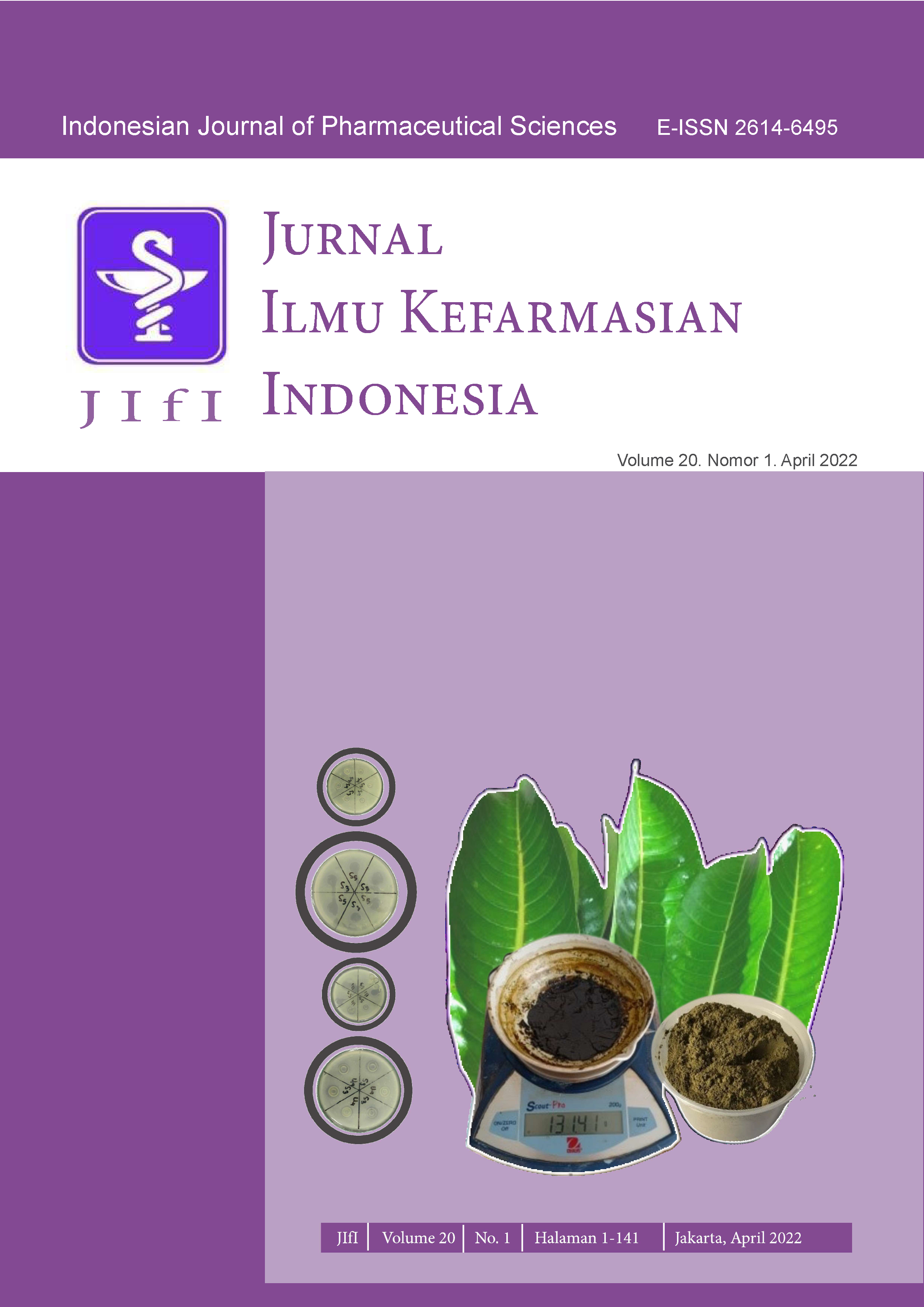
Antioxidant Activity Assay from N-Hexane Fraction of Binjai Mangifera caesia Jack. Ex. Wall. Leaves Methanolic Extract Using DPPH Method
English
DOI:
https://doi.org/10.35814/jifi.v20i1.1133Keywords:
Antioxidant, Binjai leaves, methanol extract, n-hexane fraction, DPPHAbstract
Natural antioxidant compounds can be found in plants of the Mangifera genus, one of them is Mangifera caesia, Jack. ex. Wall or which was also known as binjai. This study aims to determine group compounds and the antioxidant activity of the n-hexane fraction from the binjai leaves methanol extract against 2,2-diphenyl-1-picrylhydrazyl (DPPH) radicals. The binjai leaves powder extraction was carried out using the soxhlet apparatus with methanol and liquid-liquid fractionation using water and n-hexane. Phytochemical screening was done by adding specific reagents. The antioxidant activity assay qualitatively on TLC that being sprayed with DPPH and quantitative assay by measuring the absorbance of the fraction attenuation against DPPH radicals using a UV-Vis Spectrophotometer. The Phytochemicals screening results showed that the n-hexane fraction contained phenolic, flavonoid, and steroids. The qualitative test results showed some compounds had an antioxidant activity that appeared by changing the color of the spots to yellow on a purple background after spraying with DPPH solution. The n-hexane fraction resulted in an IC50 value of 34.0668 ppm with quercetin IC50 of 2.4469 ppm. Based on these results, it can be concluded that the n-hexane fraction of binjai leaves methanol extract contains phenolic and flavonoid compounds that played a role in producing very strong antioxidant activity.
References
Downloads
Published
Issue
Section
License
Licencing
All articles in Jurnal Ilmu Kefarmasian Indonesia are an open-access article, distributed under the terms of the Creative Commons Attribution-NonCommercial-ShareAlike 4.0 International License which permits unrestricted non-commercial used, distribution and reproduction in any medium.
This licence applies to Author(s) and Public Reader means that the users mays :
- SHARE:
copy and redistribute the article in any medium or format - ADAPT:
remix, transform, and build upon the article (eg.: to produce a new research work and, possibly, a new publication) - ALIKE:
If you remix, transform, or build upon the article, you must distribute your contributions under the same license as the original. - NO ADDITIONAL RESTRICTIONS:
You may not apply legal terms or technological measures that legally restrict others from doing anything the license permits.
It does however mean that when you use it you must:
- ATTRIBUTION: You must give appropriate credit to both the Author(s) and the journal, provide a link to the license, and indicate if changes were made. You may do so in any reasonable manner, but not in any way that suggests the licensor endorses you or your use.
You may not:
- NONCOMMERCIAL: You may not use the article for commercial purposes.

This work is licensed under a Creative Commons Attribution-NonCommercial-ShareAlike 4.0 International License.