Antibacterial Effect Combination of Moringa Leaf Extract (Moringa oleifera Lam.) and Amoxicillin against Staphylococcus aureus and Escherichia coli in Vitro
DOI:
https://doi.org/10.35814/jifi.v20i1.1174Keywords:
amoxicillin, antibacterial, Escherichia coli, Moringa oleifera Lam., Staphylococcus aureusAbstract
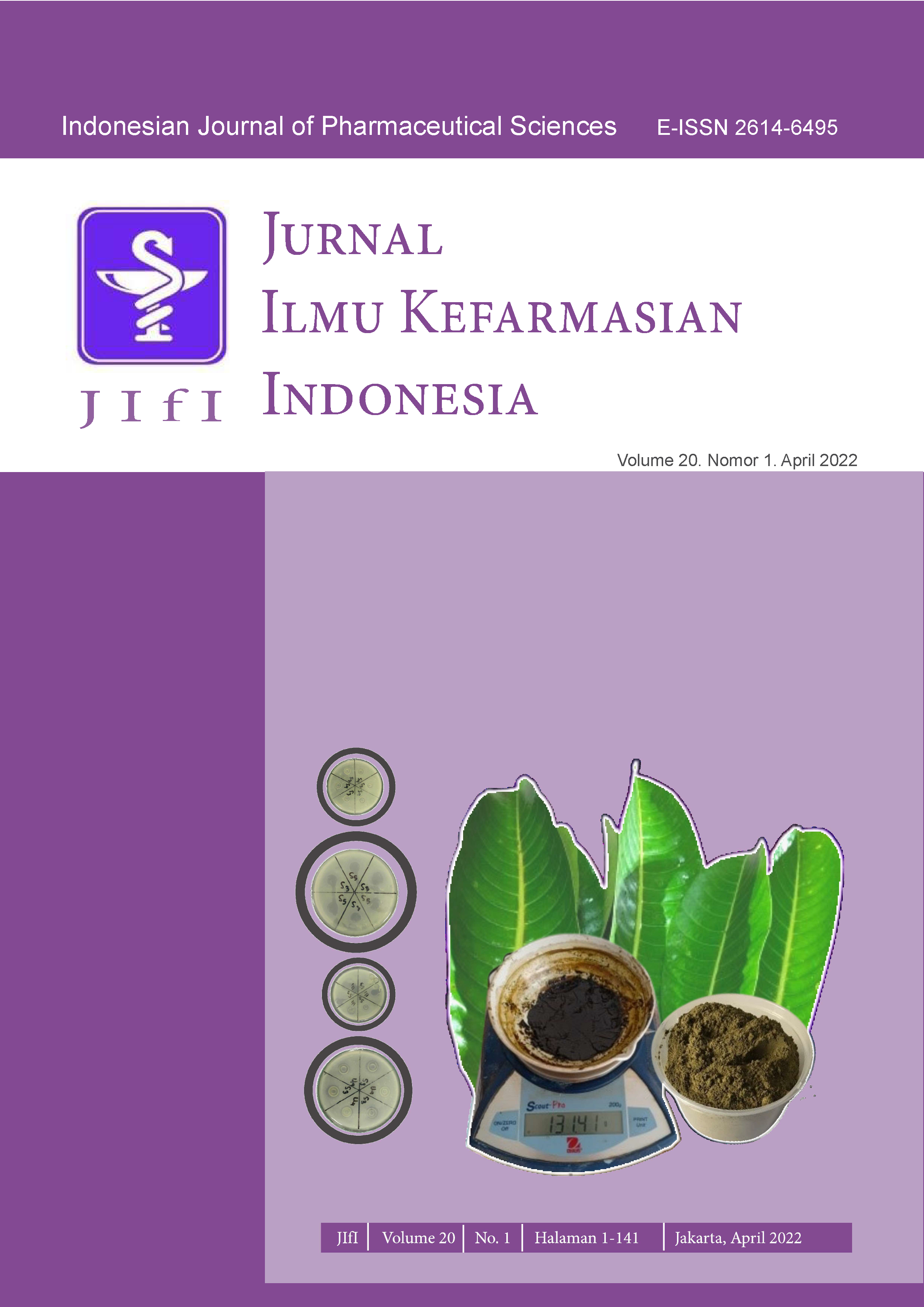
Staphylococcus aureus and Escherichia coli often infect humans and risky cause antibiotics resistance including amoxicillin. This encourages us finding alternative active ingredients: Moringa oleifera leaf. This study evaluated antibacterial activity of combination of Moringa leaf extract (KDK) and amoxicillin (KA) against S. aureus and E. coli in vitro. The research methods with true experimental research with post-test control group design. KDK obtained by maceration. Four concentrations of KDK test materials (20, 30, 40, 50%) and 1 concentration of KA (3 mg/mL). Disc diffusion test method taken and the parameter measured: the diameter of the disc inhibition zone. Data analyzed by One-way ANOVA and further Tukey’s test. KDK+KA against S. aureus (20.77±1.79 – 21.33±1.74 mm)>KDK (11.45±0.21 – 12.45±0.28 mm) or KA (14.50±0.42 mm). KDK+KA against E. coli (15.53±0.71 – 17.87±0.42 mm)>KDK (9.00±0.28 – 10.30±0.42 mm) or KA (13.45±0.35 mm). A significant (p<0.05) was obtained between the combination group (KDK+KA) versus a group (KDK or KA). The combination of Moringa leaf ethanol extract and amoxicillin synergistically effected as antibacterial against S. aureus and E. coli in vitro.
References
Downloads
Published
Issue
Section
License
Licencing
All articles in Jurnal Ilmu Kefarmasian Indonesia are an open-access article, distributed under the terms of the Creative Commons Attribution-NonCommercial-ShareAlike 4.0 International License which permits unrestricted non-commercial used, distribution and reproduction in any medium.
This licence applies to Author(s) and Public Reader means that the users mays :
- SHARE:
copy and redistribute the article in any medium or format - ADAPT:
remix, transform, and build upon the article (eg.: to produce a new research work and, possibly, a new publication) - ALIKE:
If you remix, transform, or build upon the article, you must distribute your contributions under the same license as the original. - NO ADDITIONAL RESTRICTIONS:
You may not apply legal terms or technological measures that legally restrict others from doing anything the license permits.
It does however mean that when you use it you must:
- ATTRIBUTION: You must give appropriate credit to both the Author(s) and the journal, provide a link to the license, and indicate if changes were made. You may do so in any reasonable manner, but not in any way that suggests the licensor endorses you or your use.
You may not:
- NONCOMMERCIAL: You may not use the article for commercial purposes.

This work is licensed under a Creative Commons Attribution-NonCommercial-ShareAlike 4.0 International License.