Optimization of Cocktail Composition and Up-scale Fermentation Process Development of Four Skin Commensal Bacterial Strains
DOI:
https://doi.org/10.35814/jifi.v20i1.1224Keywords:
Skin microbiome, bacterial cocktail, growth curve, real time qPCRAbstract
Analyzing the actual microbial composition in the skin microbiome is riveting to create a potential source
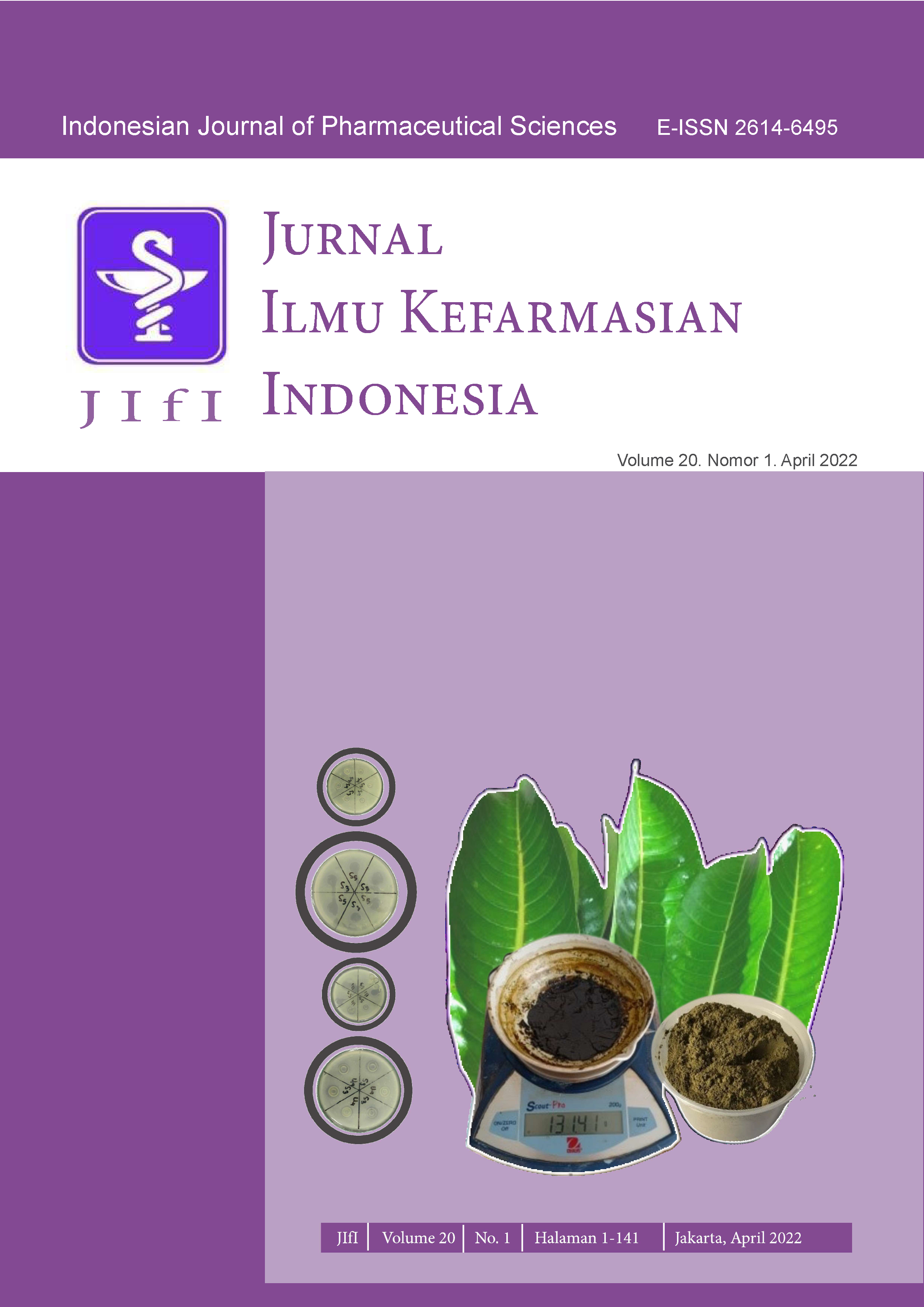
of active substances in skincare products. Our previous study isolated four bacterial strains from Javanese male and female skin samples, Staphylococcus hominis MBF12–19J, Staphylococcus warneri MBF02–19J, Bacillus subtilis MBF10–19J, and Micrococcus luteus MBF05–19J. This study aimed to determine the composition of those strains in a bacterial cocktail and optimize the condition for up-scale laboratory production of the cocktail. To assess the ability of bacteria to coexist and live in cocktail communities, simultaneous monitoring was performed using the Deferred Growth Inhibition Assay (DGIA) method and real-time PCR for DNA copy number measurement. Results showed the best composition based on even distribution and cell growth viability was at the ratio 1.5:1:0.5:0.5 of Micrococcus luteus MBF05-19J, Bacillus subtilis MBF10-19J, Staphylococcus warneri MBF02-19J, Staphylococcus hominis MBF12-19J, which is equivalent to DNA copy number/mL 1.209 x 1024 CFU : 2.484 x 1041 CFU : 2.645 x 1041 CFU : 9.041 x 1035 CFU, respectively. The optimum growth incubation time of individual bacterial cultures for an up-scale 2-L bio-fermentor mixture was as follows; Micrococcus luteus MBF05-19J = 21 hrs; Bacillus subtilis MBF10-19J = 7 hrs; Staphylococcus warneri MBF02-19J = 17 hrs; Staphylococcus hominis MBF12-19 = 15 hrs. For up-scale conditions, the fermentation incubation time was 3 hours at 37oC, agitation 50 RPM, and aeration 5% dissolved oxygen.
References
Downloads
Published
Issue
Section
License
Licencing
All articles in Jurnal Ilmu Kefarmasian Indonesia are an open-access article, distributed under the terms of the Creative Commons Attribution-NonCommercial-ShareAlike 4.0 International License which permits unrestricted non-commercial used, distribution and reproduction in any medium.
This licence applies to Author(s) and Public Reader means that the users mays :
- SHARE:
copy and redistribute the article in any medium or format - ADAPT:
remix, transform, and build upon the article (eg.: to produce a new research work and, possibly, a new publication) - ALIKE:
If you remix, transform, or build upon the article, you must distribute your contributions under the same license as the original. - NO ADDITIONAL RESTRICTIONS:
You may not apply legal terms or technological measures that legally restrict others from doing anything the license permits.
It does however mean that when you use it you must:
- ATTRIBUTION: You must give appropriate credit to both the Author(s) and the journal, provide a link to the license, and indicate if changes were made. You may do so in any reasonable manner, but not in any way that suggests the licensor endorses you or your use.
You may not:
- NONCOMMERCIAL: You may not use the article for commercial purposes.

This work is licensed under a Creative Commons Attribution-NonCommercial-ShareAlike 4.0 International License.