Physical Stability Test and Determination of Total Flavonoid Content of Watermelon (Citrullus lanatus) Fruit Mesocarp Extract Gel Preparation
DOI:
https://doi.org/10.35814/jifi.v20i2.1319Keywords:
Physical stability, gel, mesocarp, watermelonAbstract
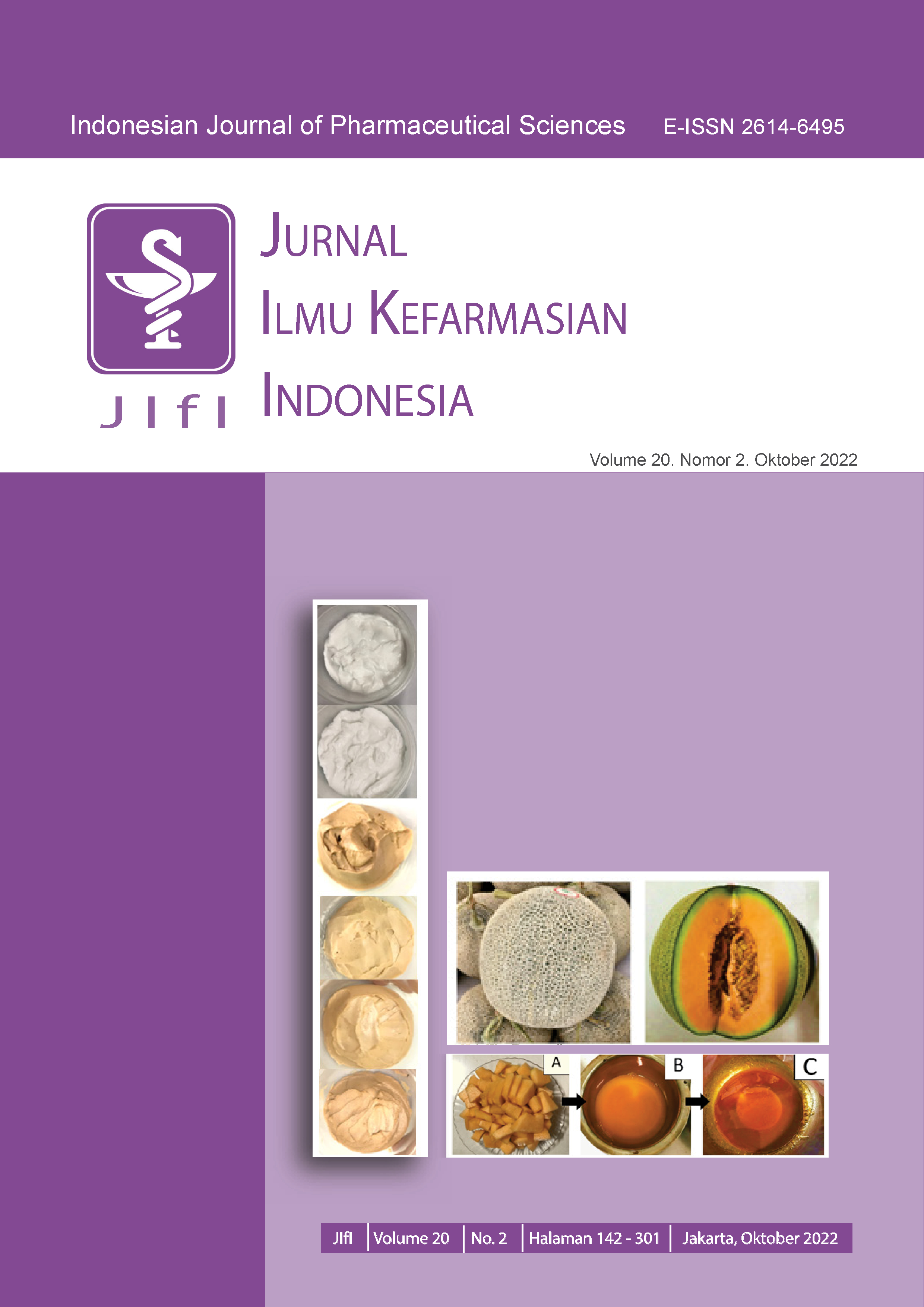
The content of flavonoids in the white skin or mesocarp of watermelon has antioxidant power so that the active substance can be used in the manufacture of cosmetics, one of which is a gel dosage form. This type of research is observational with a descriptive research design. The purpose of this study was to obtain data on the stability of the watermelon (Citrullus lanatus) mesocarp extract gel preparation using the cycling test method. Physical stability evaluations were carried out, including organoleptic, homogeneity, pH, adhesion, spreadability, and viscosity. The results showed that the organoleptic observation of the preparation was in the form of a semi-solid, had a characteristic aromatic odor of the extract, and had a brownish-yellow color. As for the test results for the entire homogeneous cycle, the average pH range is 4.75 - 5, adhesion is 2.45 - 3.96 seconds, dispersion is 5.59 - 6.67 cm, and viscosity is 5426 - 6830 cps, and total flavonoid content of the gel preparation was 5.27%. This study concluded that the gel preparation was physically stable before and after 12 days of storage and contained 5.27% flavonoids.
References
Downloads
Published
Issue
Section
License
Licencing
All articles in Jurnal Ilmu Kefarmasian Indonesia are an open-access article, distributed under the terms of the Creative Commons Attribution-NonCommercial-ShareAlike 4.0 International License which permits unrestricted non-commercial used, distribution and reproduction in any medium.
This licence applies to Author(s) and Public Reader means that the users mays :
- SHARE:
copy and redistribute the article in any medium or format - ADAPT:
remix, transform, and build upon the article (eg.: to produce a new research work and, possibly, a new publication) - ALIKE:
If you remix, transform, or build upon the article, you must distribute your contributions under the same license as the original. - NO ADDITIONAL RESTRICTIONS:
You may not apply legal terms or technological measures that legally restrict others from doing anything the license permits.
It does however mean that when you use it you must:
- ATTRIBUTION: You must give appropriate credit to both the Author(s) and the journal, provide a link to the license, and indicate if changes were made. You may do so in any reasonable manner, but not in any way that suggests the licensor endorses you or your use.
You may not:
- NONCOMMERCIAL: You may not use the article for commercial purposes.

This work is licensed under a Creative Commons Attribution-NonCommercial-ShareAlike 4.0 International License.