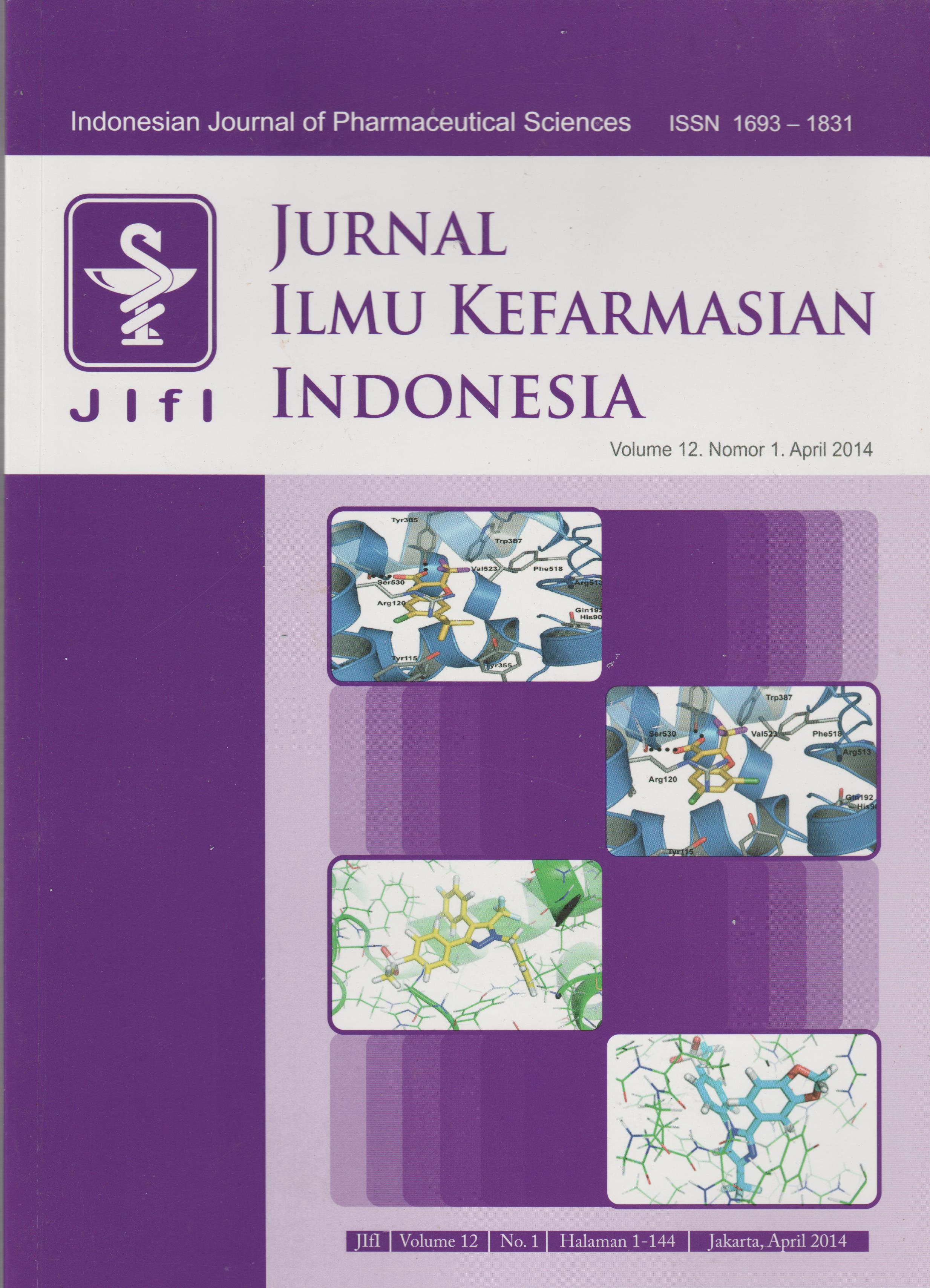
Isolation and Identification of Flavonoid Compounds in n-Buthanol Fraction of Dewa Leaves (Gynura pseudochina L.
Keywords:
Gynura pseudochina (L.) DC, flavonoid, spektrofotometri UV-cahaya tampakAbstract
Plant of dewa leaves (Gynura pseudochina ( L. ) DC) from family Asteraceae is a plant that has been widely used for some treatments including blood circulation , trauma, bleeding and blood clot. In this research, the isolation and identification of flavonoid compounds in n-butanol fraction of the methanol extract of dewa leaves (Gynura pseudochina ( L. ) DC) has been carried out. The compound in Dewa leaves was isolated using maceration with methanol which was then partitioned by n-hexane solvent, ethyl acetate and n-butanol. The n-butanol phase was then isolated by paper chromatography with BAW (4:1:5) as a mobile phase which resulted in seven bands. Each of the bands was further identified using spectrophotometry UV-vis to show wavelength of maximum absorption that was given from only three bands for flavonoids namely NB-III, NB-V and NB-VI. Moreover, the bands were further eluated with 15% acetic acid as second mobile phase and the spot appeared in the presence of ammonia. The final isolates were identified by UV-vis spectrophotometer with addition of a shift reagent. The resulting spectrum from the isolates NB-III was considered as the one of flavonol compounds with the OH group at theposition of 3.7 and oxygenation at 6 or 8 and o– at OH group in ring B; NB-V isolates, OH groups at positions 3, 5, 7 and o– at OH group in ring B and NB-VI isolates, the OH group at position 5,7 and 8.
References
Downloads
Published
Issue
Section
License
Licencing
All articles in Jurnal Ilmu Kefarmasian Indonesia are an open-access article, distributed under the terms of the Creative Commons Attribution-NonCommercial-ShareAlike 4.0 International License which permits unrestricted non-commercial used, distribution and reproduction in any medium.
This licence applies to Author(s) and Public Reader means that the users mays :
- SHARE:
copy and redistribute the article in any medium or format - ADAPT:
remix, transform, and build upon the article (eg.: to produce a new research work and, possibly, a new publication) - ALIKE:
If you remix, transform, or build upon the article, you must distribute your contributions under the same license as the original. - NO ADDITIONAL RESTRICTIONS:
You may not apply legal terms or technological measures that legally restrict others from doing anything the license permits.
It does however mean that when you use it you must:
- ATTRIBUTION: You must give appropriate credit to both the Author(s) and the journal, provide a link to the license, and indicate if changes were made. You may do so in any reasonable manner, but not in any way that suggests the licensor endorses you or your use.
You may not:
- NONCOMMERCIAL: You may not use the article for commercial purposes.

This work is licensed under a Creative Commons Attribution-NonCommercial-ShareAlike 4.0 International License.