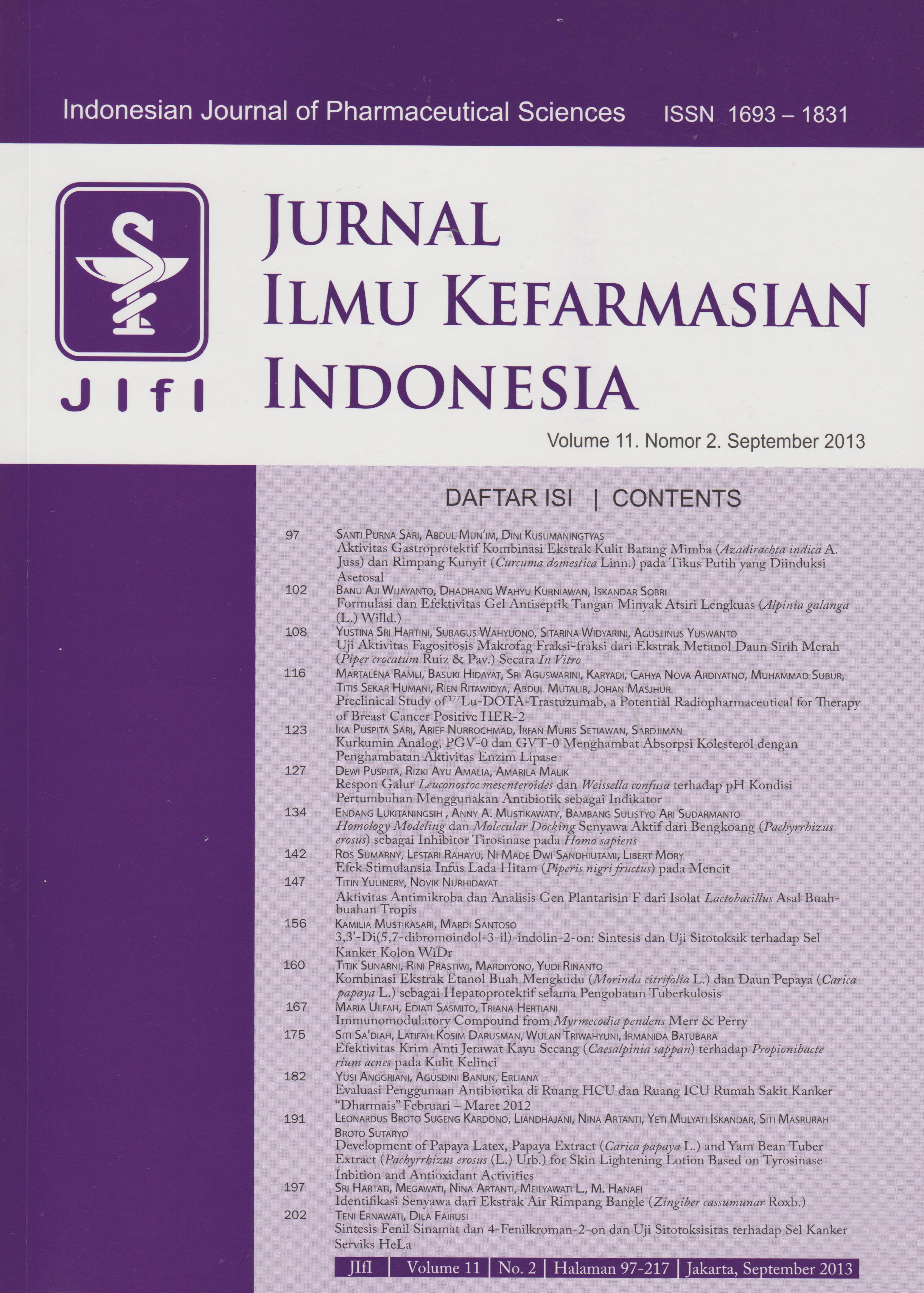
Antimicrobial Activity and Gene Analysis of Plantaricin F of Lactobacillus Originated from Tropical Fruits
Keywords:
plantaricin F, antimicrobe, Lactobacillus, probiotic, tropical fruitsAbstract
Lactobacillus isolated from tropical fruits can be used as probiotic and potential to prevent diseases in the digestive tract due to bacteriocin content. One of the bacteriocin called plantaricin F, is produced by Lactobacillus plantarum. Plantarisin F has antimicrobial activity against Gram positive and Gram negative bacteria. The aim of the research was to test the antibacterial activities of several Lactobacillus species on 5 bacteria isolates, and analyzed the gene expression of plantaricin F. Seven isolates of ten selected isolates could inhibit the growth of Gram positive and Gram negative bacteria. Lactobacillus TB (NK) produced the largest inhibition area of 2.05 cm on E.coli, and twice stronger than chloramphenicol control. As confirmation, the plantaricin F gene was analyzed using RT-PCR. The analysis result showed that the size of plantaricin F gene was 70 bp. The highest relative expression of plantaricin F gene was shown by the Lactobacillus Mar A2 isolate of 10,676 Au, followed by Lactobacillus TB (NK) of 2.9207 Au, and the lowest was Lactobacillus TB (CK) of 0.5141 Au. Lactobacillus TB (NK) can be used as candidate of probiotic and alternative antibiotic in preventing of gastrointestinal disease.
References
Downloads
Published
Issue
Section
License
Licencing
All articles in Jurnal Ilmu Kefarmasian Indonesia are an open-access article, distributed under the terms of the Creative Commons Attribution-NonCommercial-ShareAlike 4.0 International License which permits unrestricted non-commercial used, distribution and reproduction in any medium.
This licence applies to Author(s) and Public Reader means that the users mays :
- SHARE:
copy and redistribute the article in any medium or format - ADAPT:
remix, transform, and build upon the article (eg.: to produce a new research work and, possibly, a new publication) - ALIKE:
If you remix, transform, or build upon the article, you must distribute your contributions under the same license as the original. - NO ADDITIONAL RESTRICTIONS:
You may not apply legal terms or technological measures that legally restrict others from doing anything the license permits.
It does however mean that when you use it you must:
- ATTRIBUTION: You must give appropriate credit to both the Author(s) and the journal, provide a link to the license, and indicate if changes were made. You may do so in any reasonable manner, but not in any way that suggests the licensor endorses you or your use.
You may not:
- NONCOMMERCIAL: You may not use the article for commercial purposes.

This work is licensed under a Creative Commons Attribution-NonCommercial-ShareAlike 4.0 International License.