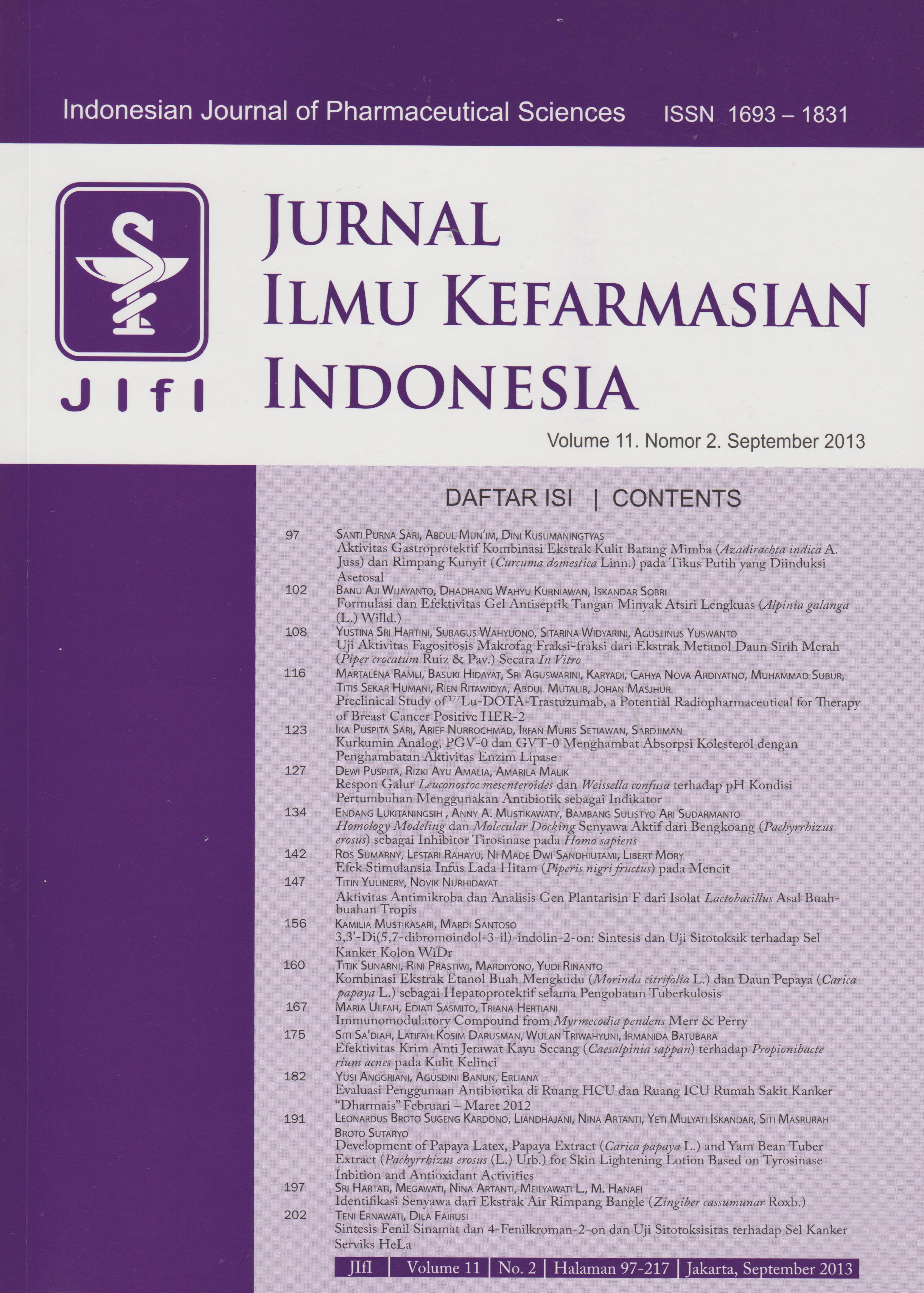
Immunomodulatory Compound from Myrmecodia pendens Merr & Perry
Keywords:
Myrmecodia pendens Merr & Perry, lymphocyte proliferation, phenol derivativeAbstract
Myrmecodia pendens Merr & Perry (Rubiaceae) is widely used in Papua as traditional medicine against various diseases. Preliminary study revealed that ethyl acetate fraction has potency to increase mice Balb/c lymphocyte proliferation in vitro. This study aimed to investigate the active compound responsible for the activity. Dried powders of plant tubers were macerated in ethanol 95% followed by solvent evaporation. The crude extract was further fractionated by liquid-liquid partition with n-hexane, ethyl acetate and water, successively. The ethyl acetate fraction was subjected to a silica gel column and separated by vacuum. The subfraction yields were tested on mice Balb/c lymphocytes to observe the influence on lymphocyte proliferation by MTT assay. Total phenolic content of subfractions were determined by Folin-Ciocalteau method. Chemical characteristics of active compound was identified by GC-MS, UV-Vis spectroscopy, IR and H-NMR. The result showed that total phenolic content has no significant correlation to the lymphocyte proliferation activity. Subfraction 7 yielded from ethyl acetate-methanol (7:3v/v) contained a major constituent (78% by GCMS, 83.75% by Densitometry). GCMS and UV spectra suggested a phenolic substructure. IR and H-NMR suggested that the phenolic was glycosilated and had aliphatic moiety.
References
Downloads
Published
Issue
Section
License
Licencing
All articles in Jurnal Ilmu Kefarmasian Indonesia are an open-access article, distributed under the terms of the Creative Commons Attribution-NonCommercial-ShareAlike 4.0 International License which permits unrestricted non-commercial used, distribution and reproduction in any medium.
This licence applies to Author(s) and Public Reader means that the users mays :
- SHARE:
copy and redistribute the article in any medium or format - ADAPT:
remix, transform, and build upon the article (eg.: to produce a new research work and, possibly, a new publication) - ALIKE:
If you remix, transform, or build upon the article, you must distribute your contributions under the same license as the original. - NO ADDITIONAL RESTRICTIONS:
You may not apply legal terms or technological measures that legally restrict others from doing anything the license permits.
It does however mean that when you use it you must:
- ATTRIBUTION: You must give appropriate credit to both the Author(s) and the journal, provide a link to the license, and indicate if changes were made. You may do so in any reasonable manner, but not in any way that suggests the licensor endorses you or your use.
You may not:
- NONCOMMERCIAL: You may not use the article for commercial purposes.

This work is licensed under a Creative Commons Attribution-NonCommercial-ShareAlike 4.0 International License.