Formulation of Losartan Nanoparticles with Chitosan as a Carrier
Keywords:
losartan, chitosan, nanoparticle, factorial designAbstract
Nanoparticle formulation is important for systemic drug delivery via several routes. This research was aimed to establish optimal formation of chitosan nanoparticle formulation with losartan, an antihypertension known as an angiotensin II receptor antagonist. Ionic gelation method was used. Formulation was established in 2 steps. Firstly, determination of the best losartan and chitosan concentrations which can produce physically stable nanoparticles without precipitation, at room temperature within 25 days. Secondly, optimization of the process by factorial design method of two factors, including pH (4.0 and 5.0) and the stirring rate (350 and 700 rpm), with the loading capacity of the nanoparticle as the observed response. The obtained nanoparticles were evaluated further for its particle size and zeta potential. The physichal stability tests indicated that two nanoparticle formulations containing losartan-chitosan of (14 mg% : 35 mg%), and losartan-chitosan of (21 mg% : 35 mg%) were stable. The factorial design studies suggested that pH 4 and the stirring rate of 350 rpm were the optimal conditions which produced the highest loading capacity (47,7%). The particle size and zeta potential of the stable nanoparticle were 290.3±52.6 nm and +50.8 ±4.8 mV respectively.
References
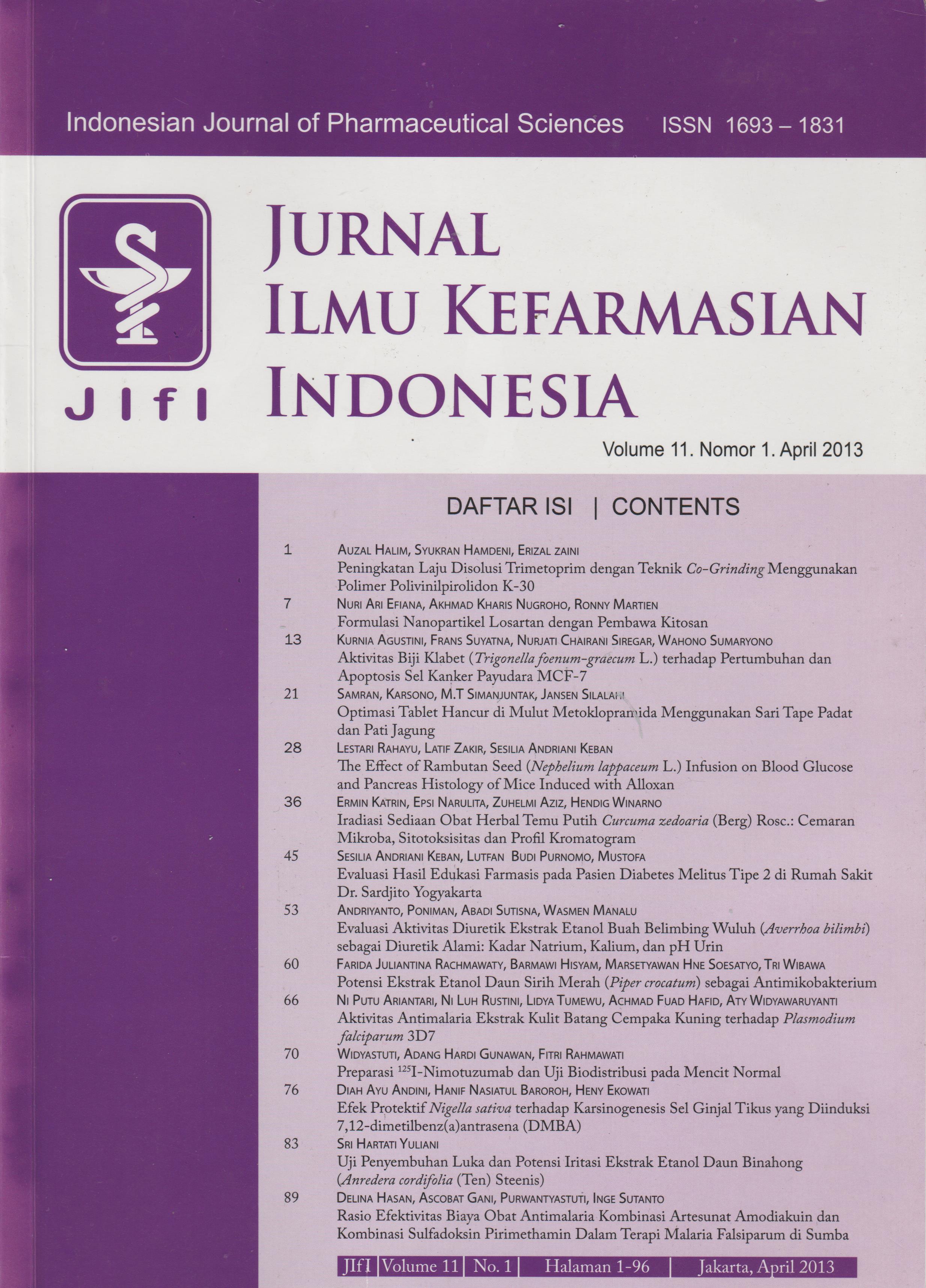
Downloads
Published
Issue
Section
License
Licencing
All articles in Jurnal Ilmu Kefarmasian Indonesia are an open-access article, distributed under the terms of the Creative Commons Attribution-NonCommercial-ShareAlike 4.0 International License which permits unrestricted non-commercial used, distribution and reproduction in any medium.
This licence applies to Author(s) and Public Reader means that the users mays :
- SHARE:
copy and redistribute the article in any medium or format - ADAPT:
remix, transform, and build upon the article (eg.: to produce a new research work and, possibly, a new publication) - ALIKE:
If you remix, transform, or build upon the article, you must distribute your contributions under the same license as the original. - NO ADDITIONAL RESTRICTIONS:
You may not apply legal terms or technological measures that legally restrict others from doing anything the license permits.
It does however mean that when you use it you must:
- ATTRIBUTION: You must give appropriate credit to both the Author(s) and the journal, provide a link to the license, and indicate if changes were made. You may do so in any reasonable manner, but not in any way that suggests the licensor endorses you or your use.
You may not:
- NONCOMMERCIAL: You may not use the article for commercial purposes.

This work is licensed under a Creative Commons Attribution-NonCommercial-ShareAlike 4.0 International License.