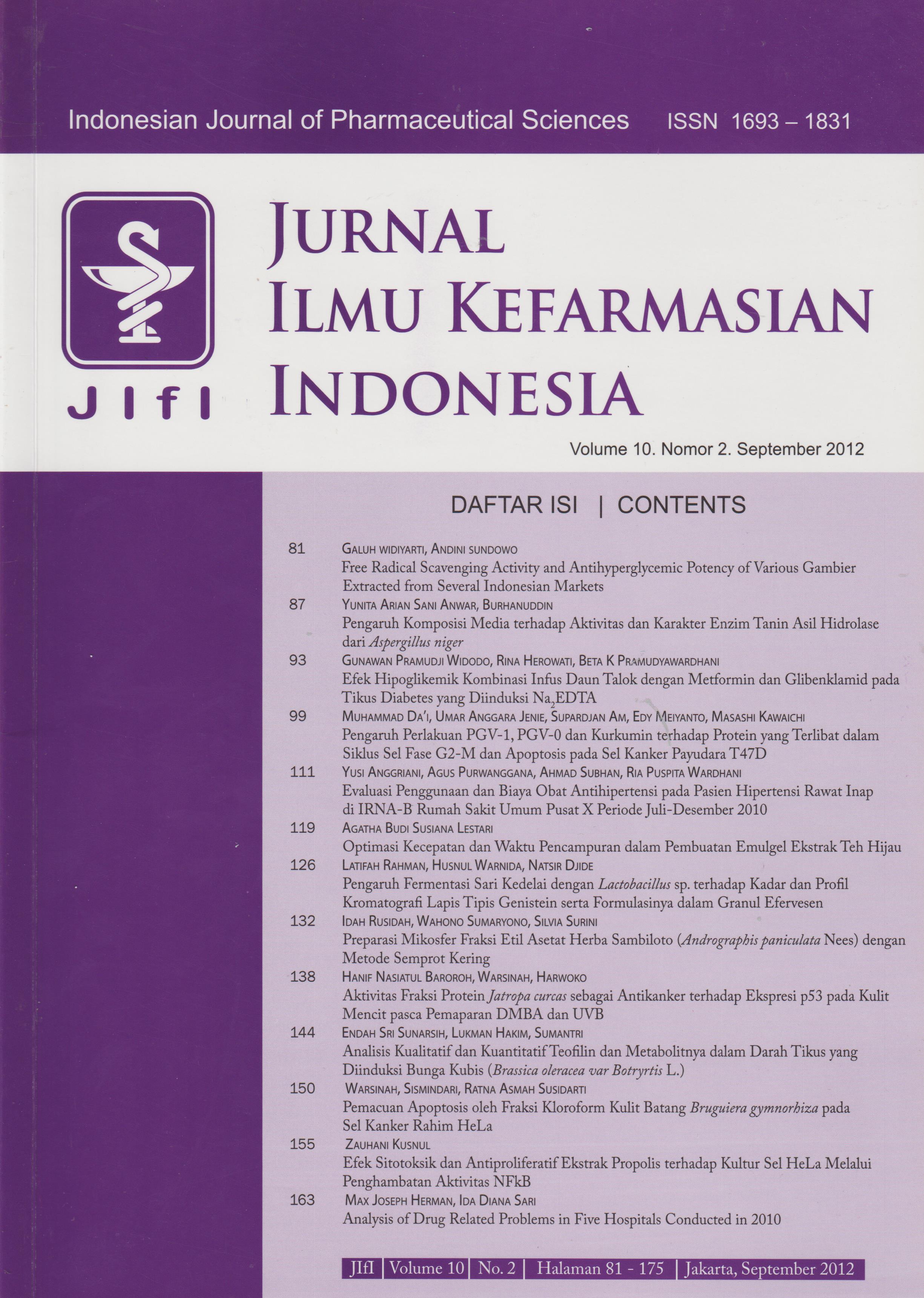
FREE RADICAL SCAVENGING ACTIVITY AND ANTIHYPERGLYCEMIC POTENCY OF VARIOUS GAMBIER COLLECTED FROM SEVERAL INDONESIAN MARKETS
Keywords:
Uncaria gambier, antioxidant, antihyperglycemic, extract, α-glucosidaseAbstract
Gambier (uncaria gambier) is known to have antioxidant properties and some studies attributed to the presence of polyphenols. The objective of this study was to investigate the potential of various gambier available in Indonesian market as free radical scavenger and to evaluate its antihyperglycemic potency as α-glucosidase inhibator. Isolation of catechin was carried out by extraction with distilled ethyl acetate as solvent. Analysis of catechin in the gambier dried extracts were carried out by TLC method. The molecular weight and catechin content of gambier dried extracts were determined by analyzing mass spectra and spectrophotometry, respectively. The free radical scavenging aactivity ofextracts were measured by using 1, 1-diphenyl1-2-picrylhydrazyl (DPPH) as stable free radical compound. The antihyperglycemic potency of gambier dried extracts were asseyed, as α-glucosidase inhibator. The results showed that various gambier available in the market were very active as antioxidant, indicated by the IC50 vvalues of gambier dried extracts were 4.6 to 18.2 µg/mL. Whilst th IC50 for glucosidase inhibition varies from 40.45 to 52.43 µg/mL, and classified as a moderate antidiabetic.
References
Downloads
Published
Issue
Section
License
Licencing
All articles in Jurnal Ilmu Kefarmasian Indonesia are an open-access article, distributed under the terms of the Creative Commons Attribution-NonCommercial-ShareAlike 4.0 International License which permits unrestricted non-commercial used, distribution and reproduction in any medium.
This licence applies to Author(s) and Public Reader means that the users mays :
- SHARE:
copy and redistribute the article in any medium or format - ADAPT:
remix, transform, and build upon the article (eg.: to produce a new research work and, possibly, a new publication) - ALIKE:
If you remix, transform, or build upon the article, you must distribute your contributions under the same license as the original. - NO ADDITIONAL RESTRICTIONS:
You may not apply legal terms or technological measures that legally restrict others from doing anything the license permits.
It does however mean that when you use it you must:
- ATTRIBUTION: You must give appropriate credit to both the Author(s) and the journal, provide a link to the license, and indicate if changes were made. You may do so in any reasonable manner, but not in any way that suggests the licensor endorses you or your use.
You may not:
- NONCOMMERCIAL: You may not use the article for commercial purposes.

This work is licensed under a Creative Commons Attribution-NonCommercial-ShareAlike 4.0 International License.