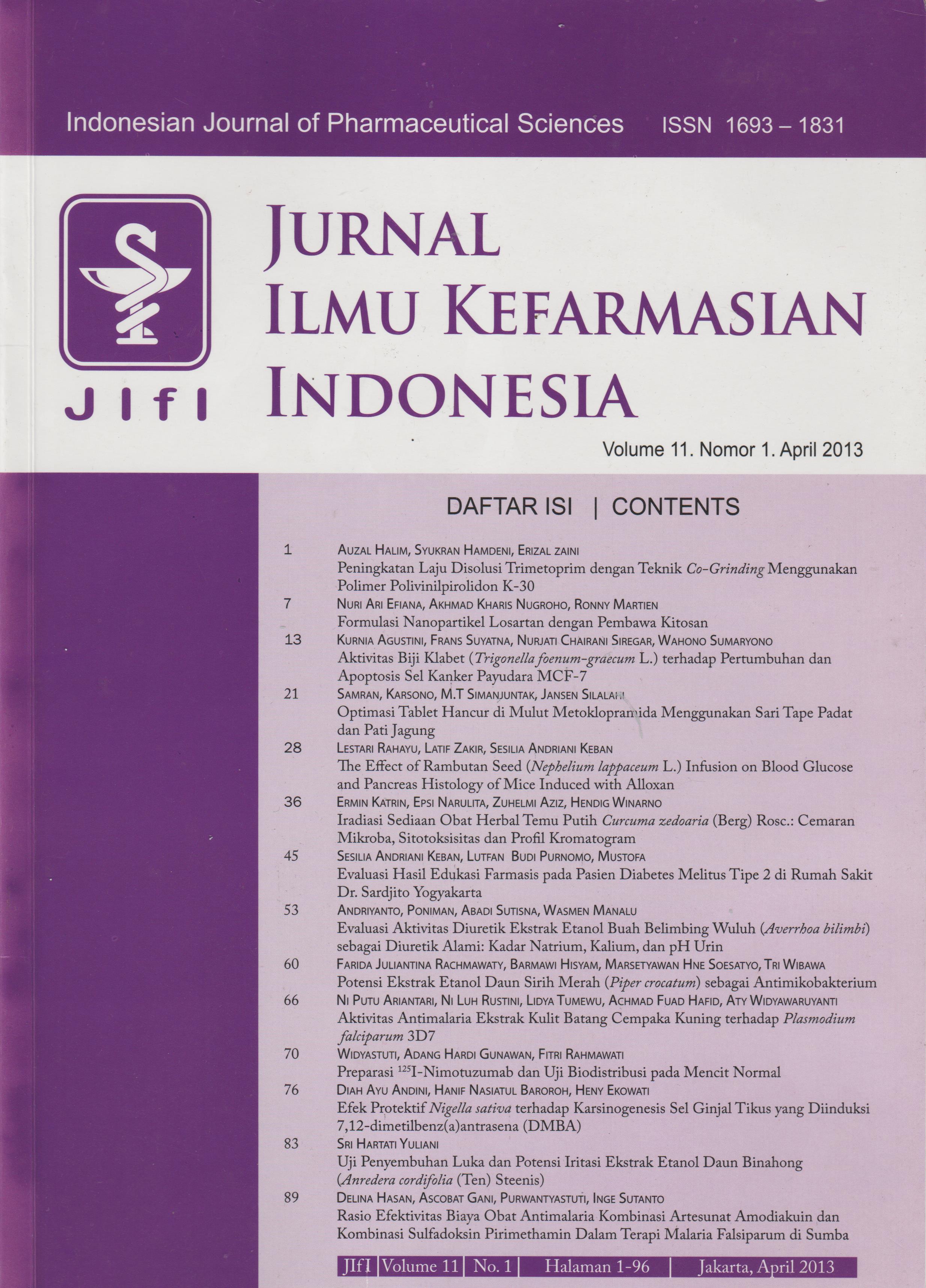
Evaluation of Diuretic Activity of Ethanolic Extract from Fruits of Belimbing Wuluh (Averrhoa bilimbi) as a Natural Diureticum: Urine Sodium and Potassium Concentrations and pH
Keywords:
ethanolic extract of Averrhoa bilimbi fruits, diuretic activity, sodium, potassium, pHAbstract
Previous study reported that Averrhoa bilimbi fruits had a potency as a natural diuretic. This research was conducted to examine the effects of ethanolic extract of Averrhoa bilimbi fruits on diuretic activity, urine sodium and potassium concentrations, and pH of urine male rats Sparague-Dawley. Fifteen rats were divided into 5 groups and 3 replications. Group 1 was given saline (negative control), group 2 was given furosemide 20 mg/kg bw (positive control), group 3 was given extract of Averrhoa bilimbi 0.44 g/kg bw, group 4 was given extract of Averrhoa bilimbi 0.88 g/kg bw, group 5 was given extract of Averhoa bilimbi 1.75 g/kg bw. Averrhoa bilimbi extract, saline, and furosemide were administred orally. The diuretic activity was determined by measuring cumulative urine volume for 10 hours post administration. The result showed that the extract of Averrhoa bilimbi at dosages of 0.88 and 1.75 g/kg bw increased sodium and potassium excretion by 18-36% and 22-27%, respectively. On the other hand, the increased diuretic activity and sodium and potassium excretion dramatically decreased urine pH. It was concluded that extract of Averrhoa bilimbi at dosages of 0.88 and 1.75 g/kg bw increased diuretic activity with enchanced sodium and potassium excretion in urine. The extract of Averrhoa bilimbi cosisted of alkaloid, flavonoid, and saporin that were assumed to have synergic activities as natural diuretics.
References
Downloads
Published
Issue
Section
License
Licencing
All articles in Jurnal Ilmu Kefarmasian Indonesia are an open-access article, distributed under the terms of the Creative Commons Attribution-NonCommercial-ShareAlike 4.0 International License which permits unrestricted non-commercial used, distribution and reproduction in any medium.
This licence applies to Author(s) and Public Reader means that the users mays :
- SHARE:
copy and redistribute the article in any medium or format - ADAPT:
remix, transform, and build upon the article (eg.: to produce a new research work and, possibly, a new publication) - ALIKE:
If you remix, transform, or build upon the article, you must distribute your contributions under the same license as the original. - NO ADDITIONAL RESTRICTIONS:
You may not apply legal terms or technological measures that legally restrict others from doing anything the license permits.
It does however mean that when you use it you must:
- ATTRIBUTION: You must give appropriate credit to both the Author(s) and the journal, provide a link to the license, and indicate if changes were made. You may do so in any reasonable manner, but not in any way that suggests the licensor endorses you or your use.
You may not:
- NONCOMMERCIAL: You may not use the article for commercial purposes.

This work is licensed under a Creative Commons Attribution-NonCommercial-ShareAlike 4.0 International License.