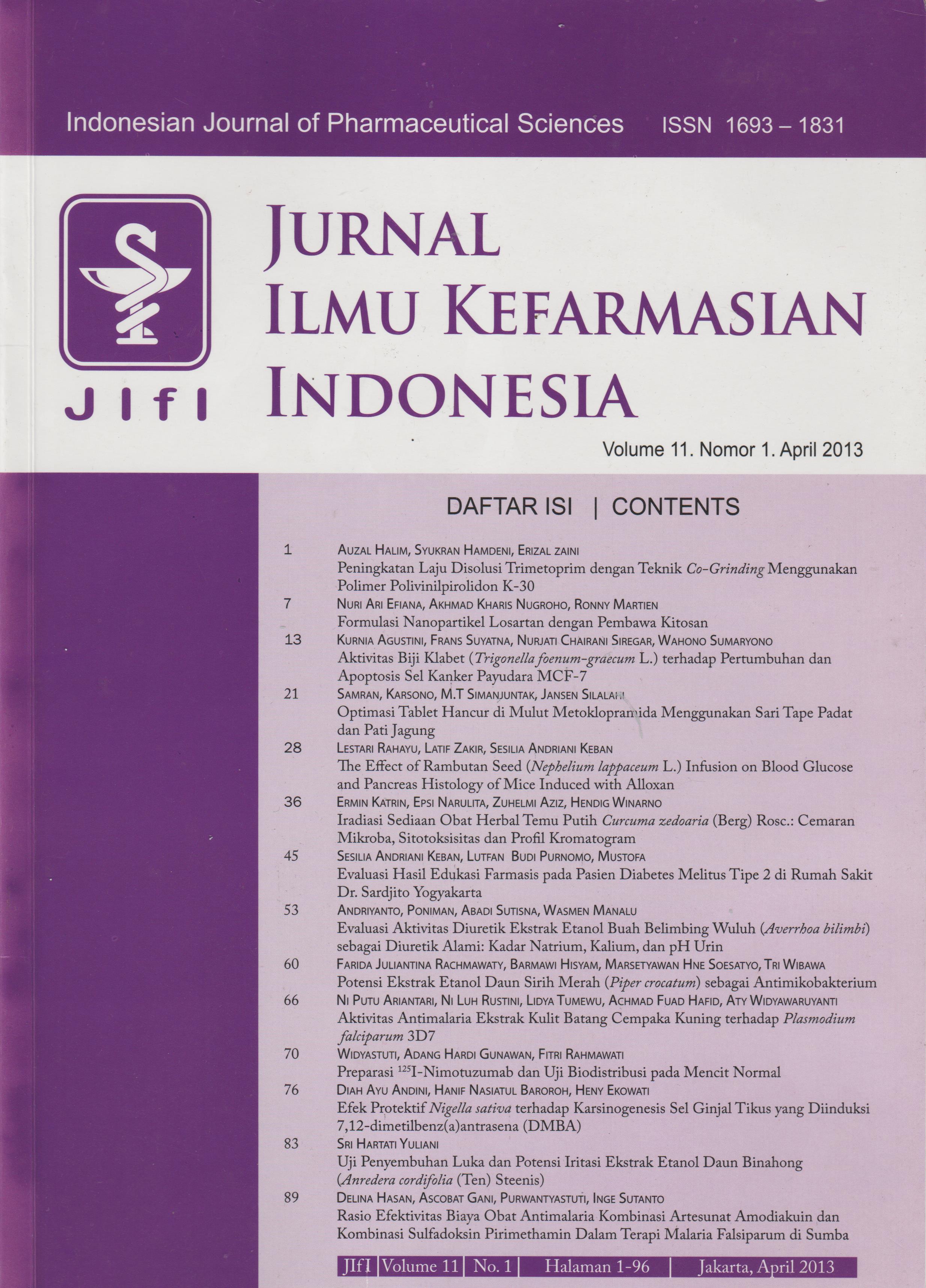
Cost Effectiveness Ratio of Artesunate-Amodiaquine and Sulfadoxine-Pyrimethamine Drug Combinations for Malaria Falsiparum Therapy in Sumba
Keywords:
falciparum malaria, combination artesunate amodiaquine, sulfadoxin pyrimethamine, cost effectiveness ratioAbstract
Malaria cases continue to increase in Indonesia, and one of the causes is many malaria parasites resistant to antimalarial drugs such as chloroquine and sulfadoxine pyrimethamine. Antimalarial drug combination recommended by the WHO yet widely available. This study aimed to explore alternative antimalarial drugs through examination of drug-effectiveness and cost-effectiveness analysis of antimalarial drug combination artesunate amodiaquine and sulfadoxine pyrimethamine. To assess the effectix eness or antimalarial drug combinations, as many asl64 patients with who meet inclusion and exclusion criteria were divided into 2 groups with 82 patients respectively. First group was given artesunate amodiaquine while the second group was given sulfadoxine pyrimethamine, and observed for 14 to 28 days. Responses to treatment according to the WHO protocol to include clinical response and parasitological response. The cost effectiveness was assessed through the pharmacoeconomic evaluation method. The results showed that fever clearence time and parasites clearence time by the artesunate amodiaquine combination was faster than by sulfadoxine pyrimethamine combination, and the cost effectiveness ratio of artesunate amodiaquine combination was lower than of sulfadoxine pyrimethamine. In conclusion, the antimalarial drug artesunate amodiaquine combination was more effective and more eflicient than the sulfadoxin pyrimethamine combination, and its cost effectiveness ratio was lower than the sulfadoxine pyrimethamine combination (p=0.05).
References
Downloads
Published
Issue
Section
License
Licencing
All articles in Jurnal Ilmu Kefarmasian Indonesia are an open-access article, distributed under the terms of the Creative Commons Attribution-NonCommercial-ShareAlike 4.0 International License which permits unrestricted non-commercial used, distribution and reproduction in any medium.
This licence applies to Author(s) and Public Reader means that the users mays :
- SHARE:
copy and redistribute the article in any medium or format - ADAPT:
remix, transform, and build upon the article (eg.: to produce a new research work and, possibly, a new publication) - ALIKE:
If you remix, transform, or build upon the article, you must distribute your contributions under the same license as the original. - NO ADDITIONAL RESTRICTIONS:
You may not apply legal terms or technological measures that legally restrict others from doing anything the license permits.
It does however mean that when you use it you must:
- ATTRIBUTION: You must give appropriate credit to both the Author(s) and the journal, provide a link to the license, and indicate if changes were made. You may do so in any reasonable manner, but not in any way that suggests the licensor endorses you or your use.
You may not:
- NONCOMMERCIAL: You may not use the article for commercial purposes.

This work is licensed under a Creative Commons Attribution-NonCommercial-ShareAlike 4.0 International License.