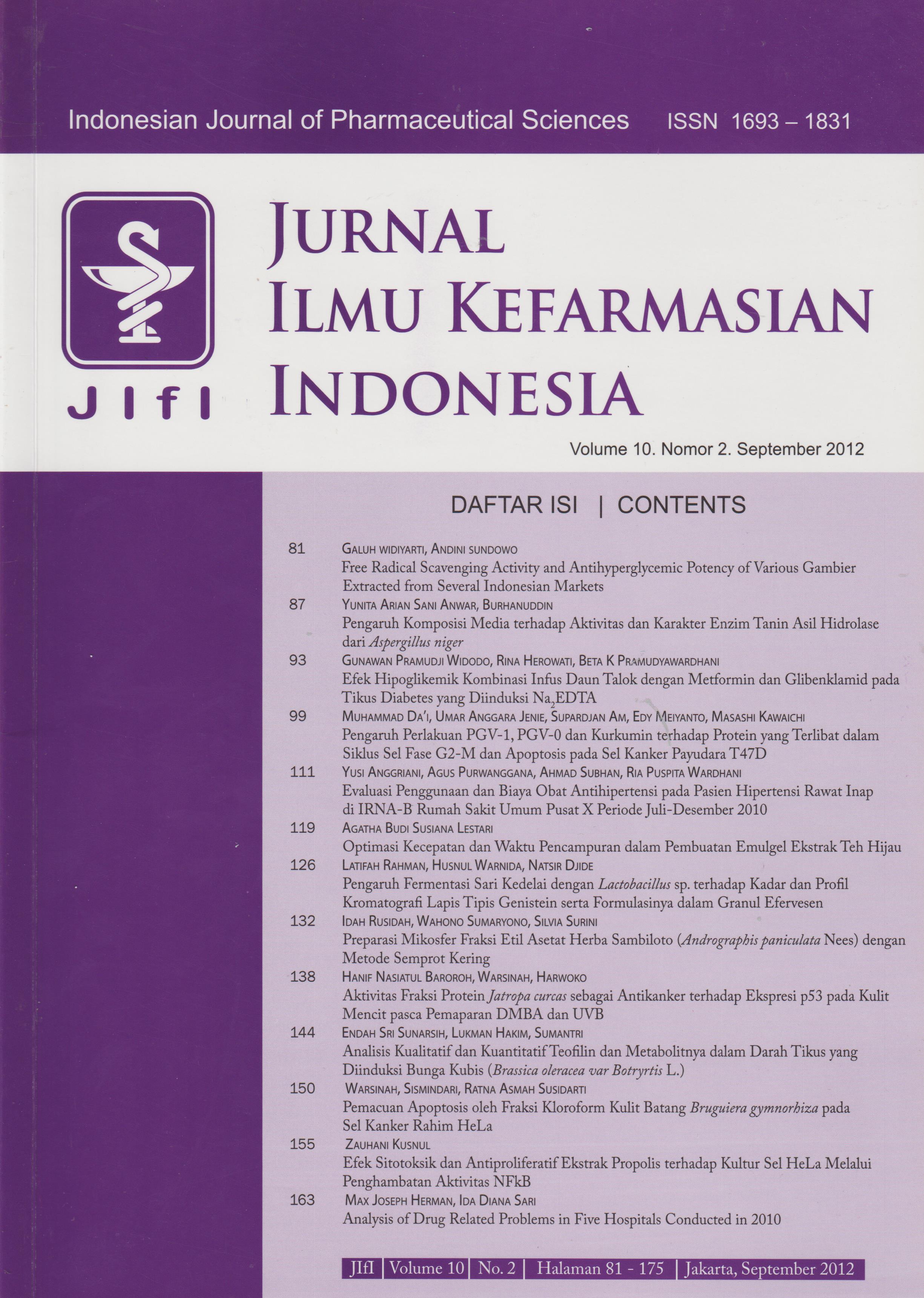
Hypoglycemic Effect of Talok Leaves Infuse in Combination with Metformin and Glibenclamide on Na2EDTA Induced-Diabetic Rats
Keywords:
Muntingia calabura leaves, metformin, glibenclamide, Na2EDTA, antidiabeticAbstract
Talok (Muntingia calabura L.) leaf is a traditional medicinal plant which empirically used to treat diabetes mellitus. This research aimed to know hypoglycemic effect of combination dose of talak leaves infuse-metformin and glibenclamide on Na2EDTA induced-diabetic rats. Diabetic animal model were conducted by induction of Na2EDTA dose of 70 mg kg bw for 3 days. The test groups divided into six groups which were treated with: 50 mg kg bw CMC-Na suspension (negative control 1st group), 0.9 mg kg bw glibenclamide (2nd group), metformin 90 mg kg bb (3rd group), 900 mg kg bw talok leaves infuse (4th group), combination of talok leaves infuse-glibenclamide (450 mg : 0.45 mg/kg bw) (5th group), combination of talok leaves infuse-metformin (450 mg : 45 mg kg bw) (6th group). The levels of blood glucose were examined in all 6 experimental groups on day 0, 4th and 7th. The data obtained were analyzed by one way ANOVA (p < 0.05). The results showed that all of combination could decrease the blood glucose levels significantly. The combination treatment of talok leaves infuse-glibenclamide showed a higher hypoglycemic effect than either drug alone, while combination treatment of talok leaves infuse-metformin showed a similar hypoglycemic effect to either drug alone.
References
Downloads
Published
Issue
Section
License
Licencing
All articles in Jurnal Ilmu Kefarmasian Indonesia are an open-access article, distributed under the terms of the Creative Commons Attribution-NonCommercial-ShareAlike 4.0 International License which permits unrestricted non-commercial used, distribution and reproduction in any medium.
This licence applies to Author(s) and Public Reader means that the users mays :
- SHARE:
copy and redistribute the article in any medium or format - ADAPT:
remix, transform, and build upon the article (eg.: to produce a new research work and, possibly, a new publication) - ALIKE:
If you remix, transform, or build upon the article, you must distribute your contributions under the same license as the original. - NO ADDITIONAL RESTRICTIONS:
You may not apply legal terms or technological measures that legally restrict others from doing anything the license permits.
It does however mean that when you use it you must:
- ATTRIBUTION: You must give appropriate credit to both the Author(s) and the journal, provide a link to the license, and indicate if changes were made. You may do so in any reasonable manner, but not in any way that suggests the licensor endorses you or your use.
You may not:
- NONCOMMERCIAL: You may not use the article for commercial purposes.

This work is licensed under a Creative Commons Attribution-NonCommercial-ShareAlike 4.0 International License.