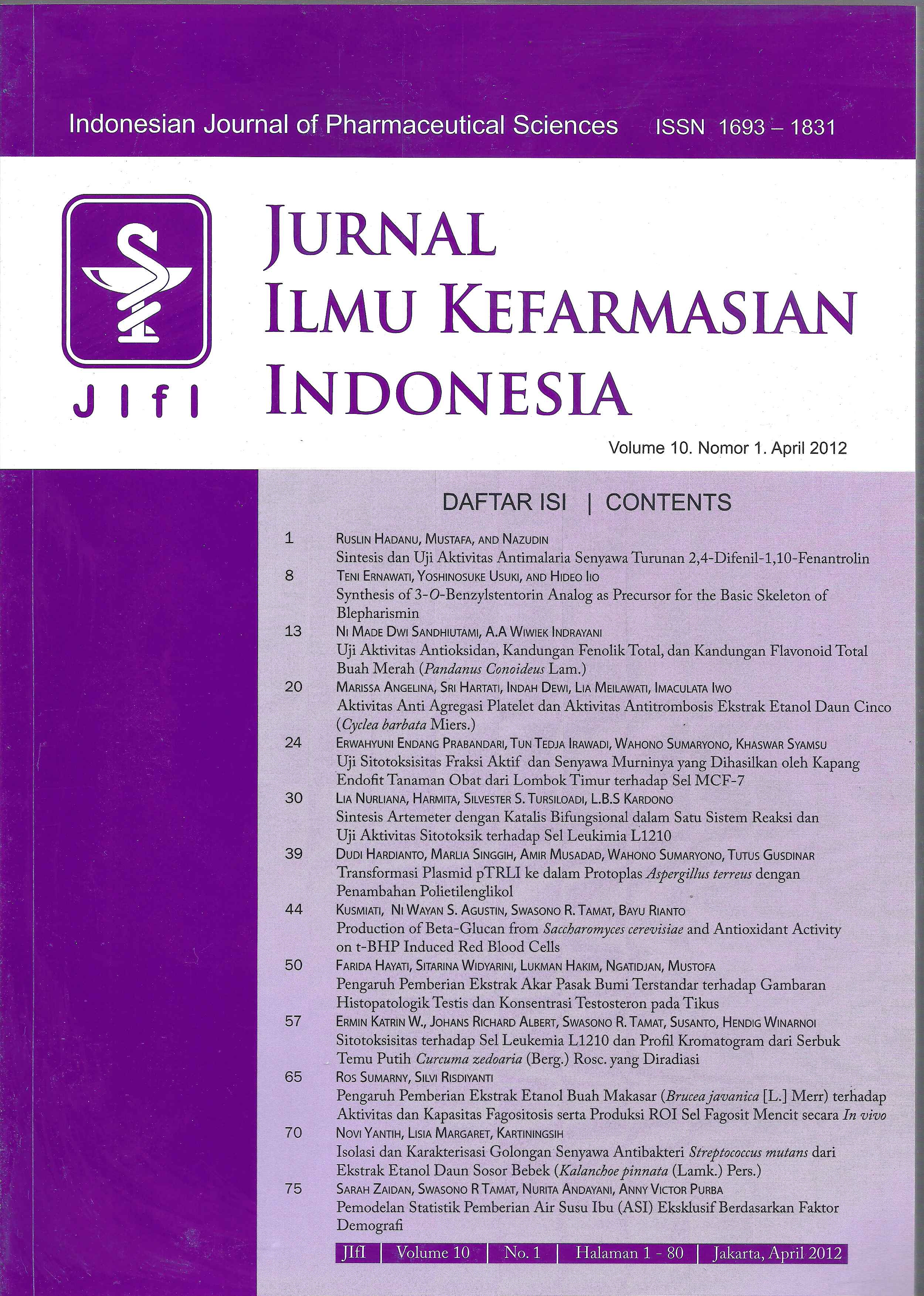
Synthesis of Artemether by Bifungtional Catalyst in One Pot Reaction System and Cytotoxocity Test Against L1210 Leukemia Cells
Keywords:
artemisinin, artemether, Ni/TiO2-SO4 solid catalyst, cytotoxicAbstract
Artemisinin has been known as herbal medicine from China, which was isolated from the Artemisia annua L. plant. Artemisinin was originally known as antipyretic and antimalarial drug. Artemisinin and its derivatives also have potential as anticancer, due to the sesquiterpene lactone containing a unique peroxide group. This study aimed to modify the structure of artemisinin into artemether using solid catalyst Ni/TiO2-SO4 through the hydrogenation and methylation of the alcohol group in one pot reaction system. The product was then investigated for its cytotoxic activity against L1210 leukemia cells. The solid catalyst in this study was composed of metalic Ni as the active center, TiO2 as a catalyst support and sulphate as the promoter. The modification of artemisinin produced 1.29% artemether white crystalls as a minor product, and 19% dihidroartemisinin as an intermediate compound. The synthesized artemether showed an anticancer activity against L1210 leukimia cells with IC50 value of 3.07 µg / mL. The result suggests that the synthesized artemether has a potency as an anticancer.
References
Downloads
Published
Issue
Section
License
Licencing
All articles in Jurnal Ilmu Kefarmasian Indonesia are an open-access article, distributed under the terms of the Creative Commons Attribution-NonCommercial-ShareAlike 4.0 International License which permits unrestricted non-commercial used, distribution and reproduction in any medium.
This licence applies to Author(s) and Public Reader means that the users mays :
- SHARE:
copy and redistribute the article in any medium or format - ADAPT:
remix, transform, and build upon the article (eg.: to produce a new research work and, possibly, a new publication) - ALIKE:
If you remix, transform, or build upon the article, you must distribute your contributions under the same license as the original. - NO ADDITIONAL RESTRICTIONS:
You may not apply legal terms or technological measures that legally restrict others from doing anything the license permits.
It does however mean that when you use it you must:
- ATTRIBUTION: You must give appropriate credit to both the Author(s) and the journal, provide a link to the license, and indicate if changes were made. You may do so in any reasonable manner, but not in any way that suggests the licensor endorses you or your use.
You may not:
- NONCOMMERCIAL: You may not use the article for commercial purposes.

This work is licensed under a Creative Commons Attribution-NonCommercial-ShareAlike 4.0 International License.