Plasmid of pTRLI Transformation into Aspergillus terreus Protoplast with Polyethylenglycol
Keywords:
transformation plasmid, pTRLI plasmid, protoplast, Aspergillus terreusAbstract
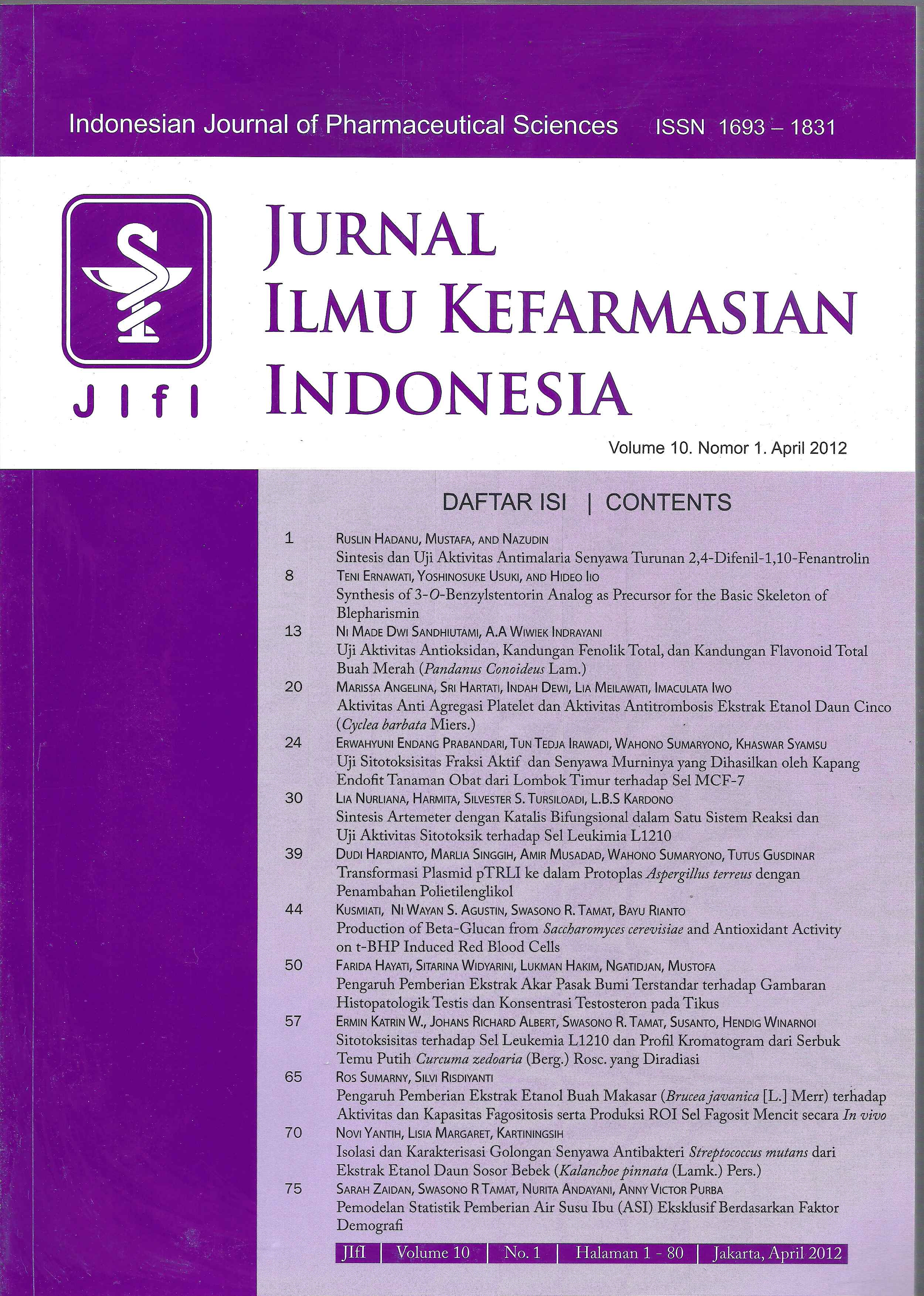
Plasmid transformation is the introduction and incorporation of exogenous plasmid into cells or protoplast. The purpose of this research is transformation of pTRLI plasmid into protoplasts of Aspergillus terreus and obtain stable transformants. The research was initiated by isolation of pTRLI plasmid and determining its purity and concentration by nanodrop machine. Furthermore, protoplasts of A. terreus were isolated enzymatically by addition of chitinase, cellulase, and maserozyme enzymes. pTRLI plasmid was transformed into protoplasts of A. terreus by addition of calcium chloride and polyethyleneglycol (PEG) solutions. These transformants were grown in Czapek-Dox agar medium containing pyrithiamine 1 mg/L and the number of transformants/µg of pTRLI plasmid was calculated. The number of transformants were produced ranging from 12 to 19 transformants/µg of pTRLI plasmid. The success of the transformation was indicated by ptrA gene in transformants that could be amplified by PCR of 801 base pairs in size. It was concluded that PEG solution could be used to transform pTRLI plasmid into protoplasts of A. terreus and transformants are stable up to live generations by growing the transformants in Czapek-Dox agar medium containing pyrithiamine 1 mg/L.
References
Downloads
Published
Issue
Section
License
Licencing
All articles in Jurnal Ilmu Kefarmasian Indonesia are an open-access article, distributed under the terms of the Creative Commons Attribution-NonCommercial-ShareAlike 4.0 International License which permits unrestricted non-commercial used, distribution and reproduction in any medium.
This licence applies to Author(s) and Public Reader means that the users mays :
- SHARE:
copy and redistribute the article in any medium or format - ADAPT:
remix, transform, and build upon the article (eg.: to produce a new research work and, possibly, a new publication) - ALIKE:
If you remix, transform, or build upon the article, you must distribute your contributions under the same license as the original. - NO ADDITIONAL RESTRICTIONS:
You may not apply legal terms or technological measures that legally restrict others from doing anything the license permits.
It does however mean that when you use it you must:
- ATTRIBUTION: You must give appropriate credit to both the Author(s) and the journal, provide a link to the license, and indicate if changes were made. You may do so in any reasonable manner, but not in any way that suggests the licensor endorses you or your use.
You may not:
- NONCOMMERCIAL: You may not use the article for commercial purposes.

This work is licensed under a Creative Commons Attribution-NonCommercial-ShareAlike 4.0 International License.