
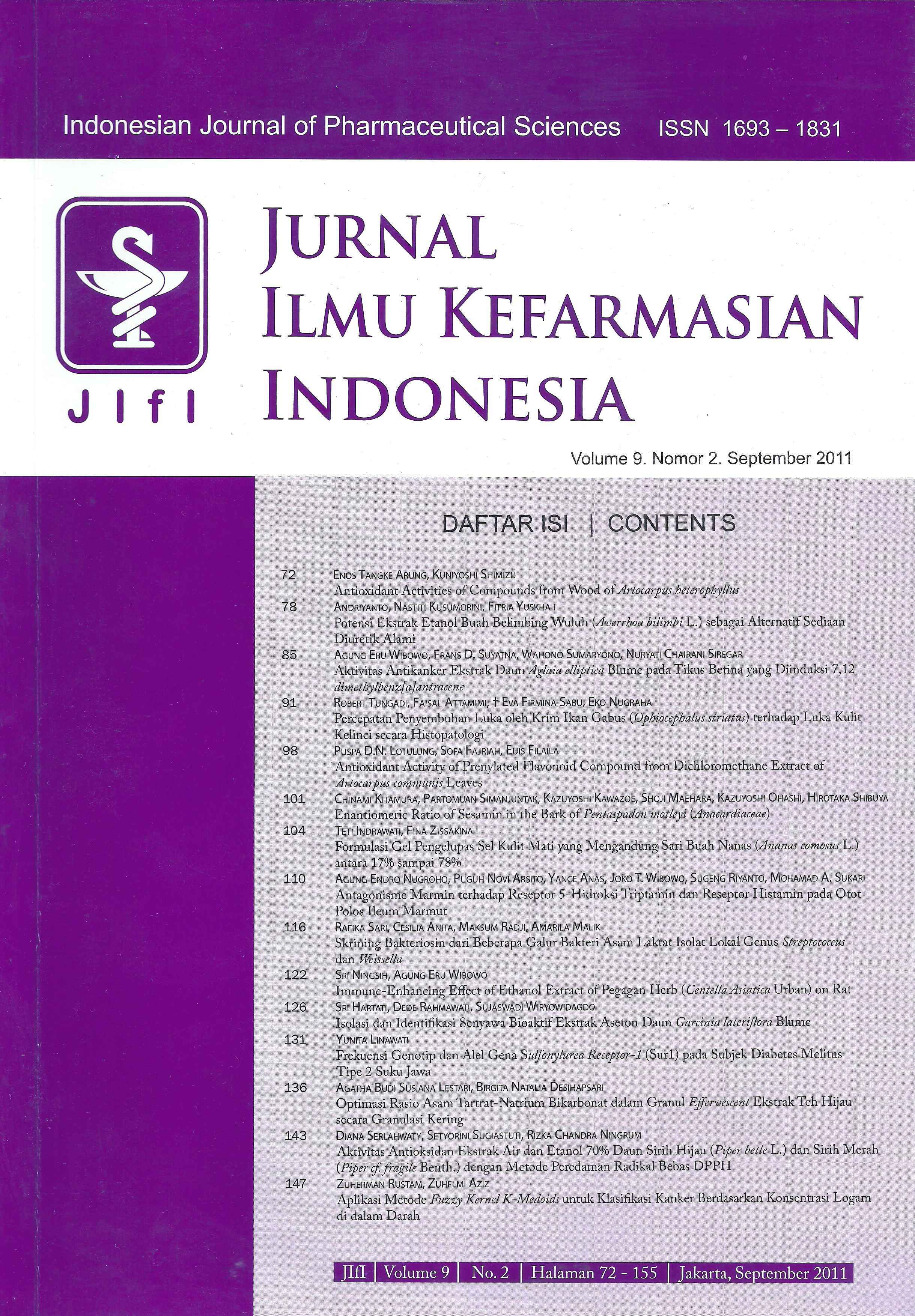
Dead Skin Cell Exfoliating Gel Formulation containing 17% to 78% of Ananas comosus L juice
Keywords:
Ananas comosus L., skin cell, gelAbstract
The juice of Ananas comosus L. contains bromelain which has been known to defoliate dead skin cells. Investigation on five gel formulations containing 17%, 33%, 50%, 67% and 78% of the juice of Ananas comosus L with 4% of HPMC as gelling agent, have been carried out. The stability of all formula were examined by the accelerated test method at room temperature and 40 oC for 6 weeks. Parameters observed were organoleptic, homogeneity, syneresis, viscosity, flow behavior, spreading ability, and pH. Results indicated that the higher the juice concentration in the gel would reduce the gel stability progressively. Gel formula using 4% of HPMC containing 17% or 33% of Ananas comosus juice can be produced while maintaining good physical stability for 6 weeks. The products were pale yellow to yellow in color, homogeneous, and have viscosity of 13000-45800 cps, pH 4.0-4.9, pseudo plastic flow, and spreading ability of 2732.58 to 4534.16 mm².
References
Downloads
Published
Issue
Section
License
Licencing
All articles in Jurnal Ilmu Kefarmasian Indonesia are an open-access article, distributed under the terms of the Creative Commons Attribution-NonCommercial-ShareAlike 4.0 International License which permits unrestricted non-commercial used, distribution and reproduction in any medium.
This licence applies to Author(s) and Public Reader means that the users mays :
- SHARE:
copy and redistribute the article in any medium or format - ADAPT:
remix, transform, and build upon the article (eg.: to produce a new research work and, possibly, a new publication) - ALIKE:
If you remix, transform, or build upon the article, you must distribute your contributions under the same license as the original. - NO ADDITIONAL RESTRICTIONS:
You may not apply legal terms or technological measures that legally restrict others from doing anything the license permits.
It does however mean that when you use it you must:
- ATTRIBUTION: You must give appropriate credit to both the Author(s) and the journal, provide a link to the license, and indicate if changes were made. You may do so in any reasonable manner, but not in any way that suggests the licensor endorses you or your use.
You may not:
- NONCOMMERCIAL: You may not use the article for commercial purposes.

This work is licensed under a Creative Commons Attribution-NonCommercial-ShareAlike 4.0 International License.













