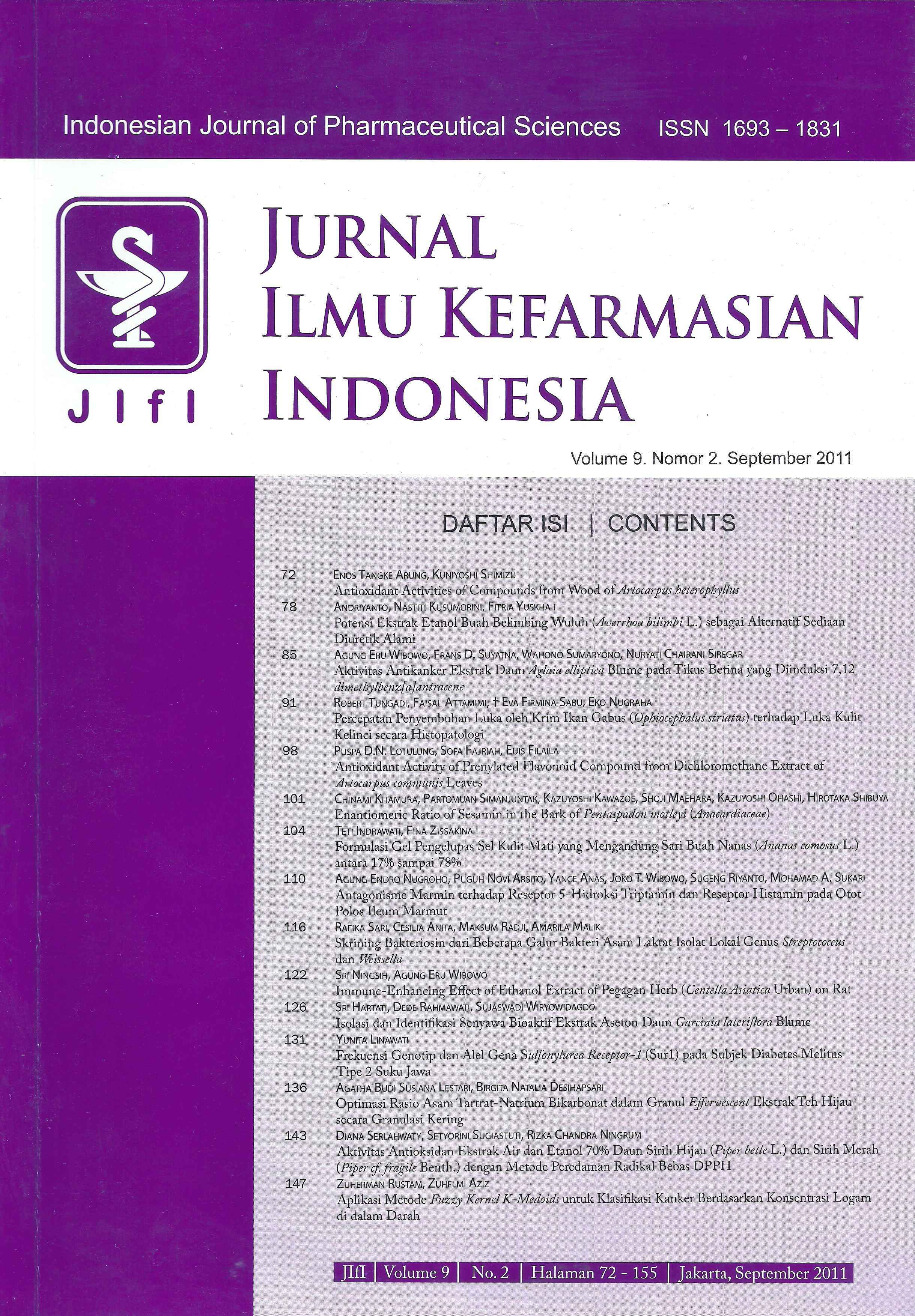
Isolation and Identification of Bioactive Compound of Aceton Extract Garcinia lateriflora Blume Leaf
Keywords:
Garcinia lateriflora BL., asaron, murine P388, Artemia salina L.Abstract
Preliminary studies have been carried out phytochemical test acetone leaf extract Garcinia
lateriflora Blume., and toxicity test against shrimp larvae (Artemia salina Leach) and murine cell line
P388. Isolates which showed the highest mortality are proceeded further for fractionation, isolation and
purification. The structure identification of active campound carriedout by analyzing the spectrum of IR ,
GC-MS (Gas chromatography mass spectrometer) and proton nuclear magnetic resonance spectrometer
(1H-NMR ) and (13C-NMR ). The results showed that the most active against the larval shrimp Artemia
salina L. with LC50 value of 18.03 ug/mL is b-asaron, IC50 of test results on cell line murine P-388 is 47.0
ug/mL. This compound was isolated first time from the plant Garcinia lateriflora BL.
References
Downloads
Published
Issue
Section
License
Licencing
All articles in Jurnal Ilmu Kefarmasian Indonesia are an open-access article, distributed under the terms of the Creative Commons Attribution-NonCommercial-ShareAlike 4.0 International License which permits unrestricted non-commercial used, distribution and reproduction in any medium.
This licence applies to Author(s) and Public Reader means that the users mays :
- SHARE:
copy and redistribute the article in any medium or format - ADAPT:
remix, transform, and build upon the article (eg.: to produce a new research work and, possibly, a new publication) - ALIKE:
If you remix, transform, or build upon the article, you must distribute your contributions under the same license as the original. - NO ADDITIONAL RESTRICTIONS:
You may not apply legal terms or technological measures that legally restrict others from doing anything the license permits.
It does however mean that when you use it you must:
- ATTRIBUTION: You must give appropriate credit to both the Author(s) and the journal, provide a link to the license, and indicate if changes were made. You may do so in any reasonable manner, but not in any way that suggests the licensor endorses you or your use.
You may not:
- NONCOMMERCIAL: You may not use the article for commercial purposes.

This work is licensed under a Creative Commons Attribution-NonCommercial-ShareAlike 4.0 International License.