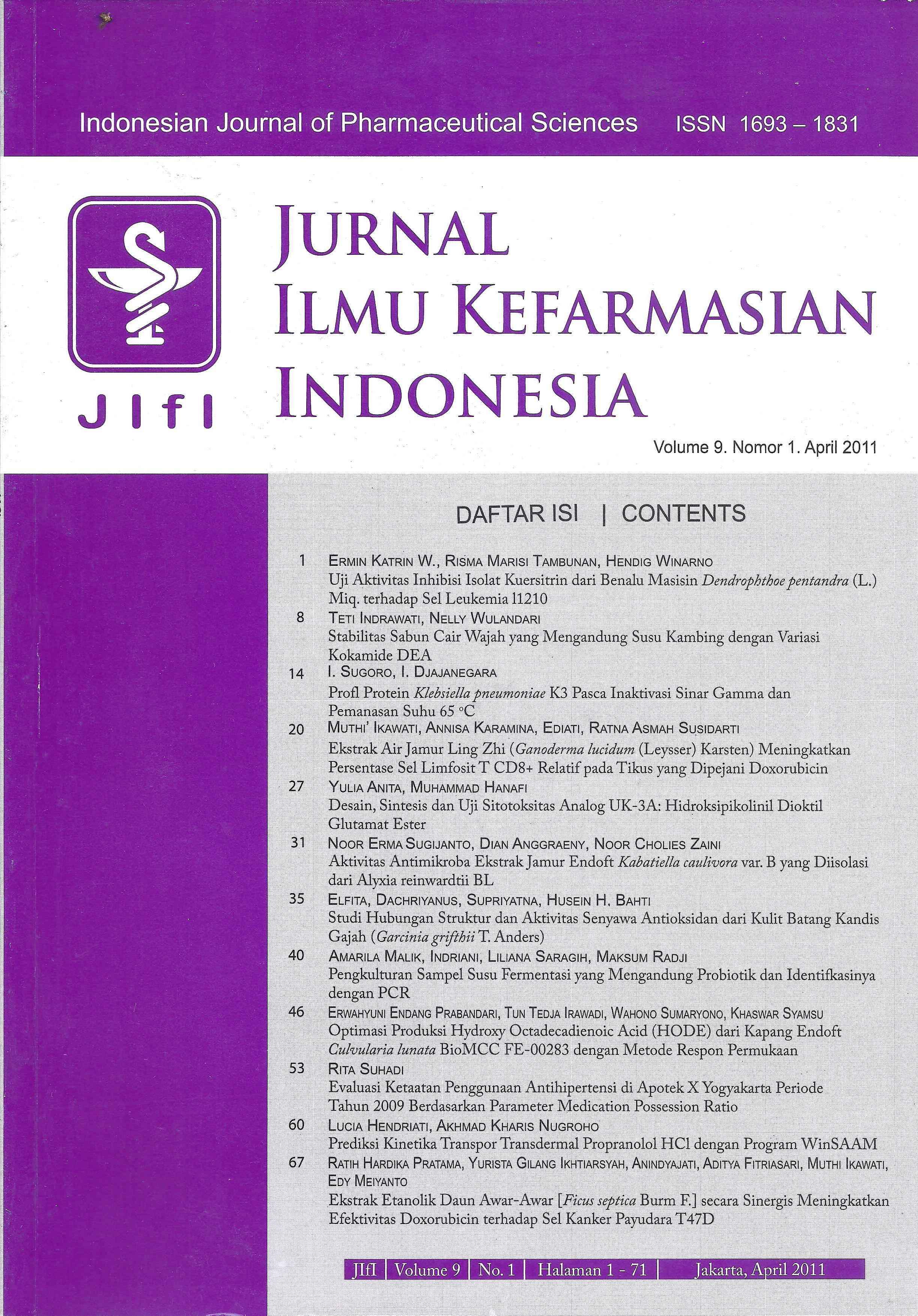
Protein Profile of Klebsiella pneumonia K3 After Inactivation by Gamma Rays and Heat at 65 C
Keywords:
Klebsiella pneumoniae, inactivated vaccine, gamma rays, heat, proteinAbstract
Klebsiella pneumoniae is one of coliform bacteria which causes human and mammalian diseases. The bacteria dominate in dairy cow milk which has been infected by mastitis and has resistent on antibiotic. Vaccination is one of aims to prevent the diseases. Nuclear technique could be used to have a vaccine candidate.This research was conducted to get inactivated K. pneumoniae by gamma irradiation and heat inactivated as vaccine candidate. The experiments were done by determination of inactivated doses, protein content, and protein profile. analysis. K. pneumoniae could be inactivated using gamma rays by doses higher than 600 Gy. Neither irradiation nor heat (65 oC) influenced the K. pneumoniae total protein content The intensity of protein profile in gamma ray inactivated was higher than heat inactivated. There were 35, 36, and 60 kDa protein which were diagnosed as antigen protein. It could be concluded that inactivated by gamma irradiation K. pneumoniae could be chosen as a vaccine candidate and as a model for other bacterial vaccine.
References
Downloads
Published
Issue
Section
License
Licencing
All articles in Jurnal Ilmu Kefarmasian Indonesia are an open-access article, distributed under the terms of the Creative Commons Attribution-NonCommercial-ShareAlike 4.0 International License which permits unrestricted non-commercial used, distribution and reproduction in any medium.
This licence applies to Author(s) and Public Reader means that the users mays :
- SHARE:
copy and redistribute the article in any medium or format - ADAPT:
remix, transform, and build upon the article (eg.: to produce a new research work and, possibly, a new publication) - ALIKE:
If you remix, transform, or build upon the article, you must distribute your contributions under the same license as the original. - NO ADDITIONAL RESTRICTIONS:
You may not apply legal terms or technological measures that legally restrict others from doing anything the license permits.
It does however mean that when you use it you must:
- ATTRIBUTION: You must give appropriate credit to both the Author(s) and the journal, provide a link to the license, and indicate if changes were made. You may do so in any reasonable manner, but not in any way that suggests the licensor endorses you or your use.
You may not:
- NONCOMMERCIAL: You may not use the article for commercial purposes.

This work is licensed under a Creative Commons Attribution-NonCommercial-ShareAlike 4.0 International License.