Antimicrobial Activity of Endophytic Fungi Kabatiella caulivora var. B Isolated from Alyxia reinwardtii BL
Keywords:
caulivora var B, Alyxia reinwardtii BL, antimicrobial activity, endophytic fungiAbstract
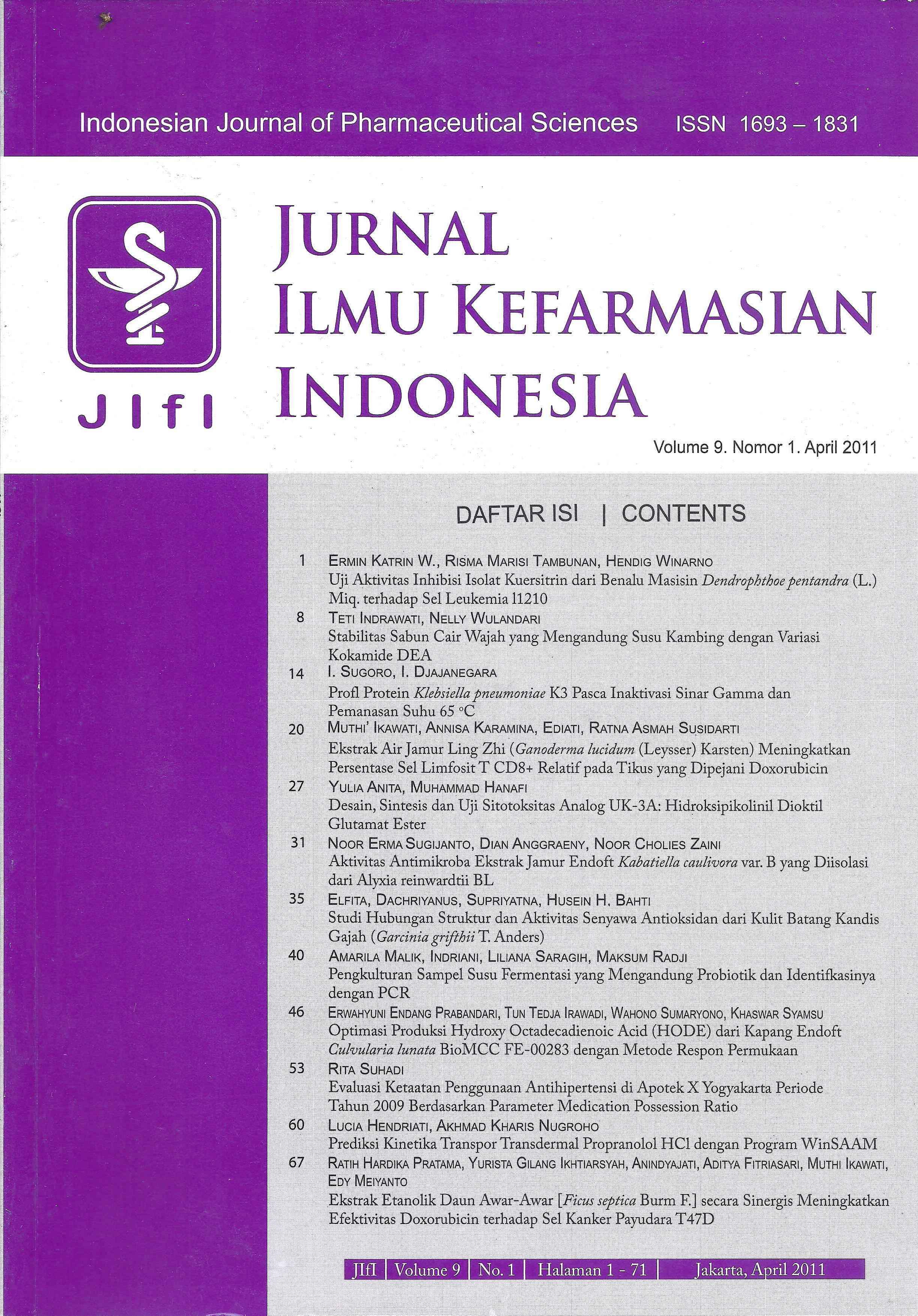
Endophytic fungi Kabatiella caulivora var B, have been isolated from Alyxia reinwardtii which was collected at Purwodadi Botanical Garden, Pasuruan, East Java. The objective of this present work is to asses the antimicrobial activity from extracts of the endophytic fungi Kabatiella caulivora var B against Bacillus subtilis, Escherichia coli, Salmonella thypi, Pseudomonas aeruginosa, Staphylocooccus aureus and Candida albicans. Disc diffusion method was conducted in this project with two concentration extracts (10 mg/disc and 5 mg/disc). The results showed that the methanol and ethyl acetate extracts of Kabatiella caulivora var B both have antimicrobial activity against all microbial tested, but the methanol extract showed negative activity against Staphylocooccus aureus and Candida albicans at concentration 5 mg. The discovery of endophytic fungi that produces bioactives metabolites has opened a promising new approach to obtain drugs on a commercial scale from microbes that grow inside plants.
References
Downloads
Published
Issue
Section
License
Licencing
All articles in Jurnal Ilmu Kefarmasian Indonesia are an open-access article, distributed under the terms of the Creative Commons Attribution-NonCommercial-ShareAlike 4.0 International License which permits unrestricted non-commercial used, distribution and reproduction in any medium.
This licence applies to Author(s) and Public Reader means that the users mays :
- SHARE:
copy and redistribute the article in any medium or format - ADAPT:
remix, transform, and build upon the article (eg.: to produce a new research work and, possibly, a new publication) - ALIKE:
If you remix, transform, or build upon the article, you must distribute your contributions under the same license as the original. - NO ADDITIONAL RESTRICTIONS:
You may not apply legal terms or technological measures that legally restrict others from doing anything the license permits.
It does however mean that when you use it you must:
- ATTRIBUTION: You must give appropriate credit to both the Author(s) and the journal, provide a link to the license, and indicate if changes were made. You may do so in any reasonable manner, but not in any way that suggests the licensor endorses you or your use.
You may not:
- NONCOMMERCIAL: You may not use the article for commercial purposes.

This work is licensed under a Creative Commons Attribution-NonCommercial-ShareAlike 4.0 International License.