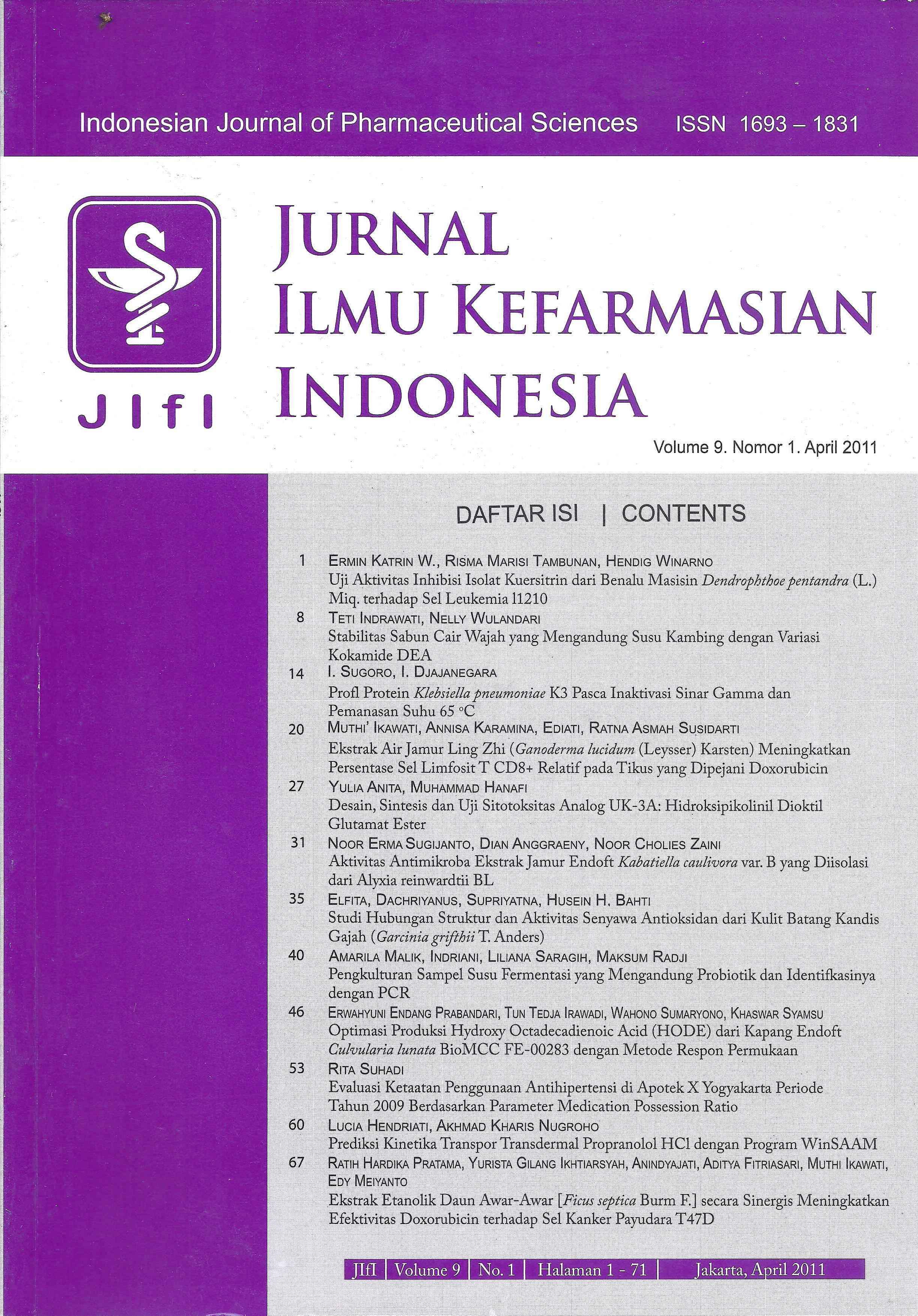
Optimization of Hydroxy Octadecadienoic Acid (HODE) Production by Culvularia lunata BioMCC FE-00283 Using Response Surface Methodology
Keywords:
optimization, RSM, hydroxy octadecadienoic acid, endophytic fungi, Culvularia lunataAbstract
Hydroxyl octadecadienoic acid (HODE) is an oxidized aliphatic fatty acid from the oxylipins group, which shows bioactivity and can be produced by Curvularia lunata BioMCC FE-00283 by submerged fermentation. Glucose, monosodium glutamate, and corn oil were media components that showed significant effect toward HODE production by C. lunata BioMCC FE-00283. Composition optimization of these three medium components was carried out by Response surface methodology (RSM). A full factorial central composite design (CCD) was used to explain the interaction effect between media components. Maximum HODE production as predicted by the quadratic model have chromatogram area of 4540000, which was verified experimentally to be 1091338 ± 152489. Eventhough experimental veriiication showed lower result compared to the model prediction, however it was higher compared to the HODE production using basal media with unoptimized composition of carbon, nitrogen, and inducer which only have chromatogram area of 295045 ± 71200. The verification also showed that optimization increased HODE production by 3.7 fold compared to that produced by the unoptimized media.
References
Downloads
Published
Issue
Section
License
Licencing
All articles in Jurnal Ilmu Kefarmasian Indonesia are an open-access article, distributed under the terms of the Creative Commons Attribution-NonCommercial-ShareAlike 4.0 International License which permits unrestricted non-commercial used, distribution and reproduction in any medium.
This licence applies to Author(s) and Public Reader means that the users mays :
- SHARE:
copy and redistribute the article in any medium or format - ADAPT:
remix, transform, and build upon the article (eg.: to produce a new research work and, possibly, a new publication) - ALIKE:
If you remix, transform, or build upon the article, you must distribute your contributions under the same license as the original. - NO ADDITIONAL RESTRICTIONS:
You may not apply legal terms or technological measures that legally restrict others from doing anything the license permits.
It does however mean that when you use it you must:
- ATTRIBUTION: You must give appropriate credit to both the Author(s) and the journal, provide a link to the license, and indicate if changes were made. You may do so in any reasonable manner, but not in any way that suggests the licensor endorses you or your use.
You may not:
- NONCOMMERCIAL: You may not use the article for commercial purposes.

This work is licensed under a Creative Commons Attribution-NonCommercial-ShareAlike 4.0 International License.