
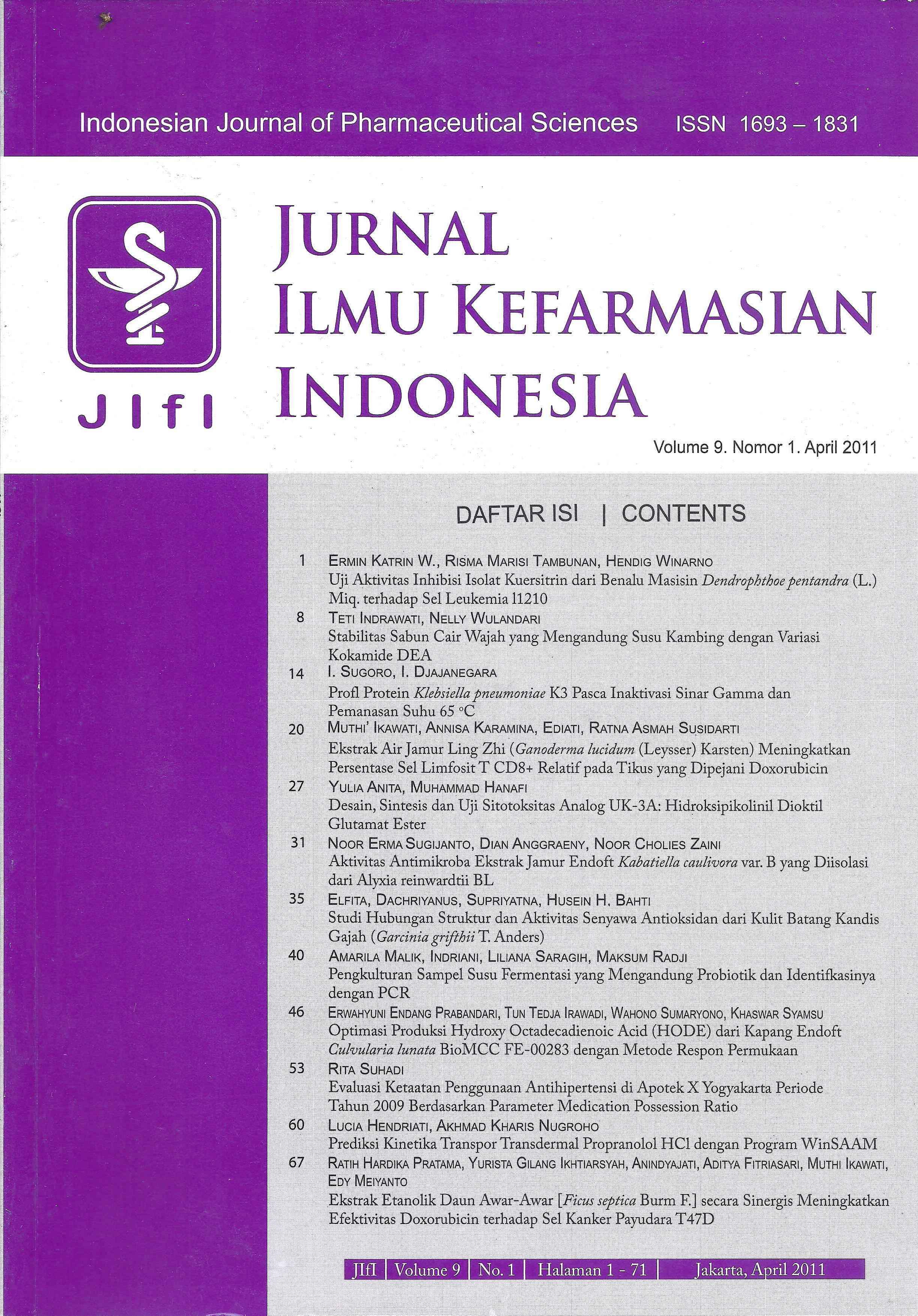
Evaluation of Adherence on Antihypertensive Use at X-Pharmacy Yogyakarta in 2009 Based on Medication Possession Ratio
Keywords:
adherence, Medication Possession Ratio, antihypertensiveAbstract
World Health Organization reported that hypertension was in the top rank as global causes of death in 2009. Adherence to the antihypertensive medication reduced risks of various cardiovascular diseases. A cross-sectional study has been carried out to observe profile of the use of antihypertensive and to evaluate patient’s compliance based on Medication Possession Ratio (MPR) at X-Pharmacy Yogyakarta in 2009. Study subjects were the prescription of antihypertensive for patient regularly visits at least 3 times. The MPR was calculated as the ratio of the sum of the days supply of the prescription filled, excluding the latest prescription, divided by number of days filled. Results showed that the class and type of the most commonly prescribed antihypertensives based on the number of units and the highest mean units per prescription was the ACEI (captopril 25mg) and based on the frequency of prescribing was CCB (amlodipin 5mg). The use of generic drugs versus branded medicines 5.6 times in the units, 3.2 times more in the frequency of prescribing, and 1.7 times more generic drugs in mean units per prescription. There was no significant difference between the adherence of patients based on sex, with or without costsharing; as well as single or combination antihypertensive based on MPR (p > 0.05); mean MPR was 0.78 ± 0.15 (range 0.41-1.00); and as many as 50.00 0 had MPR > 0.8 and considered as adherent patients.
References
Downloads
Published
Issue
Section
License
Licencing
All articles in Jurnal Ilmu Kefarmasian Indonesia are an open-access article, distributed under the terms of the Creative Commons Attribution-NonCommercial-ShareAlike 4.0 International License which permits unrestricted non-commercial used, distribution and reproduction in any medium.
This licence applies to Author(s) and Public Reader means that the users mays :
- SHARE:
copy and redistribute the article in any medium or format - ADAPT:
remix, transform, and build upon the article (eg.: to produce a new research work and, possibly, a new publication) - ALIKE:
If you remix, transform, or build upon the article, you must distribute your contributions under the same license as the original. - NO ADDITIONAL RESTRICTIONS:
You may not apply legal terms or technological measures that legally restrict others from doing anything the license permits.
It does however mean that when you use it you must:
- ATTRIBUTION: You must give appropriate credit to both the Author(s) and the journal, provide a link to the license, and indicate if changes were made. You may do so in any reasonable manner, but not in any way that suggests the licensor endorses you or your use.
You may not:
- NONCOMMERCIAL: You may not use the article for commercial purposes.

This work is licensed under a Creative Commons Attribution-NonCommercial-ShareAlike 4.0 International License.













