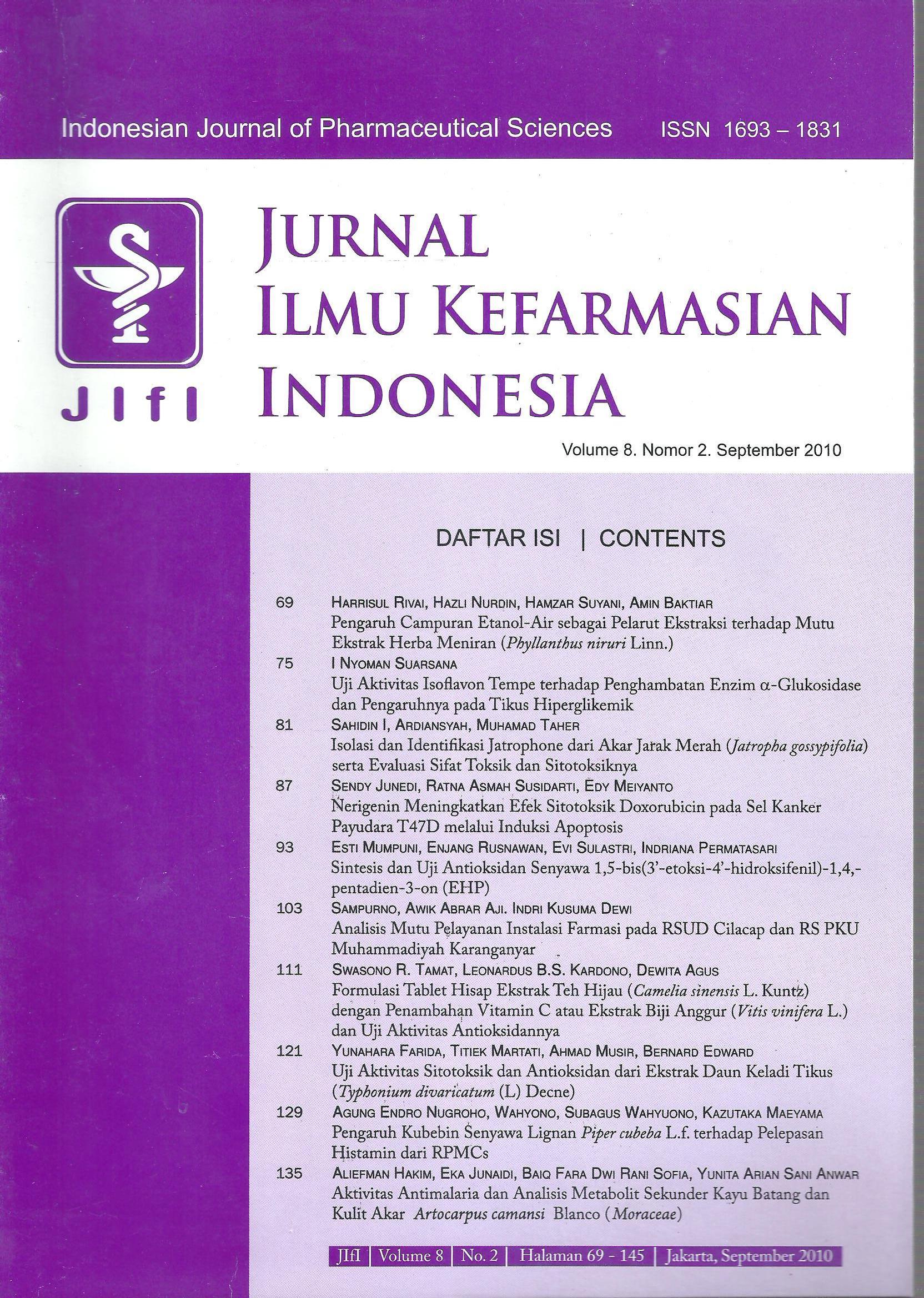
Formulation of Lozenges Containing Green Tea Extract (Camellia sinensis L. Kuntz) with Additon of Vitamin C or Grape Seed Extract (Vitis vinifera L.) and Their Antioxidant Activities
Keywords:
green tea extract, grape seed extract, vitamin C, antioxidant activity, lozengesAbstract
Formulation of lozenges containing: A) green tea extract; B) green tea extract with sodium ascorbate; and C) green tea extract with grape seed extract have been carried out. Antioxidant activities were compared to the activity of raw active materials. Lozenges were tested for physical characteristics, hedonic values, dissolution rate, and stability during storage, Physical tests indicated that the lozenges comply with the Farmakope Indonesia IV requirements. Determination of IC50 antioxidant activity using DPPI-I free radical scavenger showed that IC50 of formula A, B, and C were 844.04 µg/mL, 221.80 µg/ mL, and C 57.4 µg/mL, respectively. Meanwhile, IC50 value of green tea extract, sodium ascorbate, and grape seed extract were 4.29 µg/mL, 12.95 µg/mL, and 1.96 µg/ml., respectively. Accelerated stability test were carried out based on the EGCG concentration observed by using HPLC and then calculated by Arrhenius equation showed that the shelf life of lozenges of formula A, B, and C Were 2,11 years; 1.87 years; and 2,73 years, respectively. The result showed that the lozenge containing green tea extract and grape seed extract (formula C) is the best formula based on FI IV requirements, antioxidant activity and lozenges stability.
References
Downloads
Published
Issue
Section
License
Licencing
All articles in Jurnal Ilmu Kefarmasian Indonesia are an open-access article, distributed under the terms of the Creative Commons Attribution-NonCommercial-ShareAlike 4.0 International License which permits unrestricted non-commercial used, distribution and reproduction in any medium.
This licence applies to Author(s) and Public Reader means that the users mays :
- SHARE:
copy and redistribute the article in any medium or format - ADAPT:
remix, transform, and build upon the article (eg.: to produce a new research work and, possibly, a new publication) - ALIKE:
If you remix, transform, or build upon the article, you must distribute your contributions under the same license as the original. - NO ADDITIONAL RESTRICTIONS:
You may not apply legal terms or technological measures that legally restrict others from doing anything the license permits.
It does however mean that when you use it you must:
- ATTRIBUTION: You must give appropriate credit to both the Author(s) and the journal, provide a link to the license, and indicate if changes were made. You may do so in any reasonable manner, but not in any way that suggests the licensor endorses you or your use.
You may not:
- NONCOMMERCIAL: You may not use the article for commercial purposes.

This work is licensed under a Creative Commons Attribution-NonCommercial-ShareAlike 4.0 International License.