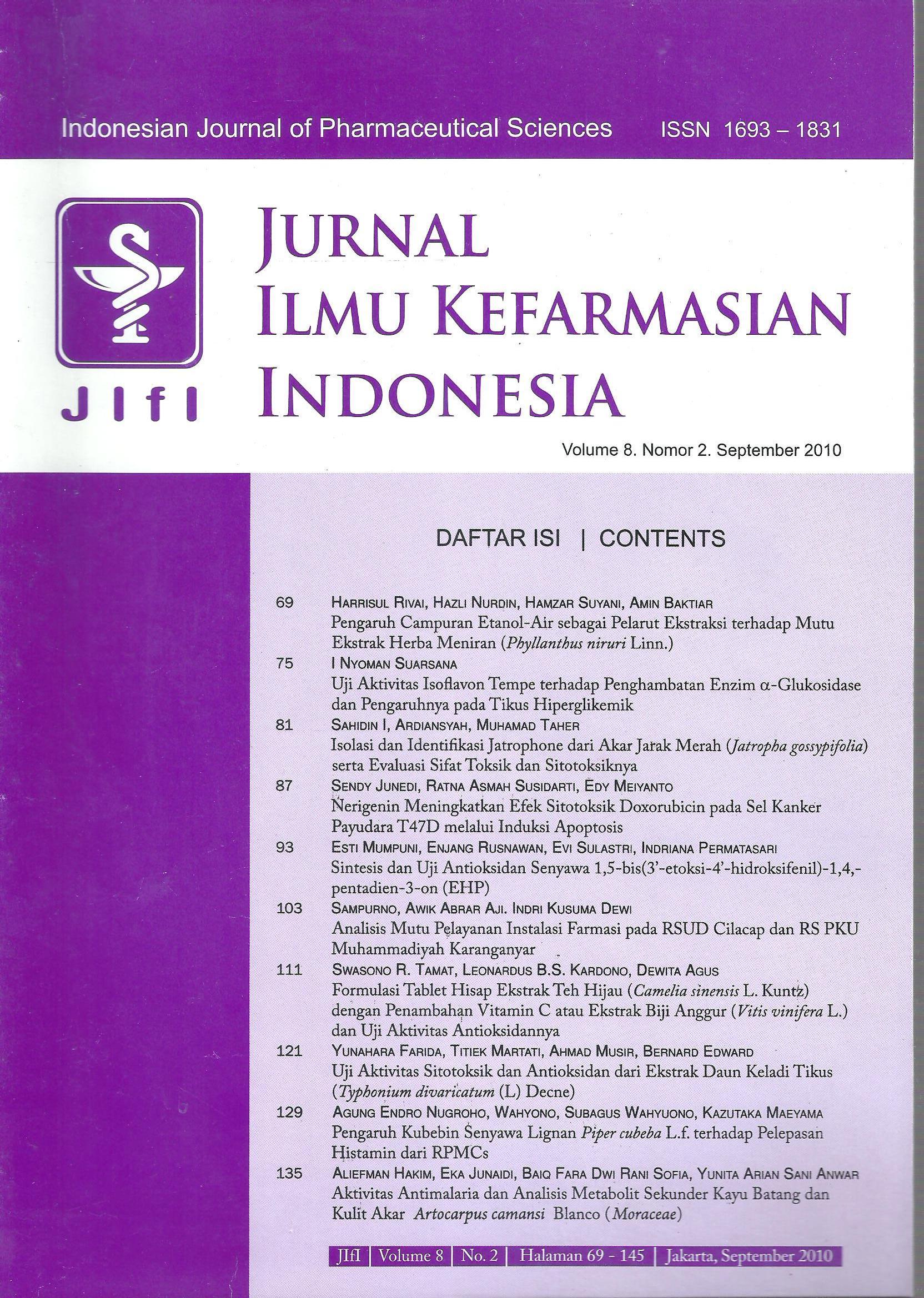
The Effects of Cubebin, a Lignan from Piper cubeba L.f. on Histamine Release from RPMCs
Keywords:
cubebin, histamine, connective tissue mast cell, RPMCsAbstract
Cubebin is a lignan isolated from Indonesian plant Piper cubeba L.f fruits. Cubebin has been found to strongly inhibit contraction of isolated-trachea of guinea pig induced by histamine or metacholine. ln the present study, the effcct of cubebin was investigated on histamine release from rat peritoneal mast cells (RPMCS), a connective tissue mast cell. Compound 48/80 (G Protein activator), thapsigargin (SERCA inhibitor), ionoinycin (calcium ionophore), and PMA (PKC activator) were used as inducers for histamine release from connective tissue mast cell. Histamine released in the medium was measured by HPLC-Huorometry. The results showed that cubebin at the concentration of 30 and 100 µM inhibited the histamine release from RPMCS induced by thapsigargin by 12,86 ± 1,84 % and 40.38 ± 1.93 %, respectively. In addition, there was a partial inhibition seen in respond to ionornycin, with no effects towards compound 48/80 or PMA, These data indicate that cubebin inhibited thc histamine release from connective mast cells, and might involve in the activation of sarco/ endoplasmic reticulum Ca2+ ATPase.
References
Downloads
Published
Issue
Section
License
Licencing
All articles in Jurnal Ilmu Kefarmasian Indonesia are an open-access article, distributed under the terms of the Creative Commons Attribution-NonCommercial-ShareAlike 4.0 International License which permits unrestricted non-commercial used, distribution and reproduction in any medium.
This licence applies to Author(s) and Public Reader means that the users mays :
- SHARE:
copy and redistribute the article in any medium or format - ADAPT:
remix, transform, and build upon the article (eg.: to produce a new research work and, possibly, a new publication) - ALIKE:
If you remix, transform, or build upon the article, you must distribute your contributions under the same license as the original. - NO ADDITIONAL RESTRICTIONS:
You may not apply legal terms or technological measures that legally restrict others from doing anything the license permits.
It does however mean that when you use it you must:
- ATTRIBUTION: You must give appropriate credit to both the Author(s) and the journal, provide a link to the license, and indicate if changes were made. You may do so in any reasonable manner, but not in any way that suggests the licensor endorses you or your use.
You may not:
- NONCOMMERCIAL: You may not use the article for commercial purposes.

This work is licensed under a Creative Commons Attribution-NonCommercial-ShareAlike 4.0 International License.