
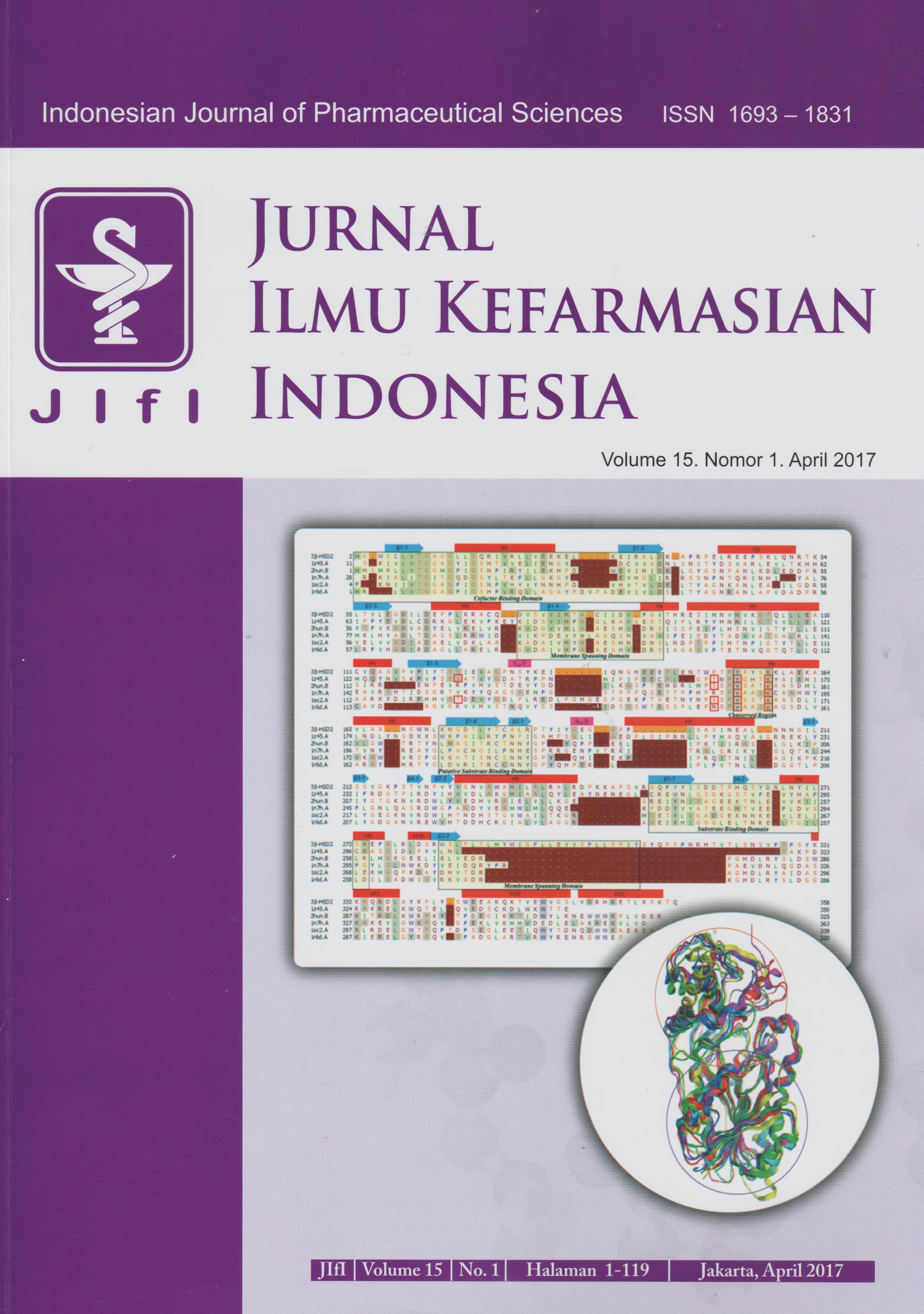
Ensemble Protein-Ligand Interaction Fingerprints in Construction and Validation of Virtual Screening Protocol Targeting C-X-C Chemokine Receptor Type 4
Keywords:
structure-based virtual screening (SBVS), binary quantitative structure-activity relationship, ensemble protein-ligand interaction fi ngerprint (PLIF), C-X-C chemokine receptor type 4 (CXCR4)Abstract
Structure-Based Virtual Screening (SBVS) protocols targeting C-X-C chemokine receptor type 4 (CXCR4) have been constructed by employing PLANTS 1.2 to perform molecular docking simulations and PyPLIF 0.1.1 to identify Protein-Ligand Interaction Fingerprint (PLIF). By using ChemPLP score from PLANTS 1.2 and Tc-PLIF from PyPLIF 0.1.1 to select best pose in the retrospective SBVS showed Enrichment Factor (EF) values of less than the EF value of the reference SBVS (17.5). Nevertheless, the retrospective SBVS campaigns have also resulted in PLIF bitstrings for all poses resulted from the molecular docking simulations.In this article, binary Quantitative Structure-Activity Relationship (QSAR) analysis employing new predictors ensemble PLIF resulted from the retrospective SBVS campaings, instead of using PLIF bitsrings from the best pose only, are presented. The ensemble PLIF as predictors were calculated by taking into account all poses with ChemPLP score lower than a certain ChemPLP score as the predefi ned cutoff , and subsequently for every compound the percentage of “on†interactions was calculated for every PLIF bitstring. The predefi ned cutoff was selected by performing systematic trials to obtain a ChemPLP score as the cutoff with the highest F-score and Matthews correlation coeffi cient (MCC) value.The results showed that the F-score and MCC values could reach 0.58 and 0.61, respectively with EF value of 323.47, which was much better than the EF value of the reference SBVS protocol.
References
Downloads
Published
Issue
Section
License
Licencing
All articles in Jurnal Ilmu Kefarmasian Indonesia are an open-access article, distributed under the terms of the Creative Commons Attribution-NonCommercial-ShareAlike 4.0 International License which permits unrestricted non-commercial used, distribution and reproduction in any medium.
This licence applies to Author(s) and Public Reader means that the users mays :
- SHARE:
copy and redistribute the article in any medium or format - ADAPT:
remix, transform, and build upon the article (eg.: to produce a new research work and, possibly, a new publication) - ALIKE:
If you remix, transform, or build upon the article, you must distribute your contributions under the same license as the original. - NO ADDITIONAL RESTRICTIONS:
You may not apply legal terms or technological measures that legally restrict others from doing anything the license permits.
It does however mean that when you use it you must:
- ATTRIBUTION: You must give appropriate credit to both the Author(s) and the journal, provide a link to the license, and indicate if changes were made. You may do so in any reasonable manner, but not in any way that suggests the licensor endorses you or your use.
You may not:
- NONCOMMERCIAL: You may not use the article for commercial purposes.

This work is licensed under a Creative Commons Attribution-NonCommercial-ShareAlike 4.0 International License.













