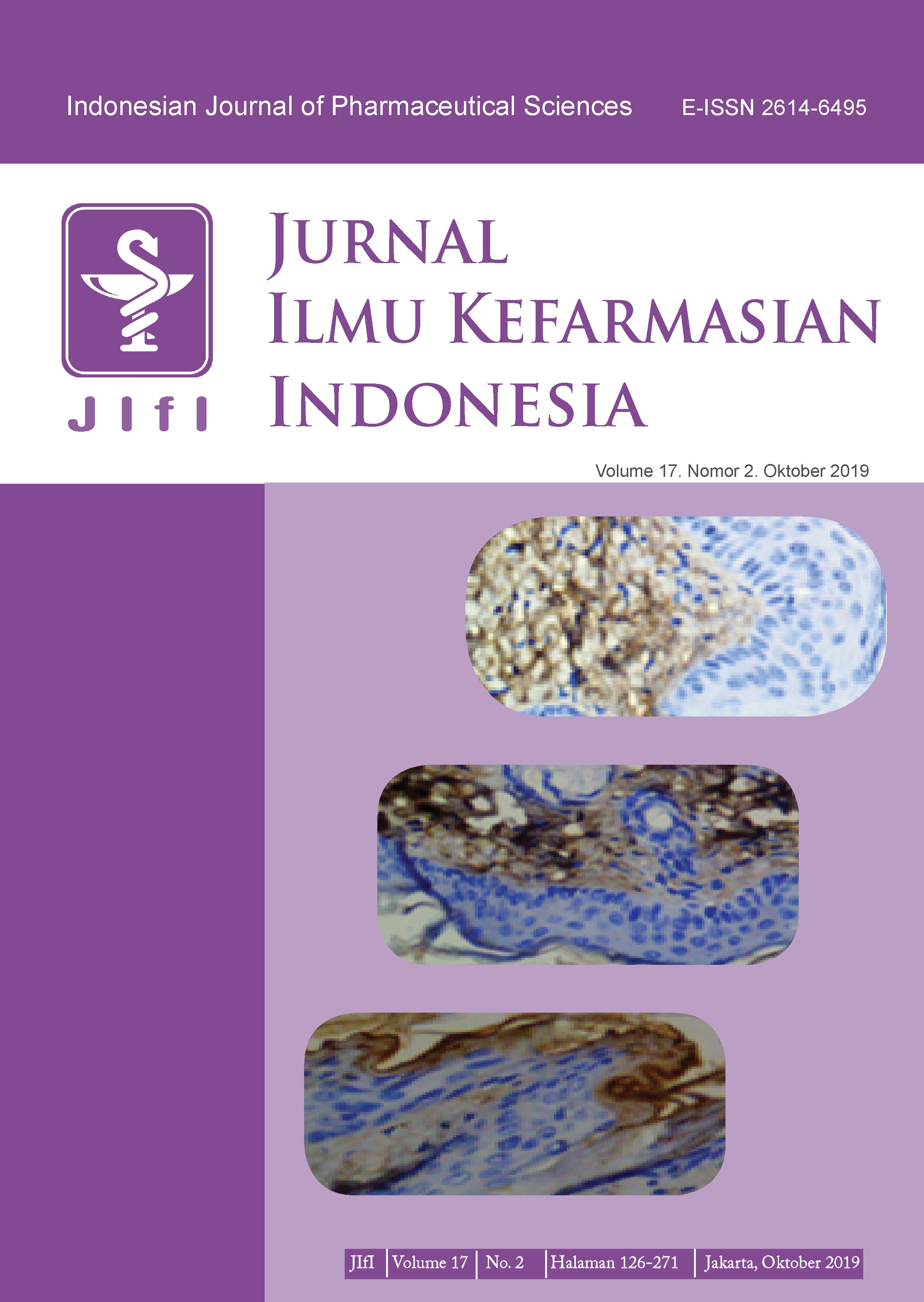
Optimization of W/O/W Multiple Nanoemulsion of Madeira vein Leaves Extract and Glycolic Acid-Chitosan Conjugate Using Box-Behnken Design
DOI:
https://doi.org/10.35814/jifi.v17i2.556Keywords:
Madeira vein, glycolic acid, chitosan, nanoemulsion, W/O/W, Box-Behnken, factorial designAbstract
Skin premature aging which is characterized by fine wrinkles can be overcome by stimulating collagen production and inhibiting its degradation, and also reducing corneocyte buildup. Madeira vein has been shown to induce collagen production and inhibit its degradation, while glycolic acid increase desquamation. The aim of this research was to optimize W/O/W multiple nanoemulsion formula of Madeira vein-leaves extract in W1 phase and glycolic acid in W2 phase. Glycolic acid was added after conjugated with chitosan to reduce its stinging effect on skin. The W/O/W multiple nanoemulsion was prepared through two emulsification steps: W1/O primary emulsion using high speed homogenizer, and the secondary emulsion using magnetic stirrer. W1/O was optimized including the selection of co surfactant and extract concentration, followed by secondary emulsion optimization using response surface methodology consisted of 2-level factorial and Box-Behnken design. The W1/O consisted of extract, polysorbate 80 as surfactant, PEG 400 as co surfactant and isopropyl myristate as oil phase. The 2-level factorial gave the three significant factors: W1/O sonication time, W1/O concentration, and secondary emulsification stirring time. Box-Behnken optimization for globule size below 400 nm was obtained by 6-10 minutes W1/O sonication time, 12-16% W1/O concentration, and 32-42 minutes stirring time of secondary emulsification.
References
Downloads
Published
Issue
Section
License
Licencing
All articles in Jurnal Ilmu Kefarmasian Indonesia are an open-access article, distributed under the terms of the Creative Commons Attribution-NonCommercial-ShareAlike 4.0 International License which permits unrestricted non-commercial used, distribution and reproduction in any medium.
This licence applies to Author(s) and Public Reader means that the users mays :
- SHARE:
copy and redistribute the article in any medium or format - ADAPT:
remix, transform, and build upon the article (eg.: to produce a new research work and, possibly, a new publication) - ALIKE:
If you remix, transform, or build upon the article, you must distribute your contributions under the same license as the original. - NO ADDITIONAL RESTRICTIONS:
You may not apply legal terms or technological measures that legally restrict others from doing anything the license permits.
It does however mean that when you use it you must:
- ATTRIBUTION: You must give appropriate credit to both the Author(s) and the journal, provide a link to the license, and indicate if changes were made. You may do so in any reasonable manner, but not in any way that suggests the licensor endorses you or your use.
You may not:
- NONCOMMERCIAL: You may not use the article for commercial purposes.

This work is licensed under a Creative Commons Attribution-NonCommercial-ShareAlike 4.0 International License.