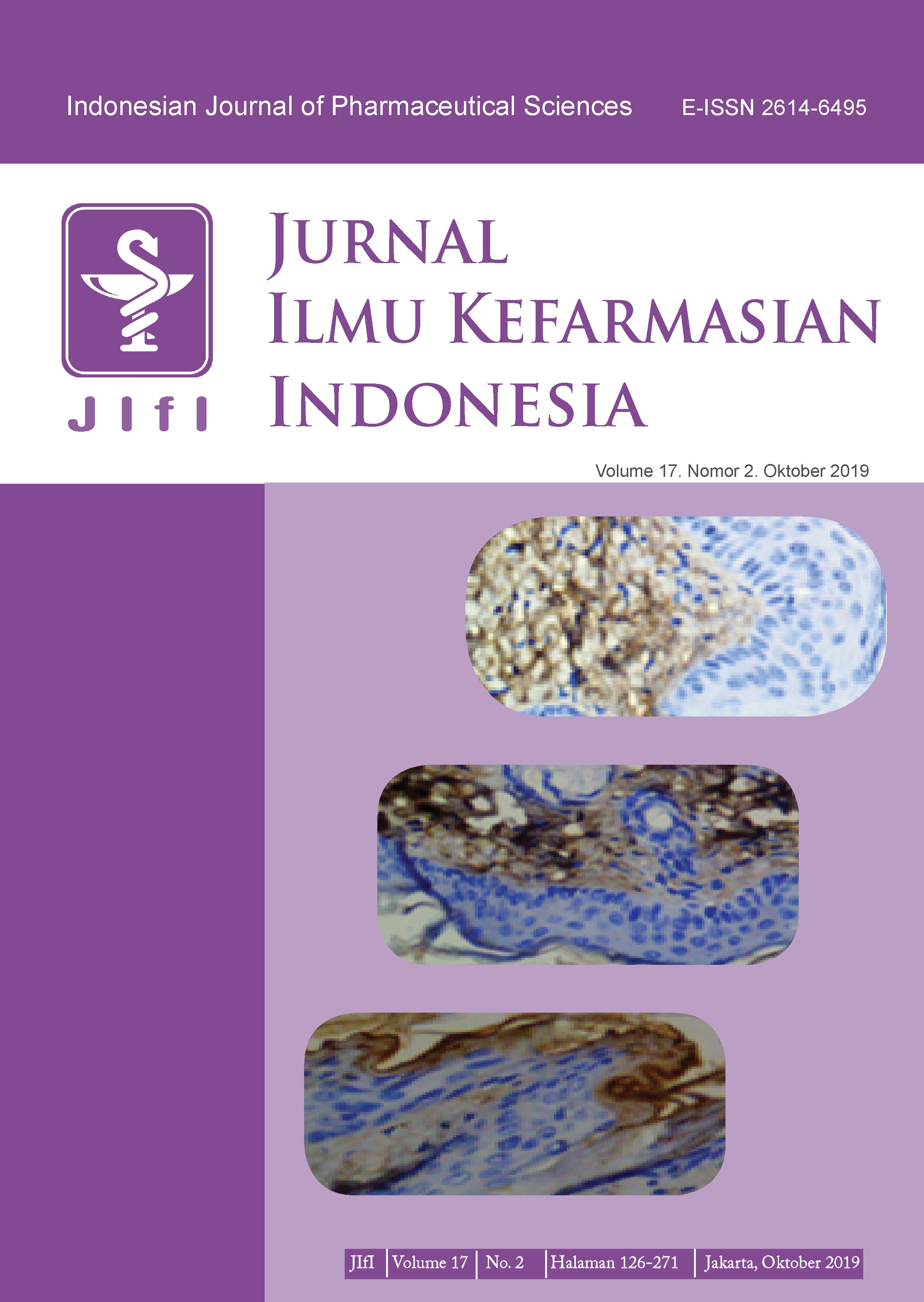
Peel Off Formulation of Peel Off Mask Ekstract Etanol Noni Fruit (Morinda citrifolia L.) and Activity as Anti Inflamatory
Peel Off Mask extract ethanol of Noni Fruit
DOI:
https://doi.org/10.35814/jifi.v17i2.564Keywords:
Inflammation, Peel off mask, Noni fruit extract, Physical Test, COX-2, IrritationAbstract
Infl ammation of the skin often occurs in acne-prone skin. Acne can be prevented in various
ways, one of them by maintaining clean skin. Noni fruit (Morinda citrifolia L.) with the active ingredient
of scopoletin has been proven to be eff ective as an anti-infl ammatory. Noni is dried into simplicia,
extracted was ethanol 96% solvent until it becomes concentrated extract. The extract is formulated into
a peel off mask with a concentration variation of 5%, 10 and 15%. The masks produced is evaluated for
physical characteristic of pH, viscosity, spreadability, and adhesivity test), as well as anti-infl ammatory
properties using mice with the parameters of COX-2 expression and irritation test using rabbit. The
evaluation results of the physical characteristic of the peel off mask fulfi lled the physical characteristic
requirements of the peel off mask preparation. Whereas in the viscosity test there were groups that
met the viscosity requirements, namely the formula I and II groups and the group that did not meet the
viscosity requirements, namely the formula III group. Anti-infl ammatory test in mice showed that the
mask lead to reduction in the amount of COX-2 expression. The best formula in 3 preparations was
indicated in formula I with COX-2 expression value of 22.635%. The results of irritation test on rabbits
did not cause irritation. According to the test results it can be concluded that the optimum value of the
ethanol extract concentration is shown in formula I with a concentration of 5%.
References
Downloads
Published
Issue
Section
License
Licencing
All articles in Jurnal Ilmu Kefarmasian Indonesia are an open-access article, distributed under the terms of the Creative Commons Attribution-NonCommercial-ShareAlike 4.0 International License which permits unrestricted non-commercial used, distribution and reproduction in any medium.
This licence applies to Author(s) and Public Reader means that the users mays :
- SHARE:
copy and redistribute the article in any medium or format - ADAPT:
remix, transform, and build upon the article (eg.: to produce a new research work and, possibly, a new publication) - ALIKE:
If you remix, transform, or build upon the article, you must distribute your contributions under the same license as the original. - NO ADDITIONAL RESTRICTIONS:
You may not apply legal terms or technological measures that legally restrict others from doing anything the license permits.
It does however mean that when you use it you must:
- ATTRIBUTION: You must give appropriate credit to both the Author(s) and the journal, provide a link to the license, and indicate if changes were made. You may do so in any reasonable manner, but not in any way that suggests the licensor endorses you or your use.
You may not:
- NONCOMMERCIAL: You may not use the article for commercial purposes.

This work is licensed under a Creative Commons Attribution-NonCommercial-ShareAlike 4.0 International License.