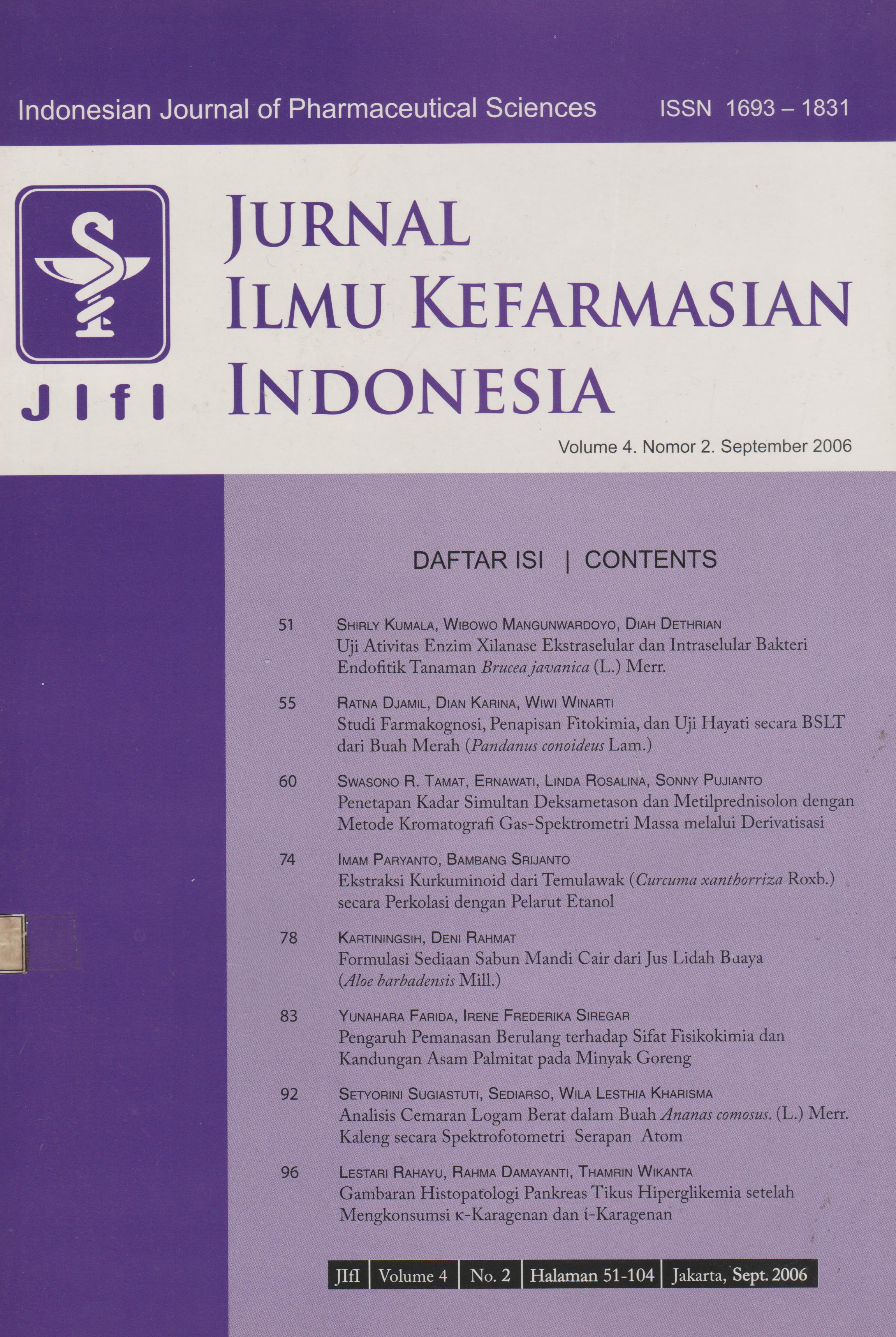
Formulasi Sediaan Sabun Mandi Cair dari Jus Lidah Buaya (Aloe barbadensis Mill.)
Keywords:
Aloe vera, sodium lauryl ether sulphate, liquid soapAbstract
Aloe vera leaf contains hydroxyanthraquinone derivatives, aloin (barbaloin and the distereoismeric 10-C glucosides of aloe-emodin anthracene) and 7-hydroxyaloin isomer and to a lesser extent aloe emodin, chrysophanol, chromone derivative and aloeresin as major glycoside-anthracene derivative. The aloin content varies in different species of aloe. The main constituent of aloin is barbaloin which is a pale yellow crystalline glycoside, soluble in water. Recent studies confirm that aloe has an antibacterial (against Staphylococcus ssp. and Streptococcus ssp.) and a fungicidal activity, so it can be used as antiseptic agent. The main purpose of this research was to obtain a physically stable liquid soap containing aloe vera. The formulation contained sodium lauryl ether sulphate with various concentrations. The obtained liquid bath soaps were evaluated cencernng their stability i.e.: viscosity, surface tension, and pH for eight weeks. Each formula gave a viscosity in the range of 8100 to 10400 cps and showed a pseudoplastic flow.
References
Downloads
Issue
Section
License
Licencing
All articles in Jurnal Ilmu Kefarmasian Indonesia are an open-access article, distributed under the terms of the Creative Commons Attribution-NonCommercial-ShareAlike 4.0 International License which permits unrestricted non-commercial used, distribution and reproduction in any medium.
This licence applies to Author(s) and Public Reader means that the users mays :
- SHARE:
copy and redistribute the article in any medium or format - ADAPT:
remix, transform, and build upon the article (eg.: to produce a new research work and, possibly, a new publication) - ALIKE:
If you remix, transform, or build upon the article, you must distribute your contributions under the same license as the original. - NO ADDITIONAL RESTRICTIONS:
You may not apply legal terms or technological measures that legally restrict others from doing anything the license permits.
It does however mean that when you use it you must:
- ATTRIBUTION: You must give appropriate credit to both the Author(s) and the journal, provide a link to the license, and indicate if changes were made. You may do so in any reasonable manner, but not in any way that suggests the licensor endorses you or your use.
You may not:
- NONCOMMERCIAL: You may not use the article for commercial purposes.

This work is licensed under a Creative Commons Attribution-NonCommercial-ShareAlike 4.0 International License.