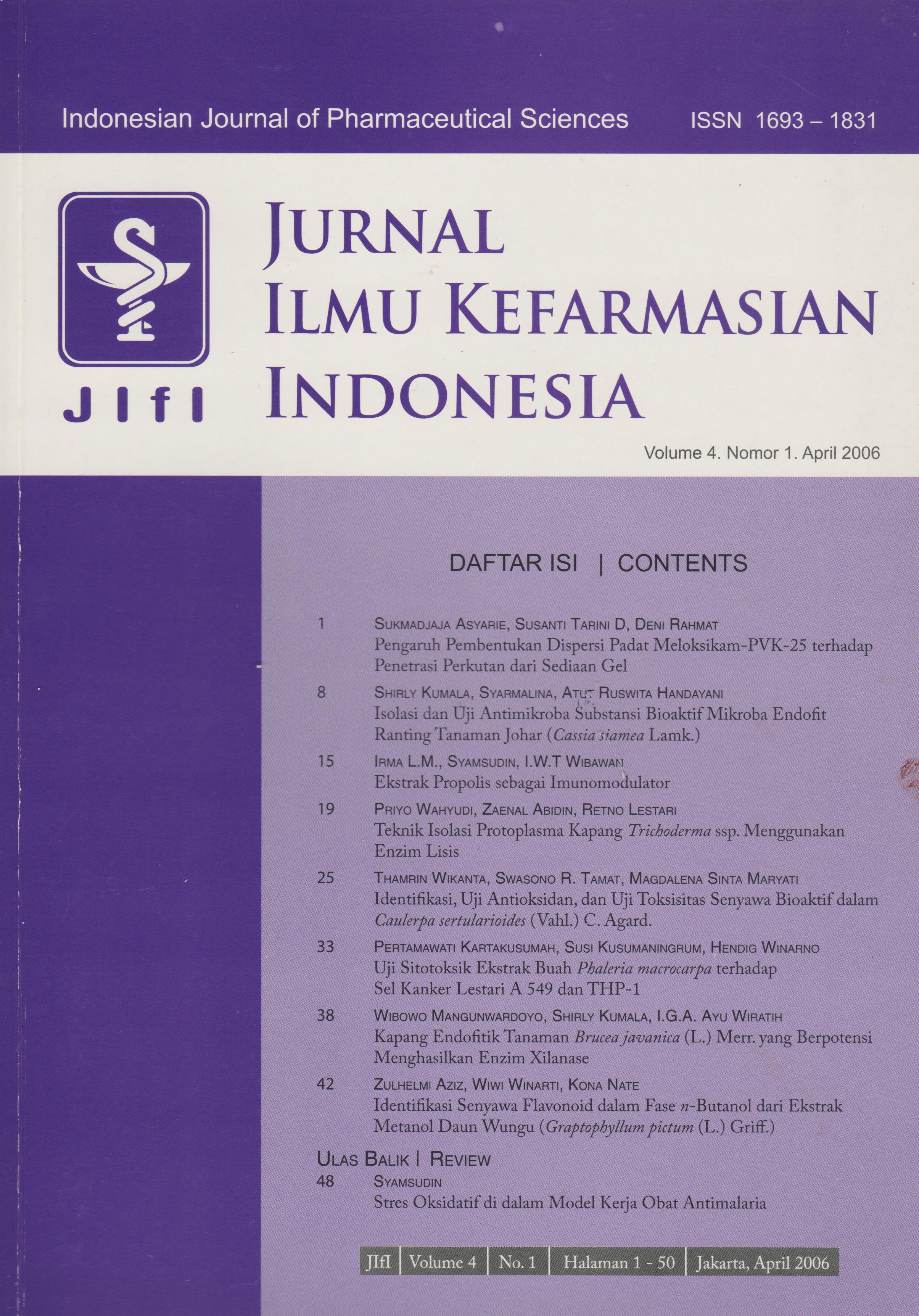
Pengaruh Pembentukan Dispersi Padat Meloksikam - PVP K-25 terhadap Penetrasi Perkutan dari Sediaan Gel
Kata Kunci:
meloxicam, PVP-K-25, solid dispersion, gelAbstrak
Most drugs are weak acids or bases and have a low water solubility. Ionized molecules are generally in small amounts absorbed by biological membranes. One possibility of drug modification for transport through biological membranes is by solid disperse system which enhances drug solubility. The solubility of drugs in such a system increases due to particle size reduction and transformation of its crystalline form. In this study, the dispersion system was used to increase the solubility of meloxicam which can influence the percutaneous permeation. Solid dispersion was prepared by modified solvent method using various ratios of PVP K-25 and was also able to lower the meloxicam melting point. Solid dispersion of meloxicam-PVP-K-25 (1:5) was characterized by infrared absorption spectroscopy, differential scanning calorimetry, X-ray diffraction analysis, and thin layer chromatography. Percutaneous penetration was studied by using a flow-through diffusion cell system, and besides that showed a lower diffusion rate of solid dispersion of meloxicam-PVP-K-25 compared to meloxicam.
Referensi
Unduhan
Diterbitkan
Terbitan
Bagian
Lisensi
Licencing
All articles in Jurnal Ilmu Kefarmasian Indonesia are an open-access article, distributed under the terms of the Creative Commons Attribution-NonCommercial-ShareAlike 4.0 International License which permits unrestricted non-commercial used, distribution and reproduction in any medium.
This licence applies to Author(s) and Public Reader means that the users mays :
- SHARE:
copy and redistribute the article in any medium or format - ADAPT:
remix, transform, and build upon the article (eg.: to produce a new research work and, possibly, a new publication) - ALIKE:
If you remix, transform, or build upon the article, you must distribute your contributions under the same license as the original. - NO ADDITIONAL RESTRICTIONS:
You may not apply legal terms or technological measures that legally restrict others from doing anything the license permits.
It does however mean that when you use it you must:
- ATTRIBUTION: You must give appropriate credit to both the Author(s) and the journal, provide a link to the license, and indicate if changes were made. You may do so in any reasonable manner, but not in any way that suggests the licensor endorses you or your use.
You may not:
- NONCOMMERCIAL: You may not use the article for commercial purposes.

This work is licensed under a Creative Commons Attribution-NonCommercial-ShareAlike 4.0 International License.