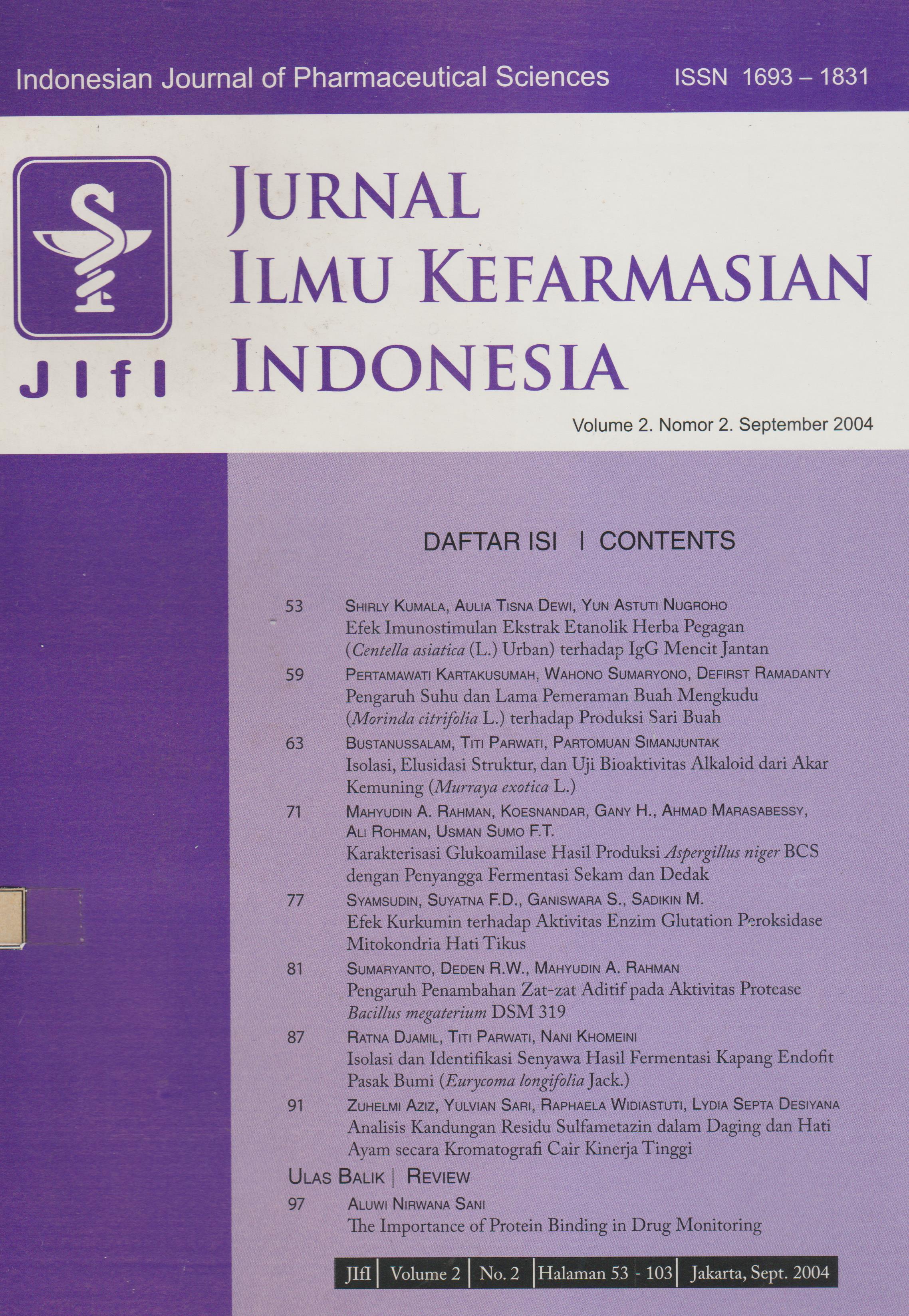
Analisis Kandungan Residu Sulfametazin dalam Daging dan Hati Ayam secara Kromatografi Cair Kinerja Tinggi
Keywords:
Sulfamethazine, broiler chicken, HPLCAbstract
Sulfamethazine is an antimicrobial and anticoccidiocis which usually used in poultry farm. The using of sulfamethazine to cattle has an accumulated residue effect on cattle products. An experiment of the decreasing motive of sulfamethazine residue concentration in chicken meat and liver has been carried out. One day old broiler chicken classified into 4 groups which are negative control, the positive control, the 7 days (7 days before the slaughtering day which on 36th day), and 5 days group (5 days before the slaughtering day which on 36th day). The last three groups are given sulfamethazine solution in oral 3 times a week with 0.2 ml/kg BW or 50 mg/kg BW dosage. After the giving of sulfamethazine stopped, each of those 4 groups slaughtered on 1st, 2nd, 3rd, 4th, 5th, 7th, 24th, 48th, 120th, 168th, 240th hour and then each of chicken meat and liver extracted and analyzed with high performance liquid chromatography (HPLC). The Sulfamethazine residue decreasing along with the increasing of time can be noticed from the experiment. In common, the decreasing of Sulfamethazine can be seen starting form 24th hour, then at 48th hour the sulfamethazine concentration stay at lower state and decrease along with the increasing of time.
References
Downloads
Issue
Section
License
Licencing
All articles in Jurnal Ilmu Kefarmasian Indonesia are an open-access article, distributed under the terms of the Creative Commons Attribution-NonCommercial-ShareAlike 4.0 International License which permits unrestricted non-commercial used, distribution and reproduction in any medium.
This licence applies to Author(s) and Public Reader means that the users mays :
- SHARE:
copy and redistribute the article in any medium or format - ADAPT:
remix, transform, and build upon the article (eg.: to produce a new research work and, possibly, a new publication) - ALIKE:
If you remix, transform, or build upon the article, you must distribute your contributions under the same license as the original. - NO ADDITIONAL RESTRICTIONS:
You may not apply legal terms or technological measures that legally restrict others from doing anything the license permits.
It does however mean that when you use it you must:
- ATTRIBUTION: You must give appropriate credit to both the Author(s) and the journal, provide a link to the license, and indicate if changes were made. You may do so in any reasonable manner, but not in any way that suggests the licensor endorses you or your use.
You may not:
- NONCOMMERCIAL: You may not use the article for commercial purposes.

This work is licensed under a Creative Commons Attribution-NonCommercial-ShareAlike 4.0 International License.