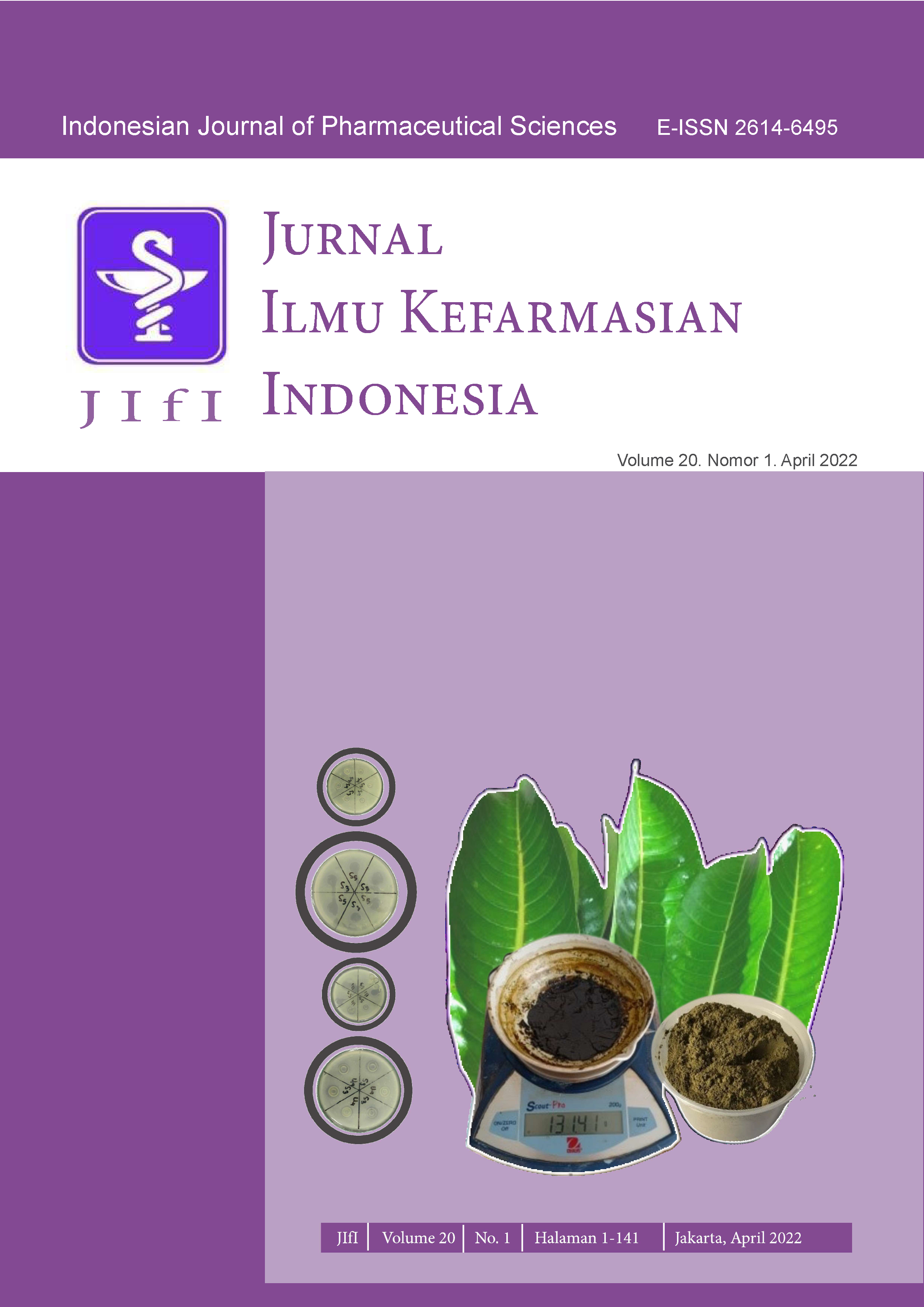
Effectivity Gel of Colocasia Esculenta (L.) Stalk for the Burn Wound Healing in Male White Rats
DOI:
https://doi.org/10.35814/jifi.v20i1.1154Keywords:
Gel, burn wound, Colocasia stalkAbstract
The stalk of Colocasia esculenta (L.) plant contains flavonoids and saponins. Flavonoids presented effects in respect of the inflammatory process, re-epithelialization and oxidative stress. Saponin not only promotes re-epithelialization of the wound but also effectively inhibits inflammatory reactions during the early phase, and promotes matrix synthesis throughout the wound healing process. So that the content of metabolites in Colocasia stalks is thought to be able to play a role in the healing process of burns, especially wounds with complications of infection. One of the topical dosage forms to treat burns is a gel dosage form. This study aimed to make and determine the effectiveness of gel of Colocasia stalk extract in healing infected burns in white male rats. The test animals were divided into five groups, each consisting of 5 rats. The groups given the gel were F1 (1% w/w), F2 (3% w/w), F3 (5% w/w). While the positive control group was given (Bioplacenton®) and the negative control group (gel base). The gel was given once a day, and the method used was the Morton method. Observations included evaluation of gel quality, decrease in wound diameter, and epithelialization time. The results showed that gel of Colocasia stalk extract (1%, 3%, and 5% w/w) had a good quality and significantly wound infected burns (p<0.05). The decrease in wound diameter and epithelialization time had a value (p<0.05) compared to the negative control group. The healing effect of burns depends on the concentration of the dried extract of Colocasia stalk in the gel preparation. Extract concentration of 5% w/w (F3) has the most effective percentage of burn wound healing for 13 days.
References
Downloads
Published
Issue
Section
License
Licencing
All articles in Jurnal Ilmu Kefarmasian Indonesia are an open-access article, distributed under the terms of the Creative Commons Attribution-NonCommercial-ShareAlike 4.0 International License which permits unrestricted non-commercial used, distribution and reproduction in any medium.
This licence applies to Author(s) and Public Reader means that the users mays :
- SHARE:
copy and redistribute the article in any medium or format - ADAPT:
remix, transform, and build upon the article (eg.: to produce a new research work and, possibly, a new publication) - ALIKE:
If you remix, transform, or build upon the article, you must distribute your contributions under the same license as the original. - NO ADDITIONAL RESTRICTIONS:
You may not apply legal terms or technological measures that legally restrict others from doing anything the license permits.
It does however mean that when you use it you must:
- ATTRIBUTION: You must give appropriate credit to both the Author(s) and the journal, provide a link to the license, and indicate if changes were made. You may do so in any reasonable manner, but not in any way that suggests the licensor endorses you or your use.
You may not:
- NONCOMMERCIAL: You may not use the article for commercial purposes.

This work is licensed under a Creative Commons Attribution-NonCommercial-ShareAlike 4.0 International License.