The Quality and Potency of Several Antibiotic Caplets/ Tablets/Capsules of e-Catalogue 2017, Their Substitutes and Originators
DOI:
https://doi.org/10.35814/jifi.v20i1.1208Keywords:
drug quality, antibiotic potency, e-Catalogue, cefadroxil, ciprofloxacin, tetracyclineAbstract
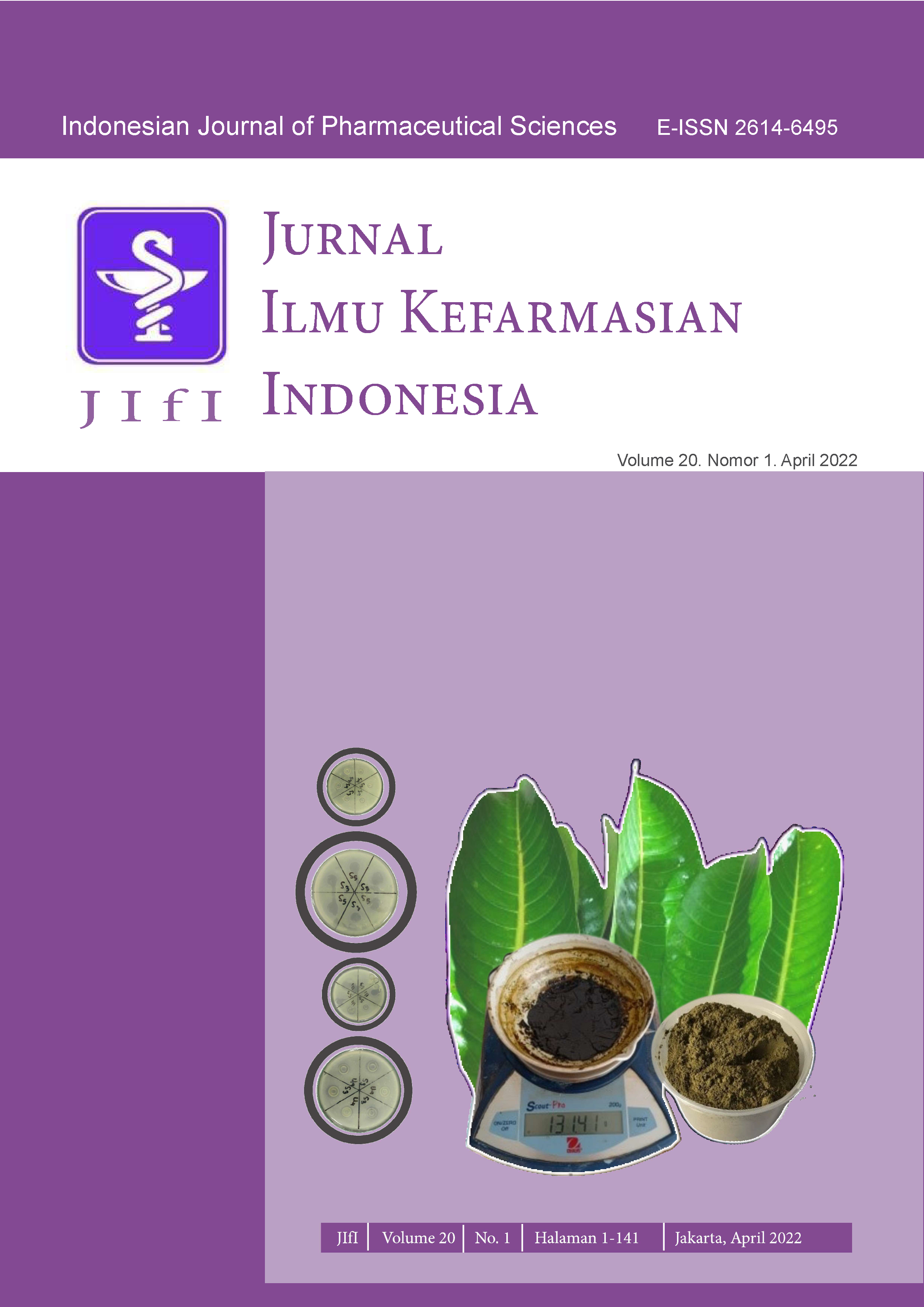
The price of drugs that win the e-Catalogue tender has long been considered too low by some pharmaceutical companies, and some even below their production cost. On the other hand, the fact that only pharmaceutical products with BPOM distribution licenses are eligible for the price tender, the quality of such e-Catalogue winners should not be of concern. This study aimed to evaluate the quality of several items of antibiotic products, an important drug category that can cause serious impacts if its quality is compromised. Samples used in the study were product items with the highest demands: Amoxicillin 500 mg, tetracycline 500 mg, cefadroxil 500 mg, and ciprofloxacin 500mg listed in the e-Catalogue 2017 as well as their generic and branded generic (OND) alternatives, and its respective originators. The quality parameters of the samples were evaluated according to the Indonesian Pharmacopoeia 5th Edition (FI-V). Antibiotic potency assays were conducted by using the Plate-Cylinder Method with S. aureus ATCC 25922 and E. coli ATCC 6538 as the testing bacteria. The results showed that all samples met the FI-V requirements on antibiotic content, weight uniformity, disintegration time, and dissolution. However, antibiotic potency of the e-Catalogue 2017 winners tend to be lower than their generic and OND alternatives as well as their respective originators, with a wide disparity: 10.3–18.2 percentage points, or a relative disparity of 12.0–26.4%, except for amoxicillin 500 mg caplet, in the assays using S. aureus. In conclusion, tetracycline 500 mg, cefadroxil 500mg, and ciprofloxacin 500 mg caplets/tablets/capsules listed in the e-Catalogue 2017 contain active pharmaceutical ingredients of lower qualities than their more expensive alternatives
References
Downloads
Published
Issue
Section
License
Licencing
All articles in Jurnal Ilmu Kefarmasian Indonesia are an open-access article, distributed under the terms of the Creative Commons Attribution-NonCommercial-ShareAlike 4.0 International License which permits unrestricted non-commercial used, distribution and reproduction in any medium.
This licence applies to Author(s) and Public Reader means that the users mays :
- SHARE:
copy and redistribute the article in any medium or format - ADAPT:
remix, transform, and build upon the article (eg.: to produce a new research work and, possibly, a new publication) - ALIKE:
If you remix, transform, or build upon the article, you must distribute your contributions under the same license as the original. - NO ADDITIONAL RESTRICTIONS:
You may not apply legal terms or technological measures that legally restrict others from doing anything the license permits.
It does however mean that when you use it you must:
- ATTRIBUTION: You must give appropriate credit to both the Author(s) and the journal, provide a link to the license, and indicate if changes were made. You may do so in any reasonable manner, but not in any way that suggests the licensor endorses you or your use.
You may not:
- NONCOMMERCIAL: You may not use the article for commercial purposes.

This work is licensed under a Creative Commons Attribution-NonCommercial-ShareAlike 4.0 International License.