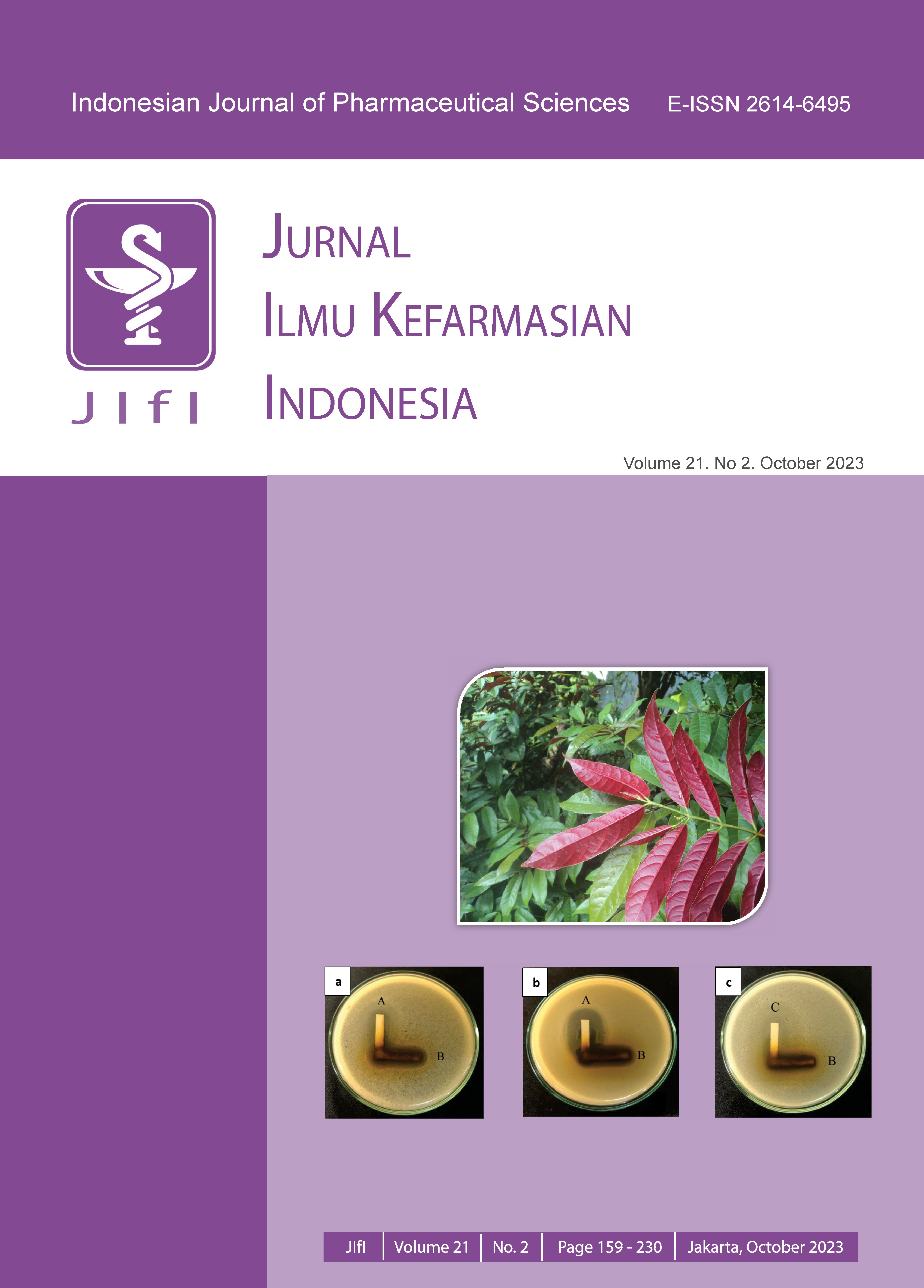
Stabilisation Potential of Cell Membrane from Different Polarity Extract of Sirih Bumi (Peperomia pellucida [L.] Kunth) as Anti-inflammatory Agent
DOI:
https://doi.org/10.35814/jifi.v21i2.1440Keywords:
Anti-inflammatory activity, cell membrane stability, dillapiol, Peperomia pellucidaAbstract
Sirih bumi (Peperomia pellucida [L.] Kunth.) is a medicinal herb. Anti-inflammatory activities are reported. These plant extracts have been shown to reduce inflammation in many studies, but it is unknown which extract works best. The objectives if this study were determine the extract that has the best anti-inflammatory activity from sirih bumi. The activity was assessed from the impact of stabilising red blood cell membranes in vitro. The research was then continued with a literature study on the chemical compounds containing the best extracts. To determine the prediction of the compound responsible for its activity and potency, several in silico tests were carried out, such as PASS online, Pre-ADMET online, and Protox II. The test results showed that the ethyl acetate extract at 200 g/mL concentration showed similar activity to aspirin at the same concentration. The activity of this extract increased with increasing concentration of the extract. Six compounds were reported to be isolated from this type of extract. Dillapiol and its derivative 6-allyl-5-methoxy-1,3-benzodioxol-4-ol are predicted to be compounds that have anti-inflammatory effects by inhibiting the membrane permeability mechanism of ethyl acetate extract. Ethyl acetate extract showed the best anti-inflammatory activity among the other type of extract from sirih bumi. Ethyl acetate extract is a type of extract with the best anti-inflammatory activity from sirih bumi.
References
Downloads
Published
Issue
Section
License
Licencing
All articles in Jurnal Ilmu Kefarmasian Indonesia are an open-access article, distributed under the terms of the Creative Commons Attribution-NonCommercial-ShareAlike 4.0 International License which permits unrestricted non-commercial used, distribution and reproduction in any medium.
This licence applies to Author(s) and Public Reader means that the users mays :
- SHARE:
copy and redistribute the article in any medium or format - ADAPT:
remix, transform, and build upon the article (eg.: to produce a new research work and, possibly, a new publication) - ALIKE:
If you remix, transform, or build upon the article, you must distribute your contributions under the same license as the original. - NO ADDITIONAL RESTRICTIONS:
You may not apply legal terms or technological measures that legally restrict others from doing anything the license permits.
It does however mean that when you use it you must:
- ATTRIBUTION: You must give appropriate credit to both the Author(s) and the journal, provide a link to the license, and indicate if changes were made. You may do so in any reasonable manner, but not in any way that suggests the licensor endorses you or your use.
You may not:
- NONCOMMERCIAL: You may not use the article for commercial purposes.

This work is licensed under a Creative Commons Attribution-NonCommercial-ShareAlike 4.0 International License.