Cosmos caudatus Kunth. Leaf Extract Herbal Nanosuspension Formulations, Characterization, and Cytotoxicity Approach Against MCF-7 Breast Cancer Cells
DOI:
https://doi.org/10.35814/jifi.v21i2.1481Keywords:
Cell toxicity, flavonoid, ionic gelation, nanotechnology, PVP K-30Abstract
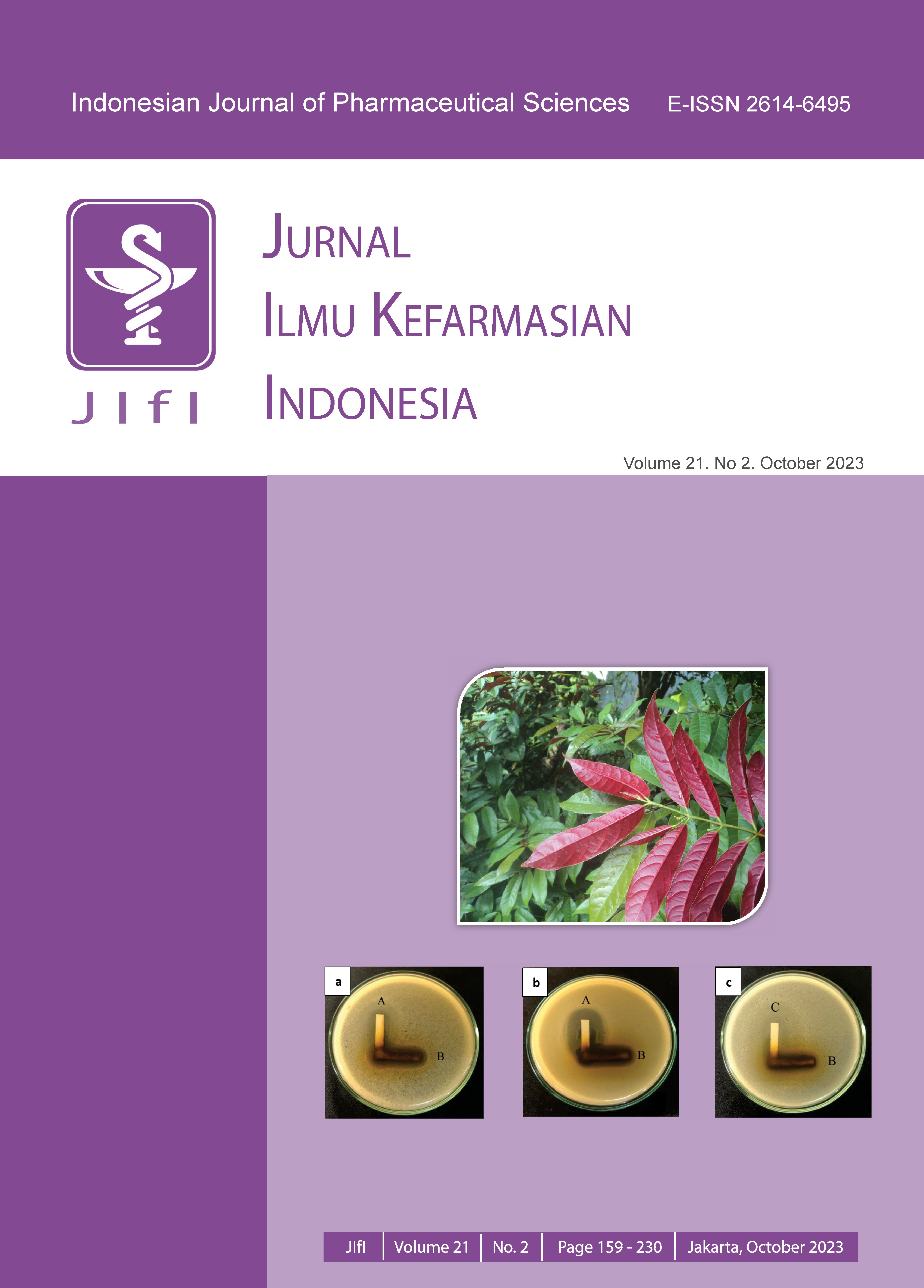
Kenikir leaves (Cosmos caudatus Kunth.) contain quercetin, which has anticancer properties. To provide more effective complementary therapy for breast cancer, nanotechnology was applied to develop preparations containing kenikir leaf extract. This research aimed to formulate a nanosuspension containing kenikir leaf extract with cytotoxic activity against MCF-7 breast cancer cells. Nanosuspension of kenikir leaf extract was prepared using the ionic gelation method with 3%, 4%, and 5% PVP K-30 stabilizer. The nanosuspension formula with the highest entrapment efficiency was further characterised, including particle size, polydispersity index (PDI), zeta potential, pH, and particle morphology. Cytotoxic activity was tested against MCF-7 cells by the MTT assay. The results showed that the formula with 5% PVP has the highest entrapment efficiency value of 85.04±0.08%, a particle size of 221.9 nm, a PDI of 0.211, a zeta potential of -21.7 mV, a pH of 4.08±0.0, and a spherical morphology. The kenikir leaf extract at a concentration of 1 mg/mL inhibited the proliferation of MCF-7 cells by 23.4% (p<0.05), whereas the nanosuspension at 10 μg/mL inhibited proliferation by 23.7%. It can be concluded that kenikir leaf extract can be formulated into a nanosuspension that meets the physical criteria and has cytotoxic activity against MCF-7 cells.
References
Downloads
Published
Issue
Section
License
Licencing
All articles in Jurnal Ilmu Kefarmasian Indonesia are an open-access article, distributed under the terms of the Creative Commons Attribution-NonCommercial-ShareAlike 4.0 International License which permits unrestricted non-commercial used, distribution and reproduction in any medium.
This licence applies to Author(s) and Public Reader means that the users mays :
- SHARE:
copy and redistribute the article in any medium or format - ADAPT:
remix, transform, and build upon the article (eg.: to produce a new research work and, possibly, a new publication) - ALIKE:
If you remix, transform, or build upon the article, you must distribute your contributions under the same license as the original. - NO ADDITIONAL RESTRICTIONS:
You may not apply legal terms or technological measures that legally restrict others from doing anything the license permits.
It does however mean that when you use it you must:
- ATTRIBUTION: You must give appropriate credit to both the Author(s) and the journal, provide a link to the license, and indicate if changes were made. You may do so in any reasonable manner, but not in any way that suggests the licensor endorses you or your use.
You may not:
- NONCOMMERCIAL: You may not use the article for commercial purposes.

This work is licensed under a Creative Commons Attribution-NonCommercial-ShareAlike 4.0 International License.