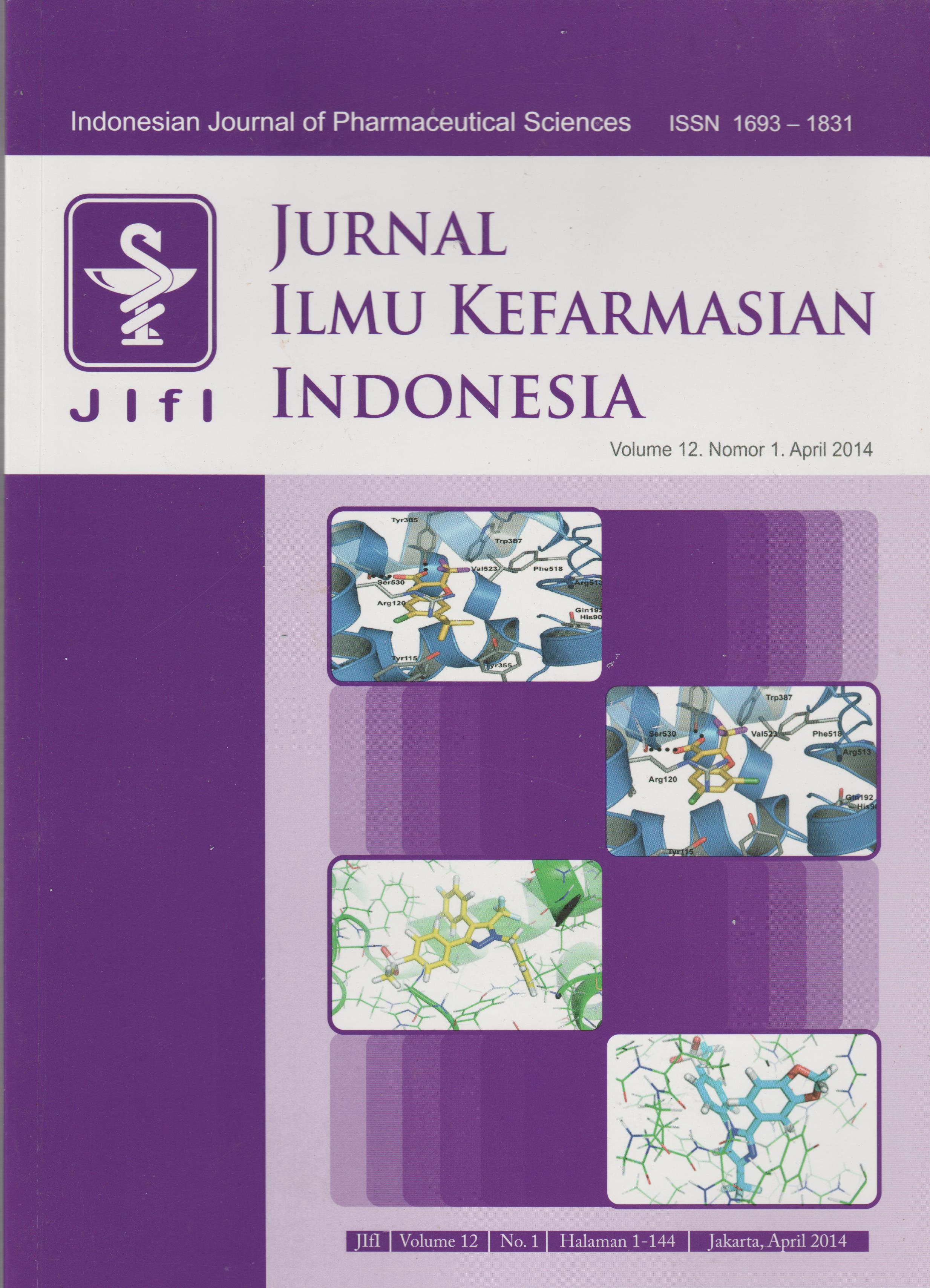
Solubility Enhancement of Andrographolide on Ethyl Acetate Fraction Sambiloto Herbs (Andrographis paniculata Nees) by Microencapsulation Using Spray Drying Methode
Keywords:
Andrographolide, PVP K30, HPMC, spray drying, dissolution rateAbstract
Sambiloto (Andrographis paniculata Nees) is one of a medicinal plants containing andrographolide as its primary bioactive component, which is able to inhibit breast cancer cell proliferation. Andrographolide is a diterpene lacton that is sparingly soluble in water. The aim of this study is to improve the solubility of andrographolide in A. paniculata herbs ethyl acetate fraction by microencapsulation method prepared using spray drying. The ethyl acetate fraction of A.paniculata herbs was microencapsulated using PVP K30 and HPMC as the coating polymer in different ratios of ethyl acetat fraction and polymer (1:5; 1:7,5 and 1:10). Microspheres containing ethyl acetate fraction of A.paniculata herbs were evaluated their saturation solubility and in vitro dissolution in aquadest, pH 6.8 phosphate and pH 1.2 chloride medium. The result showed that the microencapsulation could increase the saturation solubility and dissolution rate of andrographolide as compared to the ethyl acetate fraction and andrographolide standard. Compared to the solubility of andrographolide from A. paniculata ethyl acetate fraction, the solubility of andrographolide on ethyl acetate fraction microspheres in aquadest, pH 6.8 phosphate and pH 1.2 chloride medium were increased approximately 23.42-39.34, 19.92-34.83 and 24.56-38.25 folds respectively. Moreover, compared to the solubility of andrographolide standard, the solubility of andrographolide on ethyl acetate fraction microspheres in aquadest, pH 6.8 phosphate and pH 1.2 chloride medium were increased approximately 16.99-28.53, 19.76-34.54 and 17.26-26.87 folds respectively.
References
Downloads
Published
Issue
Section
License
Licencing
All articles in Jurnal Ilmu Kefarmasian Indonesia are an open-access article, distributed under the terms of the Creative Commons Attribution-NonCommercial-ShareAlike 4.0 International License which permits unrestricted non-commercial used, distribution and reproduction in any medium.
This licence applies to Author(s) and Public Reader means that the users mays :
- SHARE:
copy and redistribute the article in any medium or format - ADAPT:
remix, transform, and build upon the article (eg.: to produce a new research work and, possibly, a new publication) - ALIKE:
If you remix, transform, or build upon the article, you must distribute your contributions under the same license as the original. - NO ADDITIONAL RESTRICTIONS:
You may not apply legal terms or technological measures that legally restrict others from doing anything the license permits.
It does however mean that when you use it you must:
- ATTRIBUTION: You must give appropriate credit to both the Author(s) and the journal, provide a link to the license, and indicate if changes were made. You may do so in any reasonable manner, but not in any way that suggests the licensor endorses you or your use.
You may not:
- NONCOMMERCIAL: You may not use the article for commercial purposes.

This work is licensed under a Creative Commons Attribution-NonCommercial-ShareAlike 4.0 International License.