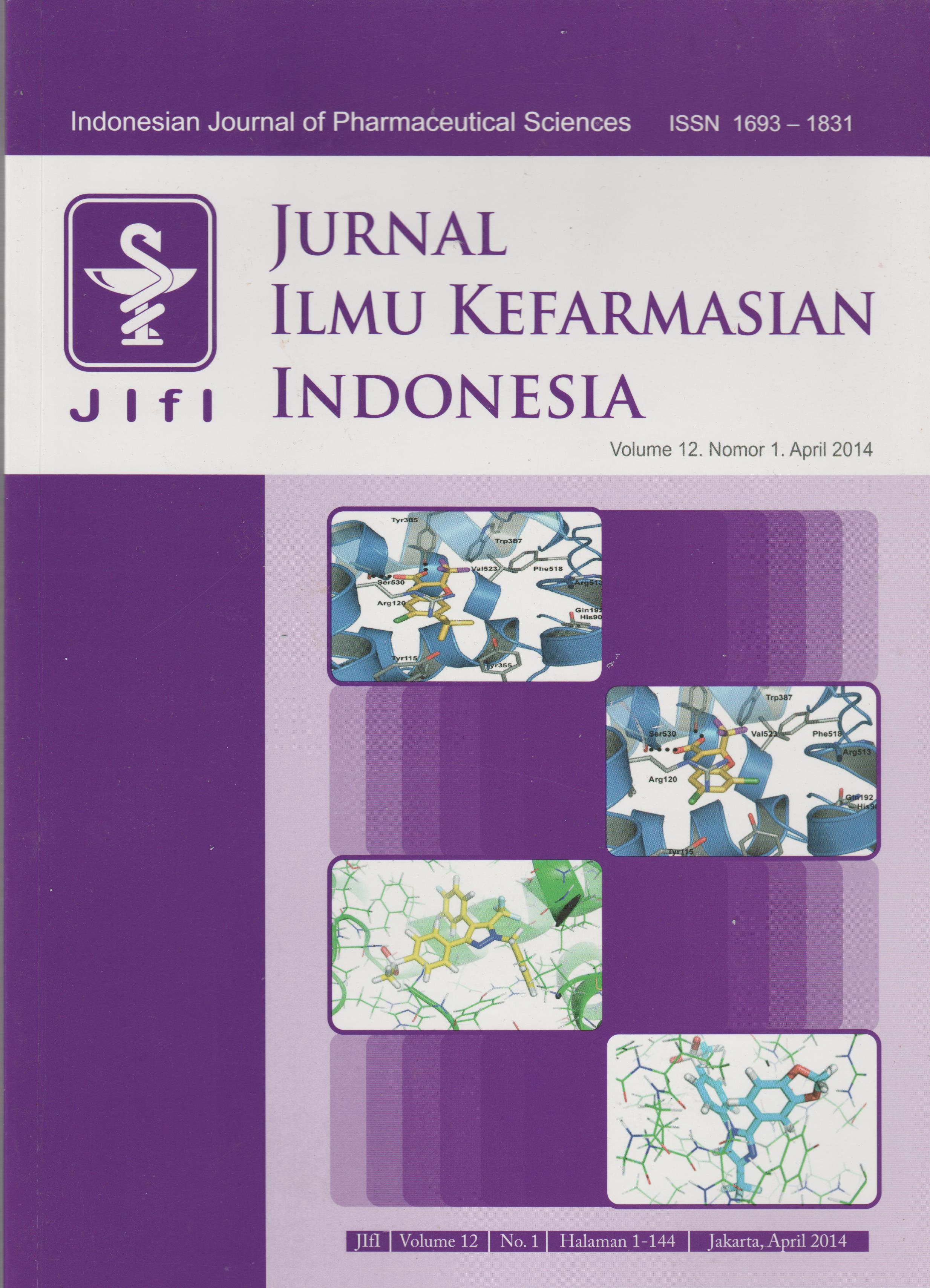
Construction and Validation of Virtual Screening Based on Code Structure of PDB3MQE, 3NTG, and 3LN0 To Discover Cyclooxygenase Inhibitor-2 (COX-2)
Keywords:
protocols, virtual screening, inhibitor, COX-2Abstract
Cyclooxygenase-2 (COX-2) inhibitors are high demand drugs in the market. However, available COX-2 inhibitors nowadays have many side effects. Therefore, there is still a need to develop more potent selective COX-2 inhibitors and one of the method that has been prove the effectivity and eficiency for new drugs research is in silico. Structure-based virtual screening (SBVS) protocols were developed to find COX-2 inhibitors using the Protein-Ligand ANT System (PLANTS) docking software, SPORES, BKChem and Open Babel. The directory of useful decoys (DUD) dataset for COX-2 was used to validate the protocols retrospectively; the DUD consist of 426 known COX-2 inhibitors and 13289 decoys. Based on criteria value of EF20% and EFmax used in the article from Huang et al (2006) and Yuniarti et al (2011), two validated protocol, AYO_COX2_v.1.1 and AYO_COX2_v.1.2 , showed good results
References
Downloads
Published
Issue
Section
License
Licencing
All articles in Jurnal Ilmu Kefarmasian Indonesia are an open-access article, distributed under the terms of the Creative Commons Attribution-NonCommercial-ShareAlike 4.0 International License which permits unrestricted non-commercial used, distribution and reproduction in any medium.
This licence applies to Author(s) and Public Reader means that the users mays :
- SHARE:
copy and redistribute the article in any medium or format - ADAPT:
remix, transform, and build upon the article (eg.: to produce a new research work and, possibly, a new publication) - ALIKE:
If you remix, transform, or build upon the article, you must distribute your contributions under the same license as the original. - NO ADDITIONAL RESTRICTIONS:
You may not apply legal terms or technological measures that legally restrict others from doing anything the license permits.
It does however mean that when you use it you must:
- ATTRIBUTION: You must give appropriate credit to both the Author(s) and the journal, provide a link to the license, and indicate if changes were made. You may do so in any reasonable manner, but not in any way that suggests the licensor endorses you or your use.
You may not:
- NONCOMMERCIAL: You may not use the article for commercial purposes.

This work is licensed under a Creative Commons Attribution-NonCommercial-ShareAlike 4.0 International License.