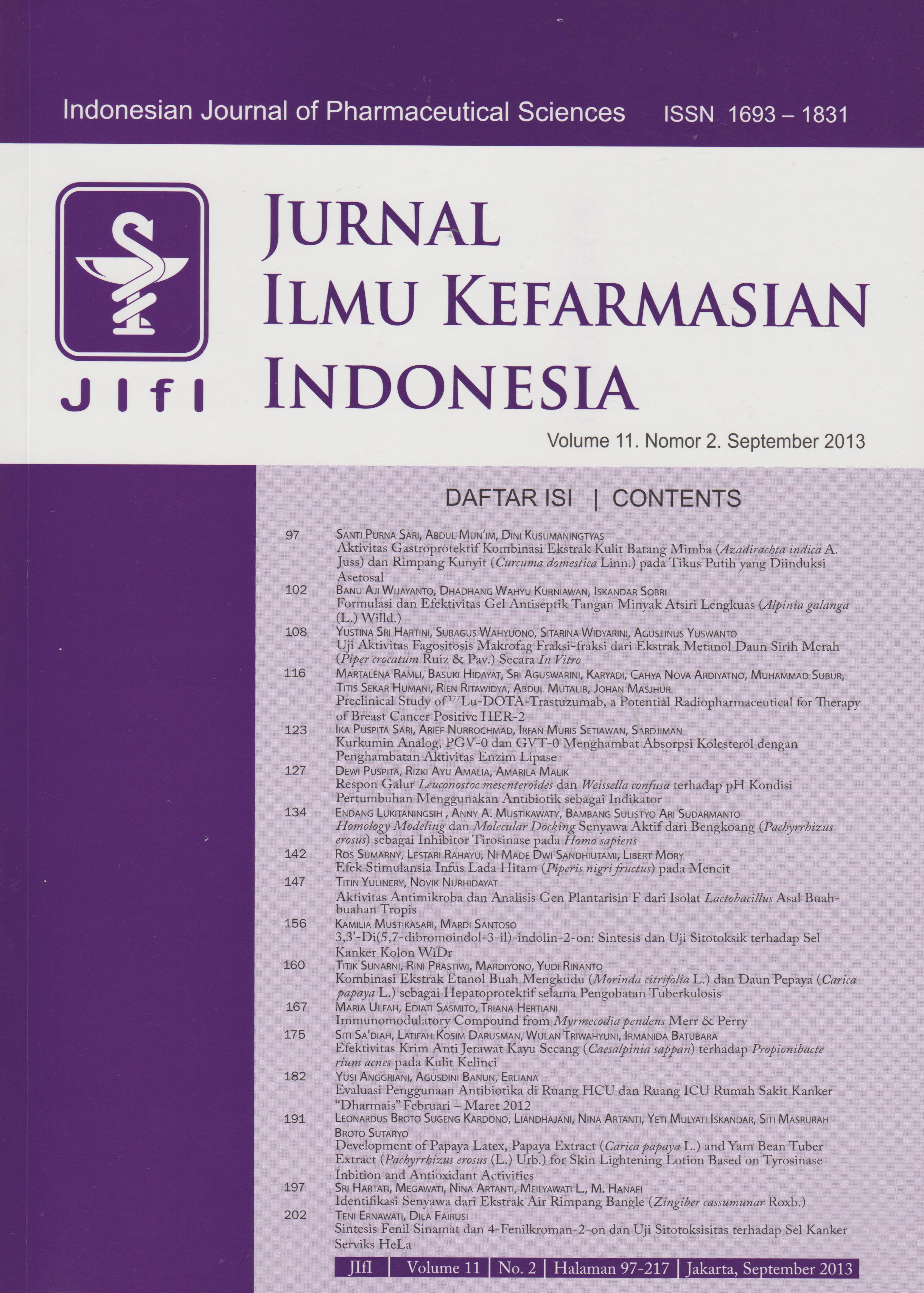
Preclinical Study of 177Lu-DOTA-Trastuzumab: A Potential Radiopharmaceutical for Therapy of Breast Cancer Positive HER-2
Keywords:
breast cancer, 177Lu-DOTA-trastuzumab, preclinical, radiolabelled Anti-HER-2 monoclonal antibodyAbstract
Radiopharmaceutical 177Lu-(1,4,7,10-tetraazacyclododecane-N,N’,Nâ€,Nâ€â€™-tetra acetic acid)-trastuzumab (177Lu-DOTA-trastuzumab), based on antihuman epithelial receptor type 2 (HER-2) monoclonal antibody which is expected to be potential for diagnostic and therapeutic agent of breast cancer positive HER-2, had been successfully prepared with radiochemical purity of > 99%. Preclinical studies aimed in providing basic data for clinical trial and particularly in finding out the effectiveness of 177Lu-DOTA-trastuzumab in killing cancer cells which over express HER-2, have been performed. The data included urine and faeces clearance tests, imaging with gamma camera and cytotoxicity test. The results showed that the excretion of radioactivity post injection of 177Lu-DOTA-trastuzumab in normal rats were more rapid through urine as compared to the excretion through faeces. The gamma camera image on normal rat 144 hours post injection of 177Lu-DOTA-trastuzumab showed that there was remaining a trace of radioactivity in hepatic area. The residue of radioactivity (< 5%, quantified by biodistribution test) was found to be relatively lower than reported for 111In-NSL-trastuzumab. However, this residue of radioactivity has to be seriously considered when 177Lu-DOTA-trastuzumab is going to be applied for treatment of cancer. Cytotoxicity test showed that 177Lu-DOTA-trastuzumab was far more effective in killing cancer cells positive HER-2 (SKOV-3 cell lines) than that of trastuzumab.
References
Downloads
Published
Issue
Section
License
Licencing
All articles in Jurnal Ilmu Kefarmasian Indonesia are an open-access article, distributed under the terms of the Creative Commons Attribution-NonCommercial-ShareAlike 4.0 International License which permits unrestricted non-commercial used, distribution and reproduction in any medium.
This licence applies to Author(s) and Public Reader means that the users mays :
- SHARE:
copy and redistribute the article in any medium or format - ADAPT:
remix, transform, and build upon the article (eg.: to produce a new research work and, possibly, a new publication) - ALIKE:
If you remix, transform, or build upon the article, you must distribute your contributions under the same license as the original. - NO ADDITIONAL RESTRICTIONS:
You may not apply legal terms or technological measures that legally restrict others from doing anything the license permits.
It does however mean that when you use it you must:
- ATTRIBUTION: You must give appropriate credit to both the Author(s) and the journal, provide a link to the license, and indicate if changes were made. You may do so in any reasonable manner, but not in any way that suggests the licensor endorses you or your use.
You may not:
- NONCOMMERCIAL: You may not use the article for commercial purposes.

This work is licensed under a Creative Commons Attribution-NonCommercial-ShareAlike 4.0 International License.