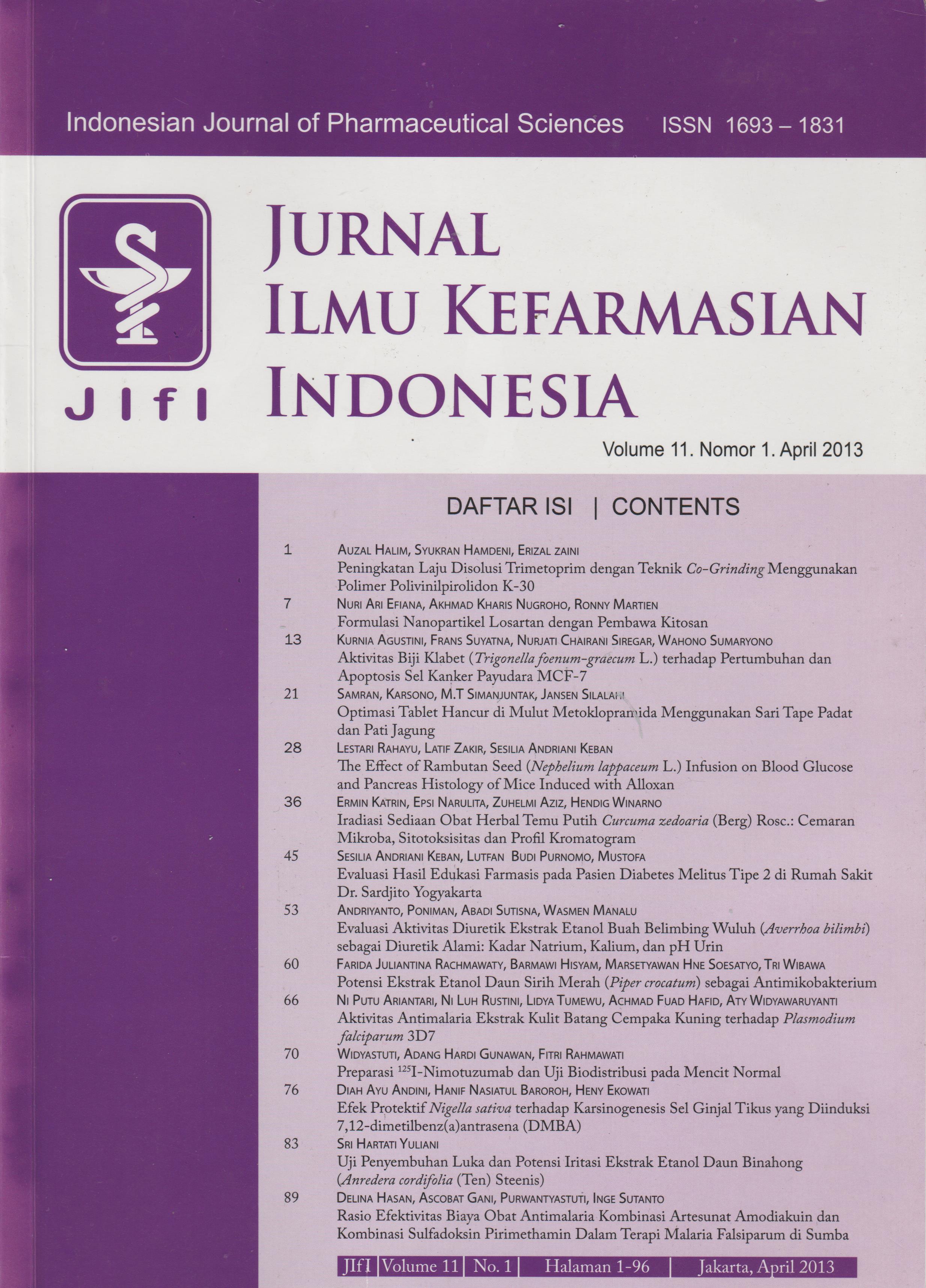
Irradiation of Herbal Medicine of White Turmeric Curcuma zedoaria (Berg.)Rosc.: Microbial Contamination, Cytotoxicity and Chromatogram Profile
Keywords:
Temu putih, Curcuma zedoaria (Berg) Rosc., irradiation, microbial contamination, cytotoxicity, chromatogramAbstract
Gamma irradiation has been used for preservation of herbal medicines, one of which is temu putih Curcuma zedoaria (Berg) Rosc. to cure cervical cancer. This research aimed to study the gamma irradiation effects on microbial contamination, cytotoxic activity against leukemia L1210 cell lines and chromatogram profile of the temu putih active fraction. Gamma irradiation was performed with a 60Co source at 5, 7.5, 10 and 15 kGy. After irradiation at > 7.5 kGy bacteria and mould were not present on herbs. Control and irradiated samples were consecutively macerated with n-hexane, ethyl acetate and ethanol. Ethyl acetate extract was the most cytotoxic gainst L1210 leukemia cells with an IC50 value of 10.60 μg/mL as compared to n-hexane or ethanol extract. Ethyl acetate extract was fractionated with column chromatography producing six fractions. Fraction 2 was the most cytotoxic against L1210 leukemia cells with an IC50 value of 2.44 μg/mL. The thin-layer chromatographic analysis results of ethyl acetate extract and fraction 2 of control and irradiated samples showed the presence of curcumin and chromatographic pattern similar to the control. Curcumin contents in fraction 2 were between 35 to 51%, which were not significantly changed between samples, although was irradiated up to 15 kGy. The maximum dose for irradiation of temu putih herbal preparation is 15kGy.
References
Downloads
Published
Issue
Section
License
Licencing
All articles in Jurnal Ilmu Kefarmasian Indonesia are an open-access article, distributed under the terms of the Creative Commons Attribution-NonCommercial-ShareAlike 4.0 International License which permits unrestricted non-commercial used, distribution and reproduction in any medium.
This licence applies to Author(s) and Public Reader means that the users mays :
- SHARE:
copy and redistribute the article in any medium or format - ADAPT:
remix, transform, and build upon the article (eg.: to produce a new research work and, possibly, a new publication) - ALIKE:
If you remix, transform, or build upon the article, you must distribute your contributions under the same license as the original. - NO ADDITIONAL RESTRICTIONS:
You may not apply legal terms or technological measures that legally restrict others from doing anything the license permits.
It does however mean that when you use it you must:
- ATTRIBUTION: You must give appropriate credit to both the Author(s) and the journal, provide a link to the license, and indicate if changes were made. You may do so in any reasonable manner, but not in any way that suggests the licensor endorses you or your use.
You may not:
- NONCOMMERCIAL: You may not use the article for commercial purposes.

This work is licensed under a Creative Commons Attribution-NonCommercial-ShareAlike 4.0 International License.