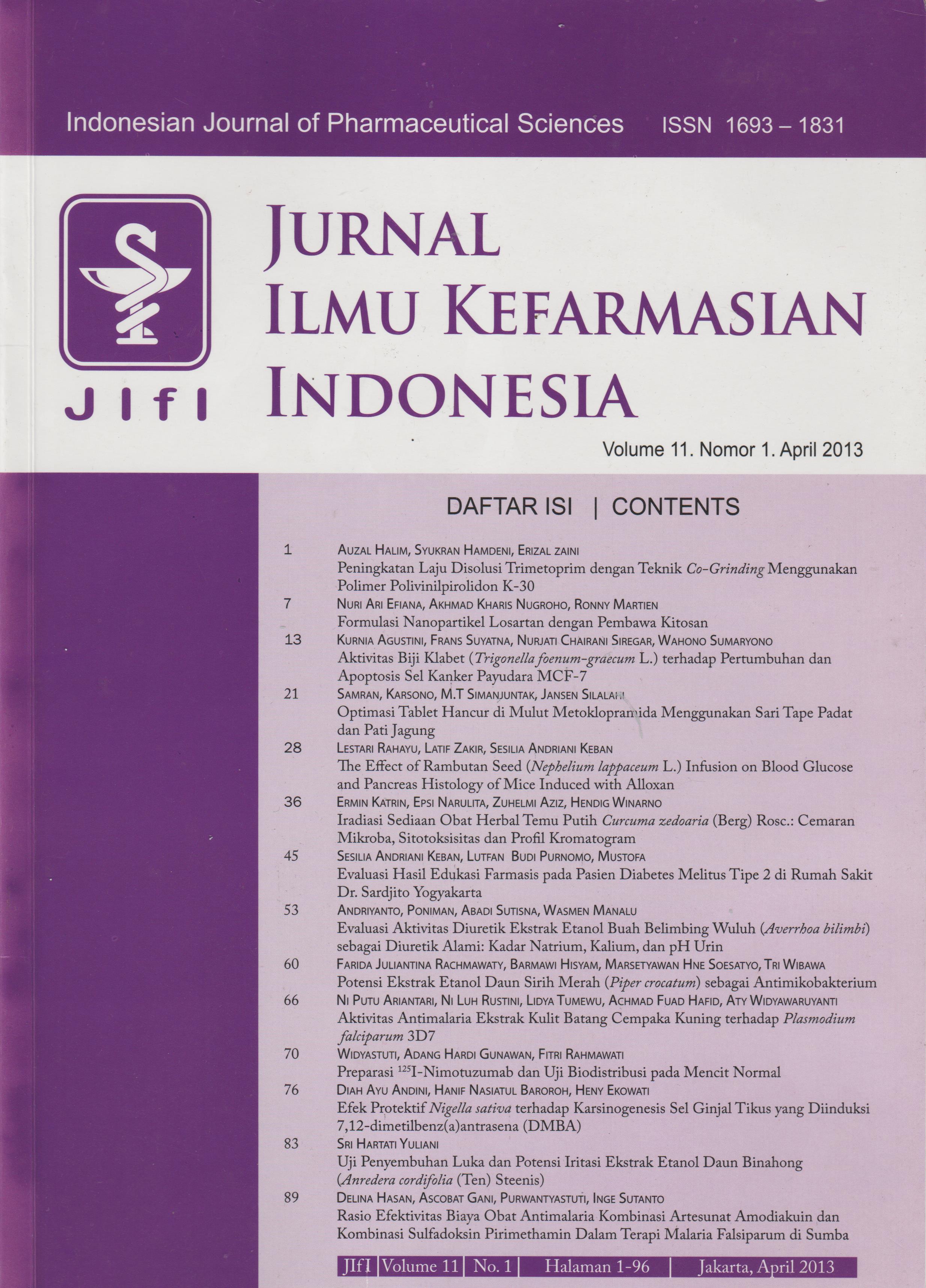
Potential of Ethanolic Extract from Leaf of Red Betel Vine (Piper crocatum) as Antimicrobacterium
Keywords:
Mycobacterium tuberculosis, antimycobacterium, red betel vine (Piper crocatum), ethanolic extractAbstract
: The incidence of tuberculosis in Indonesia is high. There is a tendency for some people to use herbs for the treatment of tuberculosis. This research aims to investigate the potency of antimycobacterium property of red betel Vine (Piper crocatum) ethanolic extract against Mycobacterium tuberculosis (M. tuberculosis). The red betel vine leaf was extracted using standard ethanol solvent. The extract was tested on Mycobacterium tuberculosis H3 7Rv. The experiment was conducted by using serial dilution method with 50%, 40%, 25%, 20%, 12.5%, 10%, and 6.25% red betel vine ethanolic extract in Middlebrook 7H9 medium and subseqently inoculated into Lowenstein Jensen (LJ) medium. The result was analyzed descriptively by observing the minimum bactericidal concentration (MBC). The experiment was repeated three times to obtain consistent result. There is no bacterial growth in LJ media at concentrations of 50%, 40%, 25%, 20%, 12.5%, and 10% of red betel vine ethanolic extract. The bacteria was able to grow only at the concentration of 6.25% red betel vine ethanolic extract. Thus the ethanolic extract of red betel vine (Piper crocatum) indicates an antimycobaterium activity against M. tuberculosis H37Rv. The MBC is found at the concentration of 10%.
References
Downloads
Published
Issue
Section
License
Licencing
All articles in Jurnal Ilmu Kefarmasian Indonesia are an open-access article, distributed under the terms of the Creative Commons Attribution-NonCommercial-ShareAlike 4.0 International License which permits unrestricted non-commercial used, distribution and reproduction in any medium.
This licence applies to Author(s) and Public Reader means that the users mays :
- SHARE:
copy and redistribute the article in any medium or format - ADAPT:
remix, transform, and build upon the article (eg.: to produce a new research work and, possibly, a new publication) - ALIKE:
If you remix, transform, or build upon the article, you must distribute your contributions under the same license as the original. - NO ADDITIONAL RESTRICTIONS:
You may not apply legal terms or technological measures that legally restrict others from doing anything the license permits.
It does however mean that when you use it you must:
- ATTRIBUTION: You must give appropriate credit to both the Author(s) and the journal, provide a link to the license, and indicate if changes were made. You may do so in any reasonable manner, but not in any way that suggests the licensor endorses you or your use.
You may not:
- NONCOMMERCIAL: You may not use the article for commercial purposes.

This work is licensed under a Creative Commons Attribution-NonCommercial-ShareAlike 4.0 International License.