
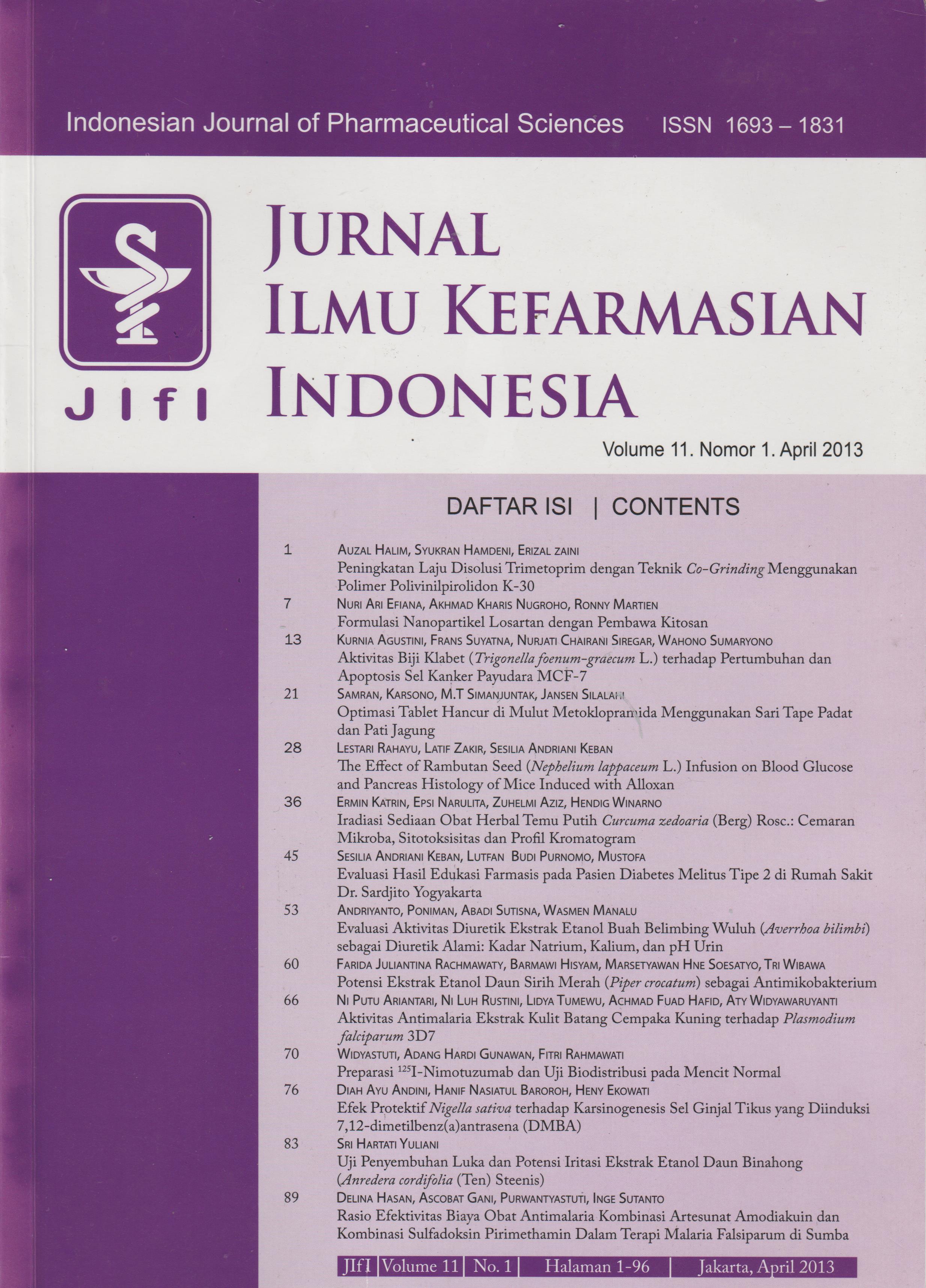
Wound Healing Evaluation and Irritation Potency of Binahong (Anredera cordifolia (Ten) Steenis) Ethanolic Extract
Keywords:
Anredera cordifolia (Ten) Steenis, wound healing, ethanolic extract, irritation potencyAbstract
Binahong (Anredera cordi olia (Ten) Steenis) has been used as wound healing in traditional Indonesian medicine. The aim of this study was to examine the wound healing activity and irritation potency of ethanolic extract of Anredera cordifolia (Ten) Steenis. Dry Binahong leaves were ground and screened with mesh no 40. Dry Binahong leaves were macerated with 10 times of volume of 96% ethanol for 90 minutes with constant agitation (200 rpm). It was screened and concentrated until the liquid would be a quarter. Then the extract was incorporated to gel base as 2,5%; 5%; 10% and 20%. Incision wound method was employed to activity test of wound healing. Male mice (strain Swiss), weight between 25 ~ 30 g, was used to this test. The male mice were classified into 7 groups i.e. negative control, control vehicle, positive control and 4 groups of sample. The extract then was assessed to irritation potency using HET-CAM method. Lactic acid was used as the positive control for irritation assessment. The result of this study stated that the highest activity of wound healing was shown by the sample containing 5% of ethanolic extract. The percentage activity of wound healing was 63,3%. Irritation appeared on the 10% and 20% ethanolic extract of binahong leaves.
References
Downloads
Published
Issue
Section
License
Licencing
All articles in Jurnal Ilmu Kefarmasian Indonesia are an open-access article, distributed under the terms of the Creative Commons Attribution-NonCommercial-ShareAlike 4.0 International License which permits unrestricted non-commercial used, distribution and reproduction in any medium.
This licence applies to Author(s) and Public Reader means that the users mays :
- SHARE:
copy and redistribute the article in any medium or format - ADAPT:
remix, transform, and build upon the article (eg.: to produce a new research work and, possibly, a new publication) - ALIKE:
If you remix, transform, or build upon the article, you must distribute your contributions under the same license as the original. - NO ADDITIONAL RESTRICTIONS:
You may not apply legal terms or technological measures that legally restrict others from doing anything the license permits.
It does however mean that when you use it you must:
- ATTRIBUTION: You must give appropriate credit to both the Author(s) and the journal, provide a link to the license, and indicate if changes were made. You may do so in any reasonable manner, but not in any way that suggests the licensor endorses you or your use.
You may not:
- NONCOMMERCIAL: You may not use the article for commercial purposes.

This work is licensed under a Creative Commons Attribution-NonCommercial-ShareAlike 4.0 International License.













