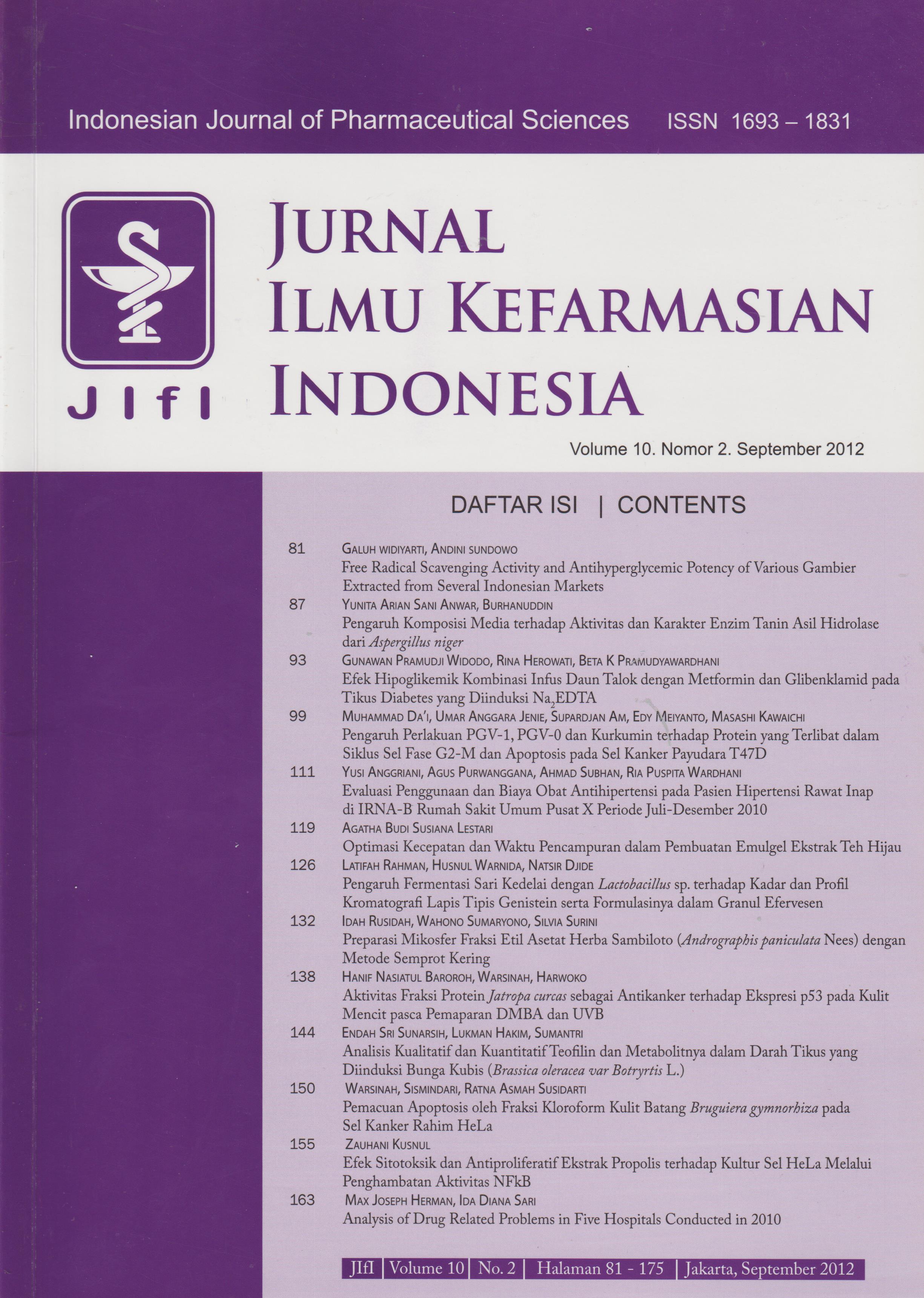
The Optimization of Mixing Rate and Mixing Time in the Formulation of Green Tea Extract Emulgel
Keywords:
green tea extract, mixing rate, among time, emulgel, factorial designAbstract
The aims of the research are to determine the Significant effect factor among mixmg rate, mixing time and their interaction on the physical properties and stability of green tea emulgel and to determine the optimum composition area which can produce good emulgel. In our previous investigation was determined the optimum composition between emulsifying agent (Tween 80 and Span 80) and gelling agent (Carbopol) This research determined the optimum mixing process, particularly on mixing rate and mixing time usig the factorial design with two factors (mixing rate and mixing time) and two levels (high level and low level). The physical properties and stability parameter investigated were including viscosity, spreading ability and viscosity shift atter storage at predetermined temperature and humidity for a month. The results showed that mixing rate Significantly influence on the viscosity and spreading ability and the mixing time significantly influence on the Viscosity shift. The optimum composttion area was not produced because the factorial design equation for viscosity respond and viscosity shin were not significant so can not be used to predict responds.
References
Downloads
Published
Issue
Section
License
Licencing
All articles in Jurnal Ilmu Kefarmasian Indonesia are an open-access article, distributed under the terms of the Creative Commons Attribution-NonCommercial-ShareAlike 4.0 International License which permits unrestricted non-commercial used, distribution and reproduction in any medium.
This licence applies to Author(s) and Public Reader means that the users mays :
- SHARE:
copy and redistribute the article in any medium or format - ADAPT:
remix, transform, and build upon the article (eg.: to produce a new research work and, possibly, a new publication) - ALIKE:
If you remix, transform, or build upon the article, you must distribute your contributions under the same license as the original. - NO ADDITIONAL RESTRICTIONS:
You may not apply legal terms or technological measures that legally restrict others from doing anything the license permits.
It does however mean that when you use it you must:
- ATTRIBUTION: You must give appropriate credit to both the Author(s) and the journal, provide a link to the license, and indicate if changes were made. You may do so in any reasonable manner, but not in any way that suggests the licensor endorses you or your use.
You may not:
- NONCOMMERCIAL: You may not use the article for commercial purposes.

This work is licensed under a Creative Commons Attribution-NonCommercial-ShareAlike 4.0 International License.