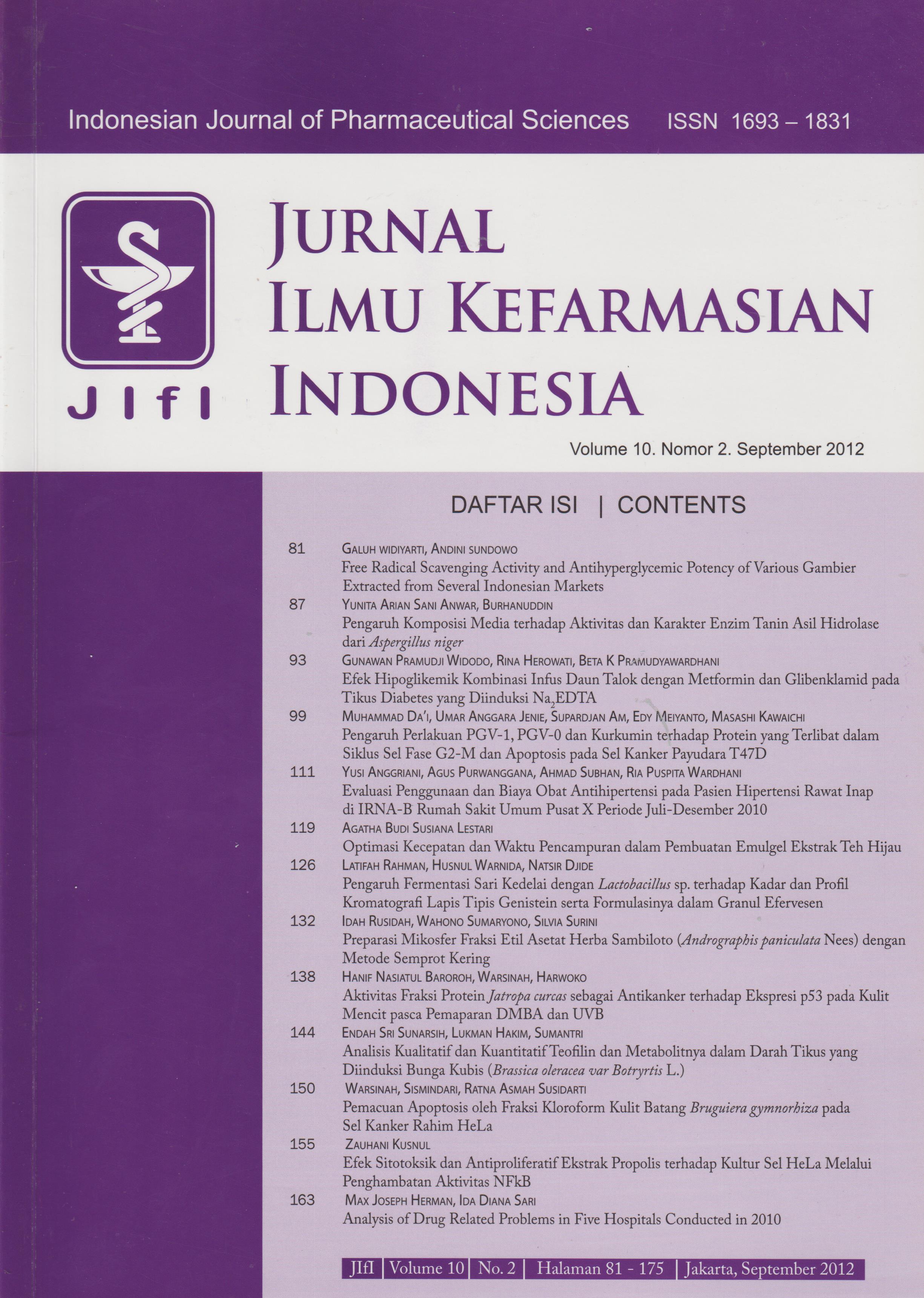
Influence of Soymilk Fermentation with Lactobacillus sp. on Thin Layer Chromatography Profile and Content of Genistein and its Formulation in Effervescent Granules
Keywords:
soybean milk, fermentation, genistein, TLC-profile, effervescent granules, Lactobacillus sp.Abstract
lsoflavones in soybean and unfermented soybean product are in glycoside form which could not be absorbed by the body and should be hydrolyzed before it is metabolized. Hydrolysis by bacteria producing β-glucosidase occur throughout the gastrointestinal tract. Probiotic microorganisms, like Lactobacillus and bfiidobacterium, have an endogenous enzyme , β-glucosidase that plays an important role in changing the profile of isoflavones during fermentation. The study was to investigate TLC profile and genestein content in fermented soybeanmilk and to formulate the freeze-dried fermented soybeanmilk into effervescent granules preparation. Soybeanmilk was fermented with Lactobacillus sp., and then freeze-dried. The soybeanmilk, before and after fermentation, were then extracted and analyzed by TLC-scanner. The freeze-dried fermented soymilk was prepared into four formulations of effervescent granules with variations in citric acid-tartaric acid ratio. Granules were prepared by the wet method and theirs physical characteristics were evaluated. Extracted granules were analyzed by TLC-scanner. Genistein content in the fermented soymilk has increased 145,32% as compared to the unfermented soymilk. All four effervescent granules have good physical characteristics except that the moisture content were above 0.7%. Formula containing citric acidtartaric acid ratio of (1 : 1) produced effervescent granules with the best physical characteristics.
References
Downloads
Published
Issue
Section
License
Licencing
All articles in Jurnal Ilmu Kefarmasian Indonesia are an open-access article, distributed under the terms of the Creative Commons Attribution-NonCommercial-ShareAlike 4.0 International License which permits unrestricted non-commercial used, distribution and reproduction in any medium.
This licence applies to Author(s) and Public Reader means that the users mays :
- SHARE:
copy and redistribute the article in any medium or format - ADAPT:
remix, transform, and build upon the article (eg.: to produce a new research work and, possibly, a new publication) - ALIKE:
If you remix, transform, or build upon the article, you must distribute your contributions under the same license as the original. - NO ADDITIONAL RESTRICTIONS:
You may not apply legal terms or technological measures that legally restrict others from doing anything the license permits.
It does however mean that when you use it you must:
- ATTRIBUTION: You must give appropriate credit to both the Author(s) and the journal, provide a link to the license, and indicate if changes were made. You may do so in any reasonable manner, but not in any way that suggests the licensor endorses you or your use.
You may not:
- NONCOMMERCIAL: You may not use the article for commercial purposes.

This work is licensed under a Creative Commons Attribution-NonCommercial-ShareAlike 4.0 International License.