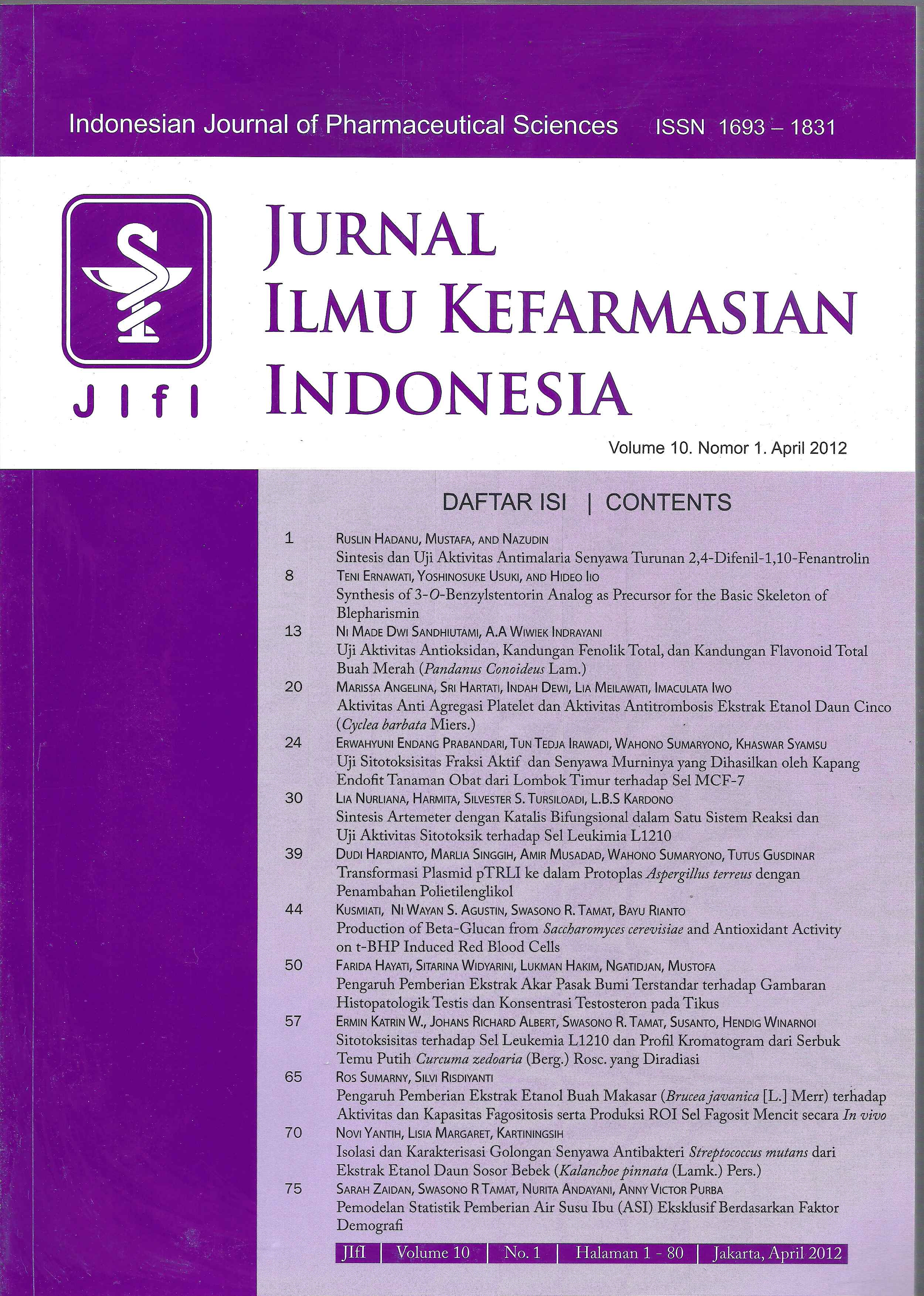
Synthesis and Testing of Antimalarial Activity of 2,4-Diphenyl-1,10-Phenanthroline Compounds
Keywords:
synthesis, 2,4-diphenyl-1,10-phenanthroline derivatives, antimalarialAbstract
Malaria is still the main health problems in subtropical and tropical countries. There are 105 countries in the world at malaria endemic and more than 500 million cases or more than 2.7 million deaths from malaria each year. The traditional remedies are no longer effective and the incidence of malarial by P. falciparum, the most dangerous species of parasite, continues to grow, while some traditional drugs such as chloroquine has been resistance. Synthesis of 2,4-diphenyl-1,10-phenanthroline [5] compounds with benzaldehyde [1], acetophenone [2], t-calcone [3], 8-aminoquinoline [4] as starting material through three steps has been carried out. The results of all steps of the reaction were obtained compounds of [5], (1)-N methyl-7,9-diphenyl-1,10-phenanthrolinium sulfate [6] and (1)-N-ethyl-7,9-diphenyl-1,10-phenanthrolinium sulfate [7]. The results of antiplasmodial activity in vitro testing of the derivatives on chloroquine resistant P. falciparum FCR3 indicated that compound [7] has higher antimalarial activity (IC5O = 0.06±0.05 µM) than the activity of [6] compound (ICSO = 1.27±O.97 µM) and [5] compound (1C50 = 1.66±0.70 µM). Results of similar in vitro testing on chloroquine resistant P. falciparum D10 strain indicated that [7] compound has higher antimalarial activity (IC50 = 0.04±0.04 uM) than the activity of [5] compound (IC50 = 1.13±0.30 µM) and [6] compound (ICSO = 0.81±0.06 µM).
References
Downloads
Published
Issue
Section
License
Licencing
All articles in Jurnal Ilmu Kefarmasian Indonesia are an open-access article, distributed under the terms of the Creative Commons Attribution-NonCommercial-ShareAlike 4.0 International License which permits unrestricted non-commercial used, distribution and reproduction in any medium.
This licence applies to Author(s) and Public Reader means that the users mays :
- SHARE:
copy and redistribute the article in any medium or format - ADAPT:
remix, transform, and build upon the article (eg.: to produce a new research work and, possibly, a new publication) - ALIKE:
If you remix, transform, or build upon the article, you must distribute your contributions under the same license as the original. - NO ADDITIONAL RESTRICTIONS:
You may not apply legal terms or technological measures that legally restrict others from doing anything the license permits.
It does however mean that when you use it you must:
- ATTRIBUTION: You must give appropriate credit to both the Author(s) and the journal, provide a link to the license, and indicate if changes were made. You may do so in any reasonable manner, but not in any way that suggests the licensor endorses you or your use.
You may not:
- NONCOMMERCIAL: You may not use the article for commercial purposes.

This work is licensed under a Creative Commons Attribution-NonCommercial-ShareAlike 4.0 International License.