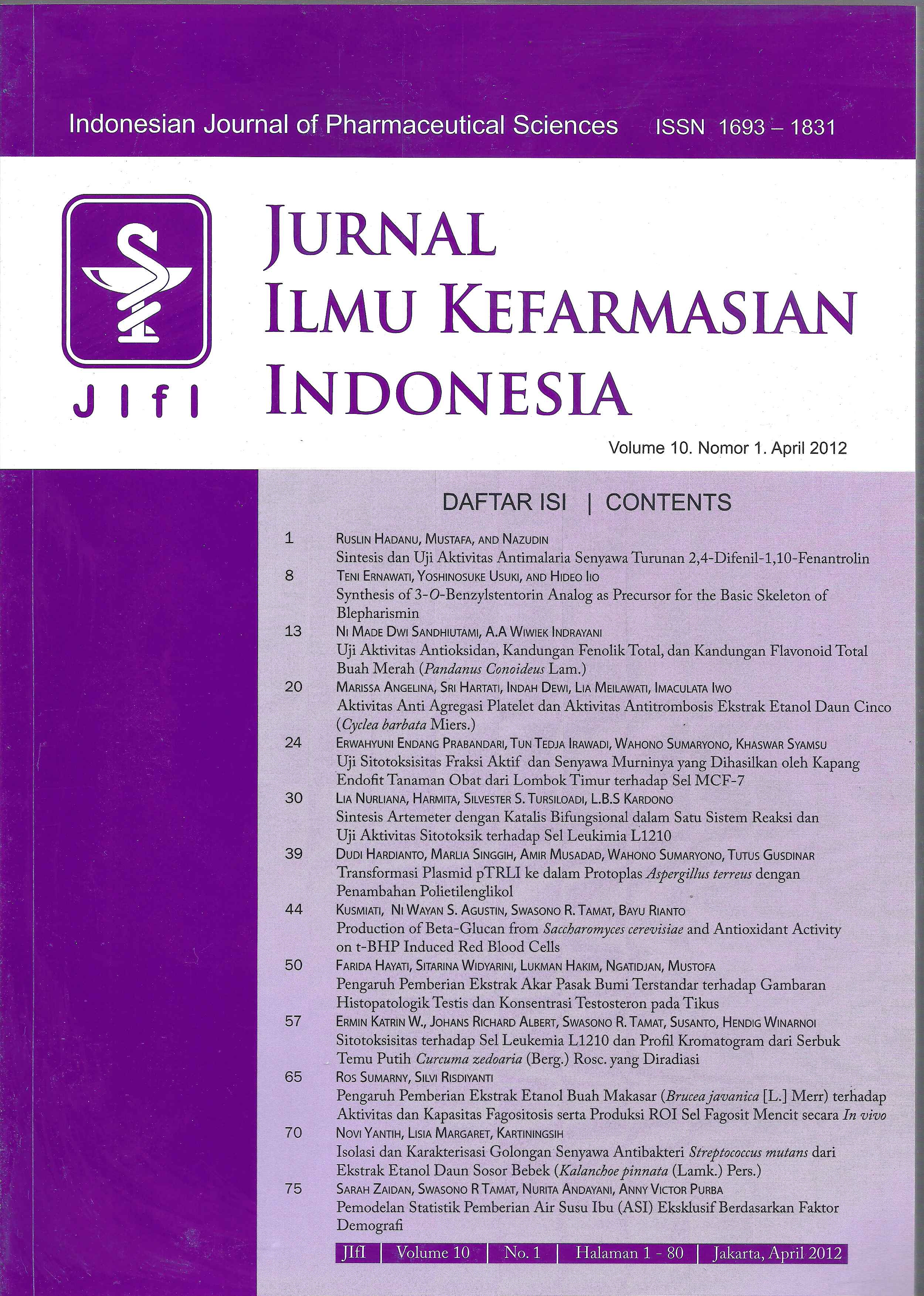
Citotoxic Activity of Active Fraction and Pure Compound Produced by Endophytic Fungi from Lombok Timur Medicinal Plants Against Breast Cancer Cell Line MCF-7
Keywords:
cytotoxicity, Artemia salina, BSLT, Curvularia lunata, Cibotium barometz, MCF-7Abstract
Screening for citotoxicity has been conducted on 36 endophytic fungi isolated from medicinal plants in East Lombok. Isolates were cultivated in 100 mL potato dextrose yeast extract medium in 250 mL Erlenmeyer, incubated at 28°C and shaked in 150 rpm for 10 days. Broth was extracted with buthanol, ethyl acetate and dichloromethane. Extracts were concentrated under vacuum concentrator and assayed for citotoxicity against Artemia salina using the BSLT method. Screening using 100 mg/L of crude extract showed that 9 extracts were active out of 108 extracts assayed. Further screening based on LC50 showed that the ethyl acetate extract from fungus ENLT 74.3d.2 was the most active with LC 50=30.21 mg/L. Fungus was isolated from Cibotium barometz and described as Curvularia lunata. The most active extract was fractionated by column silica gel 60 and eluted using hexane, ethyl acetate, and methanol. These fractions showed that the ethyl acetate fraction was the most active fraction (LC50 = 4.69 mg/L). Purification was conducted by HPLC using column C18 and eluted by gradient system of acetonitril water 15% to 100% in 25 minutes. The active compound retention time was 14-16 min, λmax = 233 nm, and at 5 mg/L could inhibit 28% MCF-7 cell proliferation.
References
Downloads
Published
Issue
Section
License
Licencing
All articles in Jurnal Ilmu Kefarmasian Indonesia are an open-access article, distributed under the terms of the Creative Commons Attribution-NonCommercial-ShareAlike 4.0 International License which permits unrestricted non-commercial used, distribution and reproduction in any medium.
This licence applies to Author(s) and Public Reader means that the users mays :
- SHARE:
copy and redistribute the article in any medium or format - ADAPT:
remix, transform, and build upon the article (eg.: to produce a new research work and, possibly, a new publication) - ALIKE:
If you remix, transform, or build upon the article, you must distribute your contributions under the same license as the original. - NO ADDITIONAL RESTRICTIONS:
You may not apply legal terms or technological measures that legally restrict others from doing anything the license permits.
It does however mean that when you use it you must:
- ATTRIBUTION: You must give appropriate credit to both the Author(s) and the journal, provide a link to the license, and indicate if changes were made. You may do so in any reasonable manner, but not in any way that suggests the licensor endorses you or your use.
You may not:
- NONCOMMERCIAL: You may not use the article for commercial purposes.

This work is licensed under a Creative Commons Attribution-NonCommercial-ShareAlike 4.0 International License.