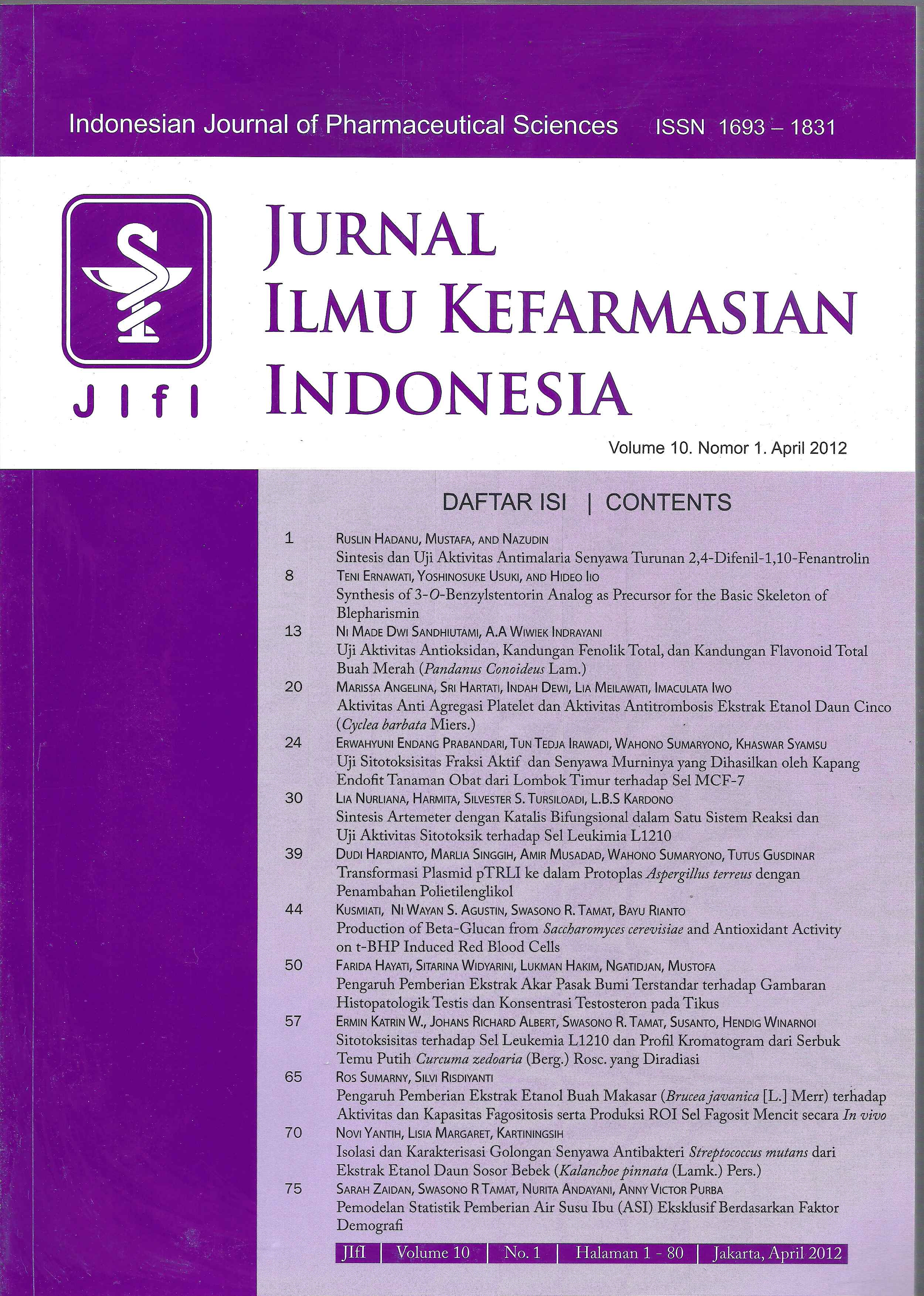
Production of Beta-Glucan from Saccharomyces cerevisiae and Antioxidant Activity on t-BHP Induced Red Blood Cells
Keywords:
Saccharomyces cerevisiae, β-glucans, antioxidant, red blood cells, t-BHPAbstract
Beta glucan is a polysaccharide that can be found in cereals, yeast, bacteria, and algae. Beta glucan produced by Saccharomyces cerevisiae has the ability to enhance the body’s defense system. The study aims to investigate the antioxidant activity of B glucan produced by three strains of Saccharomyces sp BR 1, BR 2,and SC. Antioxidant activity assay was carried out in vitro on t BHP induced red blood cells (REC) by observing the level of catalase activity, SOD activity and MDA levels as lipid peroxidation product. The investigation was performed on 6 groups: normal control, negative control, positive control (RBC+ t-BHP + vitamin E 100 IU), and samples (RBC+t-BHP) treated with 1.4 µg/mL β-glucan from Saccharomyces strain BR1, BR2 and SC respectively. Saccharomyces cerevisiae strain SC produced the highest β-glucan of 88.70% (glucose equivalent), while the BR1 and BR2 of 22.56% and 46.28% respectively. Antioxidant activity assay showed that the highest increase in catalase activity (581.48%) was given by the B glucan from SC strain, the highest increase of SOD activity and decrease of MDA levels were given by the β- glucan from BR1 strain (359.17% and 48.18%) as compared to negative controls. Statistical test (α = 0.05) showed antioxidant activity of β-glucan from Saccharomyces Sp BR2 and SC did not differ significantly from the activity of vitamin E (100 IU).
References
Downloads
Published
Issue
Section
License
Licencing
All articles in Jurnal Ilmu Kefarmasian Indonesia are an open-access article, distributed under the terms of the Creative Commons Attribution-NonCommercial-ShareAlike 4.0 International License which permits unrestricted non-commercial used, distribution and reproduction in any medium.
This licence applies to Author(s) and Public Reader means that the users mays :
- SHARE:
copy and redistribute the article in any medium or format - ADAPT:
remix, transform, and build upon the article (eg.: to produce a new research work and, possibly, a new publication) - ALIKE:
If you remix, transform, or build upon the article, you must distribute your contributions under the same license as the original. - NO ADDITIONAL RESTRICTIONS:
You may not apply legal terms or technological measures that legally restrict others from doing anything the license permits.
It does however mean that when you use it you must:
- ATTRIBUTION: You must give appropriate credit to both the Author(s) and the journal, provide a link to the license, and indicate if changes were made. You may do so in any reasonable manner, but not in any way that suggests the licensor endorses you or your use.
You may not:
- NONCOMMERCIAL: You may not use the article for commercial purposes.

This work is licensed under a Creative Commons Attribution-NonCommercial-ShareAlike 4.0 International License.