
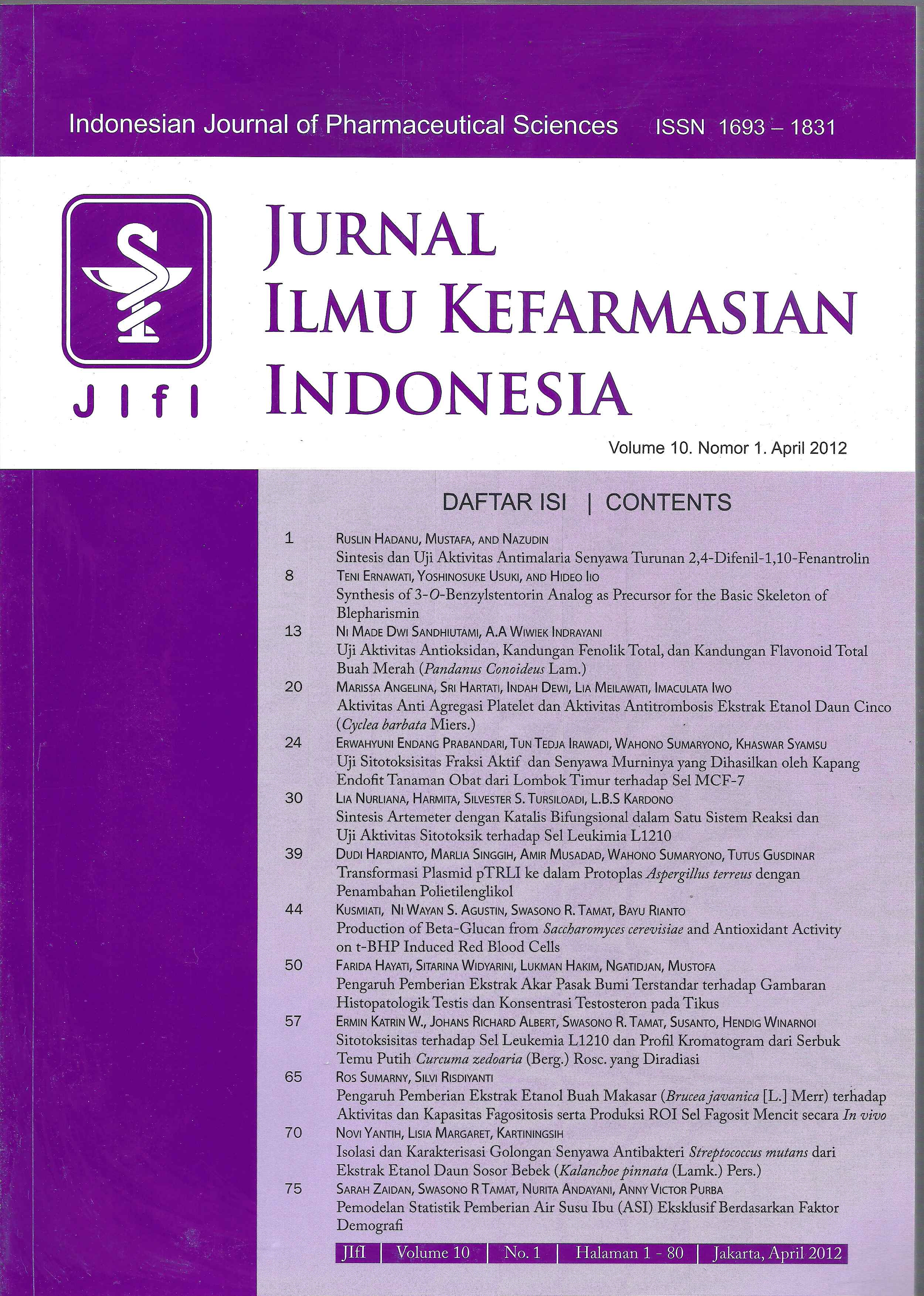
Statistical Modelling of Exclusive Breastfeeding Based on Demographic Factors
Keywords:
exclusive breastfeeding, working mothers, demographic factorAbstract
Exclusive breastfeeding is defined as giving breast milk to a baby without any additional drink, food or beverages during the first 6 months after birth. Today there is a decline in exclusive breastfeeding, and among others, one reason is the increase in the participation of mothers in the workforce, especially in urban areas. Many factors that affect the regularity of exclusive breastfeeding by working mothers, one of which, is the demographic factor. This study aims to obtain profile data of exclusive breastfeeding by working mothers and statistical modelling of exclusive breastfeeding by working mothers based on demographic factor, by conducting a survey on 384 respondents. This research uses descriptive analysis and logistic regression analysis with SPSS software version 15.0. Descriptive analysis showed that most mothers working in Jakarta (61.2%) did not give exclusive breastfeeding. Logistic regression statistical analysis showed that age, occupation, distance to work, and travel time to the workplace of working mothers are dominant factors that influence exclusive breastfeedings, with the p-value is smaller than the p value (Sig) = 0.05.
References
Downloads
Published
Issue
Section
License
Licencing
All articles in Jurnal Ilmu Kefarmasian Indonesia are an open-access article, distributed under the terms of the Creative Commons Attribution-NonCommercial-ShareAlike 4.0 International License which permits unrestricted non-commercial used, distribution and reproduction in any medium.
This licence applies to Author(s) and Public Reader means that the users mays :
- SHARE:
copy and redistribute the article in any medium or format - ADAPT:
remix, transform, and build upon the article (eg.: to produce a new research work and, possibly, a new publication) - ALIKE:
If you remix, transform, or build upon the article, you must distribute your contributions under the same license as the original. - NO ADDITIONAL RESTRICTIONS:
You may not apply legal terms or technological measures that legally restrict others from doing anything the license permits.
It does however mean that when you use it you must:
- ATTRIBUTION: You must give appropriate credit to both the Author(s) and the journal, provide a link to the license, and indicate if changes were made. You may do so in any reasonable manner, but not in any way that suggests the licensor endorses you or your use.
You may not:
- NONCOMMERCIAL: You may not use the article for commercial purposes.

This work is licensed under a Creative Commons Attribution-NonCommercial-ShareAlike 4.0 International License.













