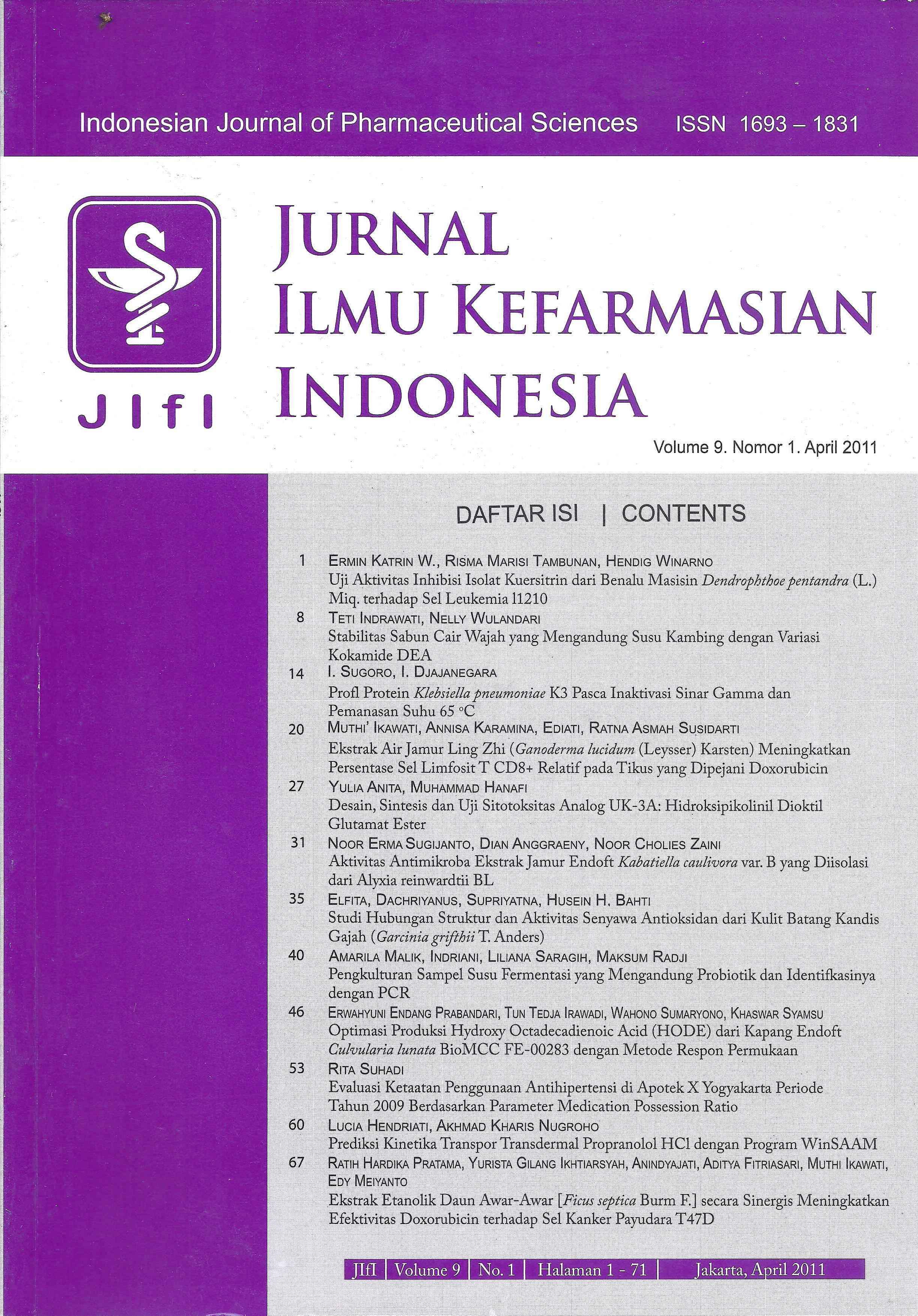
Culturation of Fermented Milk Samples Containing Probiotic and Its Identification by PCR
Keywords:
lactic acid bacteria, fermented milk, probiotic, molecular identification, PCR, 16S rRNAAbstract
Lactic Acid Bacteria (LAB) has long been used in fermented milk because its stability, unique taste and texture and also for its health benents that are provided by the probiotic. There are many fermented dairy products in the market nowadays that declared containing living culture or as probiotics. The aim of this study was to identify LAB from fermented milk product by Visual inspection on plate culture for their morphology, as well by molecular technique performing PCR and DNA sequencing methods. Morphology and growth incubation time of each isolate was observed. A pair of primer that is highly speciiic for LAB targeting the gene encoding for 168 rRNA, which represents sequences of region 677 to 693 of E. coli numbering has been used for PCR identiiication in this study. A total of nineteen isolates were obtained from 10 fermented milk samples that were grown on de Mann Rogosa Sharpe Agar (MRSA) media. Nine out of 19 isolates which represent each of the samples were selected. Genomic DNA extracted from those 9 isolates were used as template for PCR. The results showed that 8 amplicons were positively identitied as LAB, but only three identities indicated similar species as declared, while 5 others did not.
References
Downloads
Published
Issue
Section
License
Licencing
All articles in Jurnal Ilmu Kefarmasian Indonesia are an open-access article, distributed under the terms of the Creative Commons Attribution-NonCommercial-ShareAlike 4.0 International License which permits unrestricted non-commercial used, distribution and reproduction in any medium.
This licence applies to Author(s) and Public Reader means that the users mays :
- SHARE:
copy and redistribute the article in any medium or format - ADAPT:
remix, transform, and build upon the article (eg.: to produce a new research work and, possibly, a new publication) - ALIKE:
If you remix, transform, or build upon the article, you must distribute your contributions under the same license as the original. - NO ADDITIONAL RESTRICTIONS:
You may not apply legal terms or technological measures that legally restrict others from doing anything the license permits.
It does however mean that when you use it you must:
- ATTRIBUTION: You must give appropriate credit to both the Author(s) and the journal, provide a link to the license, and indicate if changes were made. You may do so in any reasonable manner, but not in any way that suggests the licensor endorses you or your use.
You may not:
- NONCOMMERCIAL: You may not use the article for commercial purposes.

This work is licensed under a Creative Commons Attribution-NonCommercial-ShareAlike 4.0 International License.