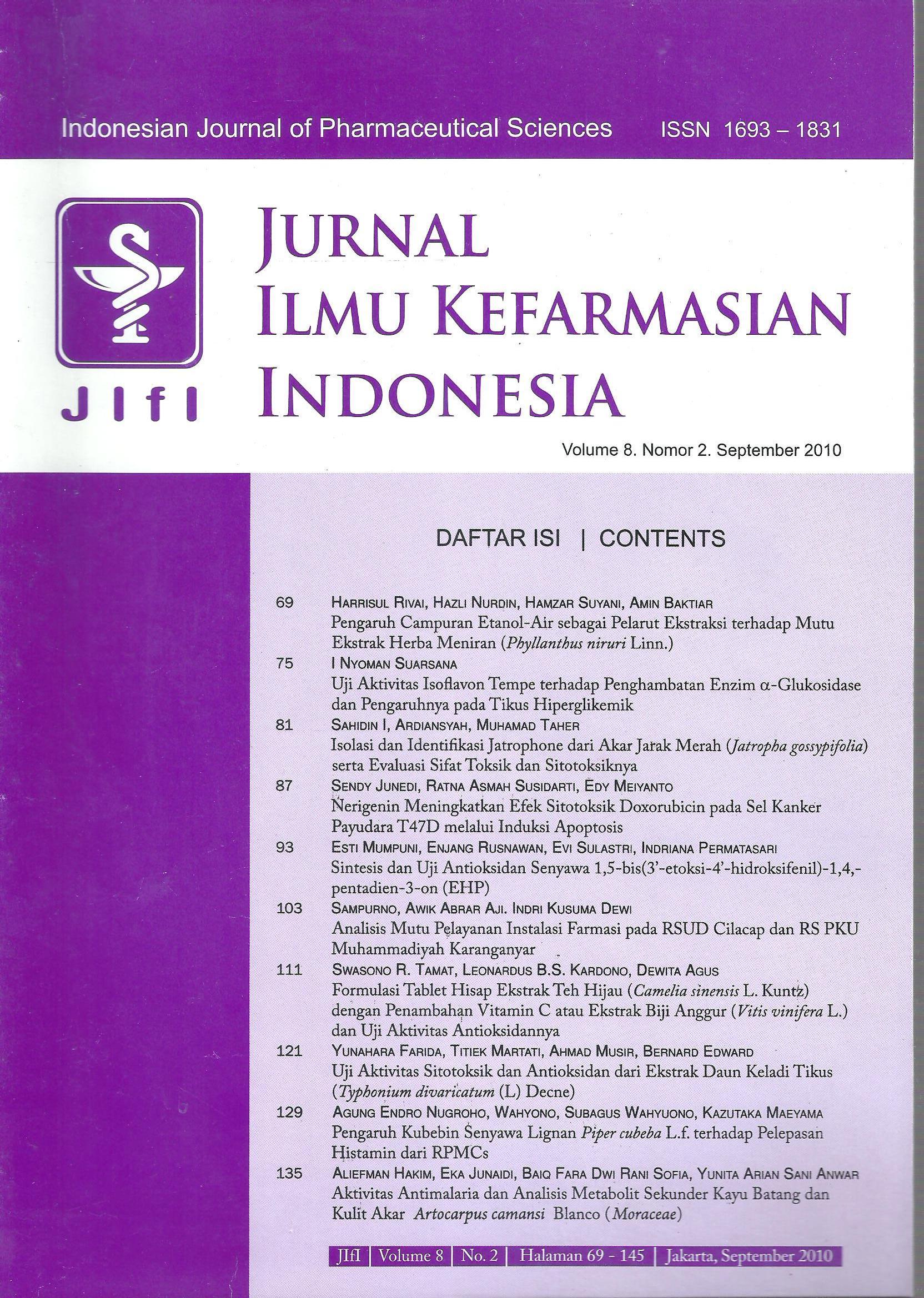
Isolation and Identification of Jatrophone from the Root of Jatropha goossyptfolia and Evaluation of Its Toxicity and Cytotoxicity
Keywords:
jatrophone, Jatropha gossypifolia, antibacteria, antifungal, cytotoxicAbstract
Isolation and identitication of secondary metabolites from root of Jatropha gossypyolia, and also its biological activity test toward microbes and tumor cells have been conducted, Isolation was carried out by using vacuum liqiud chromatography (VLC) method (adsorbent: silica gel, eluent: mixture of n-hexane, ethylacetate, chloroform, and methanol). The isolate molecular structure Was determined by spectroscopic technique i.e. FTIR, NMR-ID, 13C-DEPT, NMR-2D, comparing the data obtained with related data from literatures. Its biological activity was evaluated against bacteria (Acetobacter sp., Escherecia coli, Staphylococcus aureus, and Streptococcus sp.), fungi (Aspergillus nigcr, Pentcillium sp. [grey], Penicillium sp. [White] and Rhizopus sp.), and murine leukemia P-388 cells. The results showed that the isolate is a white needle crystal which is identified as jatrophone. Jatrophone is very active toward Acetobacter sp. (bacteria) and A. niger (fungi) with growth inhibition Zone of 3,6 cm and 4.4 cm, respectively. Meanwhile, jatrophone has low activity against murine leukemia P-388 cells with IC50, > 100 µg/mL.
References
Downloads
Published
Issue
Section
License
Licencing
All articles in Jurnal Ilmu Kefarmasian Indonesia are an open-access article, distributed under the terms of the Creative Commons Attribution-NonCommercial-ShareAlike 4.0 International License which permits unrestricted non-commercial used, distribution and reproduction in any medium.
This licence applies to Author(s) and Public Reader means that the users mays :
- SHARE:
copy and redistribute the article in any medium or format - ADAPT:
remix, transform, and build upon the article (eg.: to produce a new research work and, possibly, a new publication) - ALIKE:
If you remix, transform, or build upon the article, you must distribute your contributions under the same license as the original. - NO ADDITIONAL RESTRICTIONS:
You may not apply legal terms or technological measures that legally restrict others from doing anything the license permits.
It does however mean that when you use it you must:
- ATTRIBUTION: You must give appropriate credit to both the Author(s) and the journal, provide a link to the license, and indicate if changes were made. You may do so in any reasonable manner, but not in any way that suggests the licensor endorses you or your use.
You may not:
- NONCOMMERCIAL: You may not use the article for commercial purposes.

This work is licensed under a Creative Commons Attribution-NonCommercial-ShareAlike 4.0 International License.