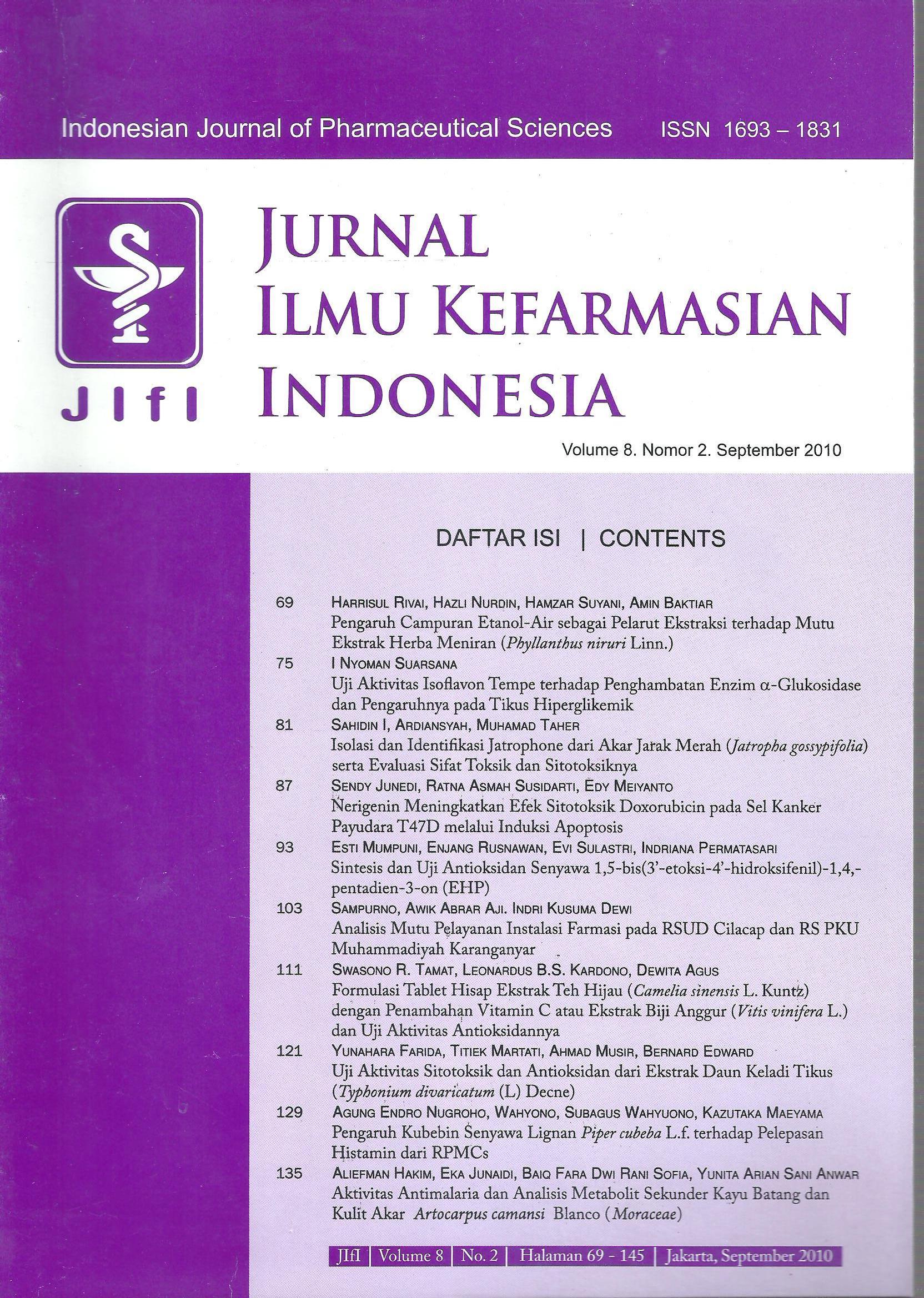
Cytotoxicity and Antioxidant Activity Tests on T yphonium divuricatum (L) Decne Leaves
Keywords:
Typhonium divaricatum (L) Decne, BSLT, Cytotoxic activity, T-47D, MTT, DPPHAbstract
Cytotoxic and antioxidant activities of Typhonium divaricatum (L) Decne leaves extract have been explored. Preliminary phytocheinical screening on the extract were carried out for the compound`s profile. Biological activity was measured by using Brine Shrimp Lethality Test (BSLT), while cytotoxic activity was conducted on breast cancer cell line T-47D using MTT method, Antioxidant activity was measured by using DPPH free radical scavenging method. The results of phytochemical screening showed that the methanol extract contained Havonoid, saponin and steroid/triterpenoid compounds, meanwhile thc n-hexane extract contained steroid/triterpenoid compounds only. The highest biological activity was found in methanol extract (IC50 = 32.9 ppm). The highest cytotoxic activity was shown by n-hexane extract (IC50 = 32.50 ppm). The highest antioxidant activity using vitamin C as positive control was found in methanol extract (IC50 = 56.63 ppm). The preliminary results indicated that Typhonium divaricatum (L) Decne lcavcs is potential for anticancer and free radical scavenger.
References
Downloads
Published
Issue
Section
License
Licencing
All articles in Jurnal Ilmu Kefarmasian Indonesia are an open-access article, distributed under the terms of the Creative Commons Attribution-NonCommercial-ShareAlike 4.0 International License which permits unrestricted non-commercial used, distribution and reproduction in any medium.
This licence applies to Author(s) and Public Reader means that the users mays :
- SHARE:
copy and redistribute the article in any medium or format - ADAPT:
remix, transform, and build upon the article (eg.: to produce a new research work and, possibly, a new publication) - ALIKE:
If you remix, transform, or build upon the article, you must distribute your contributions under the same license as the original. - NO ADDITIONAL RESTRICTIONS:
You may not apply legal terms or technological measures that legally restrict others from doing anything the license permits.
It does however mean that when you use it you must:
- ATTRIBUTION: You must give appropriate credit to both the Author(s) and the journal, provide a link to the license, and indicate if changes were made. You may do so in any reasonable manner, but not in any way that suggests the licensor endorses you or your use.
You may not:
- NONCOMMERCIAL: You may not use the article for commercial purposes.

This work is licensed under a Creative Commons Attribution-NonCommercial-ShareAlike 4.0 International License.