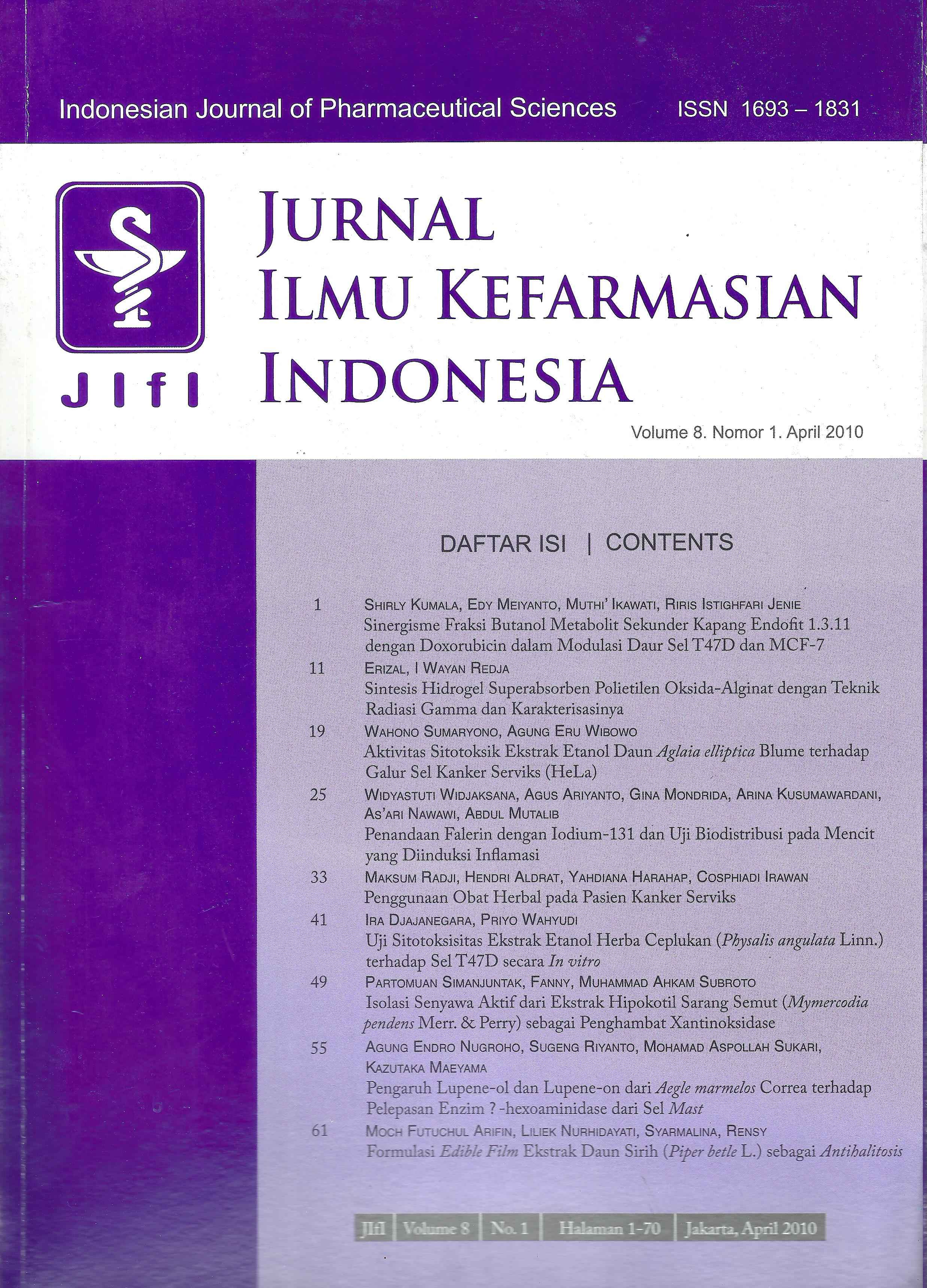
Penggunaan Obat Herbal pada Pasien Kanker Serviks
Keywords:
herbal medicine, cervical cancer patient, Pandanus conoideus, Phaleria macrocarpa, Curcuma zedoariaAbstract
Herbal medicines have widely been used to treat many type of diseases despite the advance of standard or conventional therapy. In fact, many people in Indonesia use medicinal plant as their customary part of life. Therefore, it is necessary to further explore the use of herbal medicines through modern perception. ln this study we would like to know the frequency and species of herbal medicines used among cervical cancer patients in National Cancer Hospital Dharmais, Jakarta, Indonesia and also to assess the relationship between age, education, jobs, stage of cancer, and payment status of the patients. The results were 61,8% patients used herbal medicines. The herbal medicines used most were mahkota dewa (Phaleria macrocarpa Scheetf Boerl.) 35.3%, temu putih (Curcuma zedoaria Rosc.) 32.4%, and buah merah (Pandanus conoideus Lam) 17,6%. There was a significant relationship (p=0,039) between the use of herbal medicines and stage of cancer but no relationship between age, education, occupation, income and payment status with the use of herbal medicines.
References
Downloads
Published
Issue
Section
License
Licencing
All articles in Jurnal Ilmu Kefarmasian Indonesia are an open-access article, distributed under the terms of the Creative Commons Attribution-NonCommercial-ShareAlike 4.0 International License which permits unrestricted non-commercial used, distribution and reproduction in any medium.
This licence applies to Author(s) and Public Reader means that the users mays :
- SHARE:
copy and redistribute the article in any medium or format - ADAPT:
remix, transform, and build upon the article (eg.: to produce a new research work and, possibly, a new publication) - ALIKE:
If you remix, transform, or build upon the article, you must distribute your contributions under the same license as the original. - NO ADDITIONAL RESTRICTIONS:
You may not apply legal terms or technological measures that legally restrict others from doing anything the license permits.
It does however mean that when you use it you must:
- ATTRIBUTION: You must give appropriate credit to both the Author(s) and the journal, provide a link to the license, and indicate if changes were made. You may do so in any reasonable manner, but not in any way that suggests the licensor endorses you or your use.
You may not:
- NONCOMMERCIAL: You may not use the article for commercial purposes.

This work is licensed under a Creative Commons Attribution-NonCommercial-ShareAlike 4.0 International License.